
42 – The Influence of the Game Board
Rarely is any element in a board game more in focus than the game board. That makes it perfect for building atmosphere. The color palette sets a certain mood, and the spaces on the board should draw us into the game. Especially when learning a new game, small details on the board can help distract from longer waiting times and make the first play feel more pleasant.
In many games, the spaces on the board are tied to specific actions — in many worker‑placement games, for example, but also in games like Magical Friends. These spaces require a lot of fine‑tuning. How many spaces are optimal so they can be used well during the game? Does the number of spaces match the game length? Do players end up using the same spaces over and over — and if so, is that fun? If the same spaces are always used, it might be because there are simply too few, but it could also mean the balance between them is off.
If some spaces are clearly better than others, they’ll be used at every opportunity, while the weaker ones become consolation prizes and stop feeling good. Balance is crucial. Often, using a space comes with a cost. This mechanic is great for making small adjustments to balance: you can weaken overly strong spaces or strengthen weaker ones. If you have the chance to improve a weak space, that’s usually the better choice — powerful actions are generally more fun for players. But if there are interactions with other abilities, you have to be careful not to let things spiral out of control and create a strategy that’s far stronger than the rest.
You often see actions that are reliably good in general, while others are highly situational. Those situational actions should be a bit stronger — and it’s especially nice if players have ways to intentionally create those situations. That allows them to set up turns that feel particularly satisfying.
A game board also offers a great opportunity to increase replayability. With interchangeable tiles, you can create a variable setup. This can change resource distribution or interactions with other game elements from one play to the next.
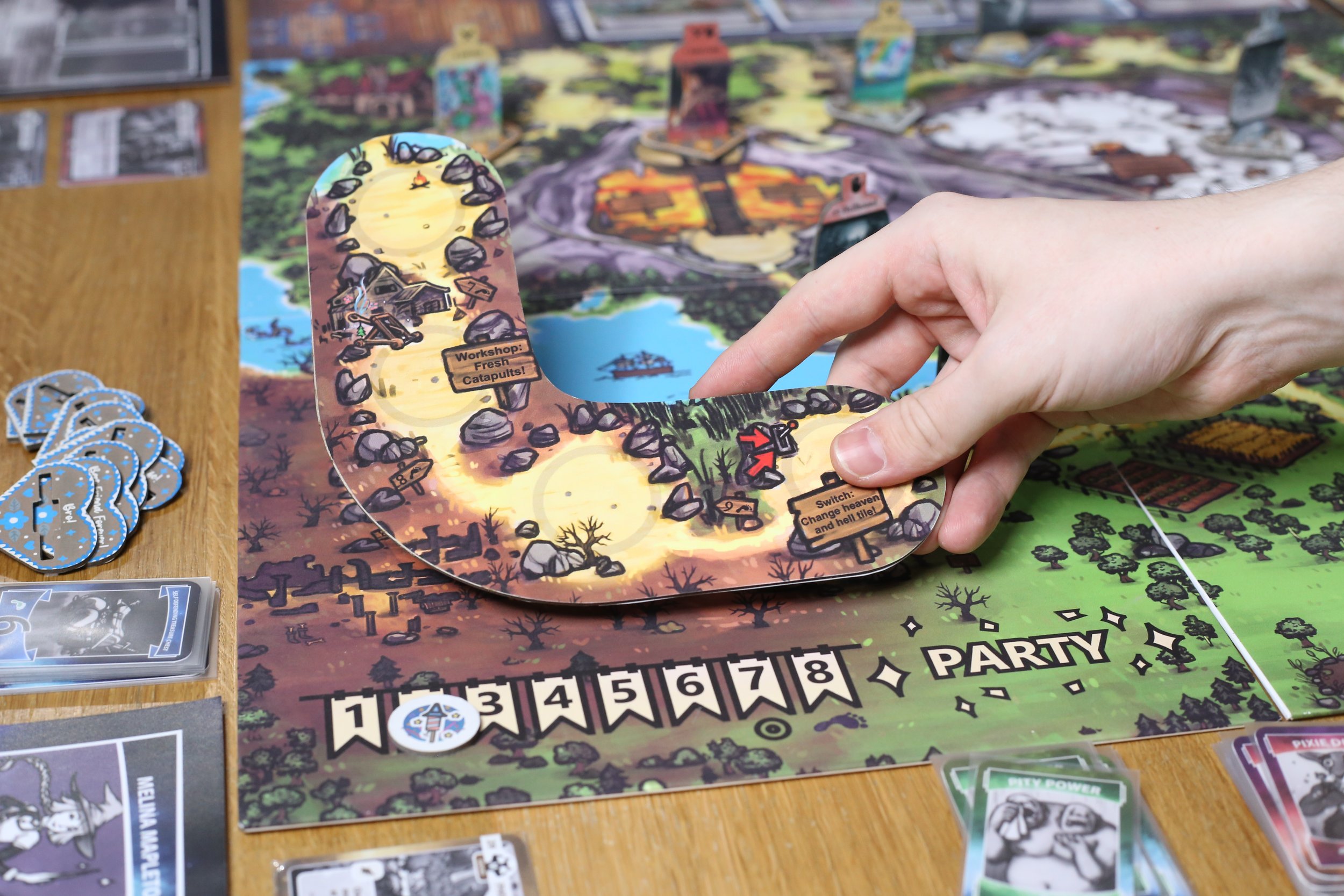
In Magical Friends, for example, there are five double‑sided paths to the goal, with the four main paths being different lengths. This creates shorter and longer routes. Naturally, depending on the group composition, some paths will be more dangerous than others — but the paths themselves should still be balanced. Shorter paths carry certain risks, while longer ones offer bonuses. The double‑sided paths create many interactions with the creatures, giving the game a high replay value. The action spaces are designed to encourage players to stop and prepare stronger moves. Of course, this comes with the risk that other players can reach you more easily and sabotage your plans. If you’ve already had the chance to test the game, you may have noticed that the Heaven/Hell path will receive some small adjustments in this regard.
In general, it’s very important to test the game board — and any changes to it — frequently. In Magical Friends, for example, it makes a big difference whether a space can be reached in a single turn or whether you need some preparation to get there. This placement alone can have a huge impact on how attractive a path is.
If you’d like to try Magical Friends, there’s a Workshopfile for it on Tabletop Simulator. If you already own Tabletop Simulator, you can play Magical Friends on it for free.
Are there game boards you particularly love? Examples where something works especially well? Leave a comment — I’d love to chat about it.
