
38 – The Kickstarter and the Goal
38 – The Kickstarter and the Goal
Some of you are probably wondering why I canceled the Kickstarter at €21,000 when we would have reached €25,000. Realistically, in the final week it likely would have ended somewhere around €27,000–€29,000.
But what’s behind that goal? Technically, it would have been possible to produce a small print run of the game. Sounds good, right? Well… not quite. I could produce 1,500 copies and would have already sold 500 of them. But that would leave almost no buffer for the currently very unstable freight costs. On top of that, the remaining 1,000 copies would still need to be sold — and of course, storing them also costs money. Keep in mind: for a small card game, 1,500 copies fit easily on a single pallet. For a game the size of Magical Friends, it’s more like ten pallets.
Selling the game outside of Kickstarter as a still‑unknown designer is definitely harder and very time‑consuming. If you sell to retailers, the sale price is significantly lower. Typically, you receive about 45% of the net price or 60% of the gross price. With distributors, the price is even lower.
Yes, you could still generate revenue from the remaining games, but so far only the production costs would be covered. I’ve paid all marketing costs myself, and my illustrators should be paid fairly as well. So after selling the games, I might end up with less of a loss than I currently have — but my working time (which continues to increase after the Kickstarter due to production and sales) would not be compensated in the slightest. And let’s not forget: I’ve already put 3,000 hours of work into this game. That’s two years of full‑time work without earning any other income.
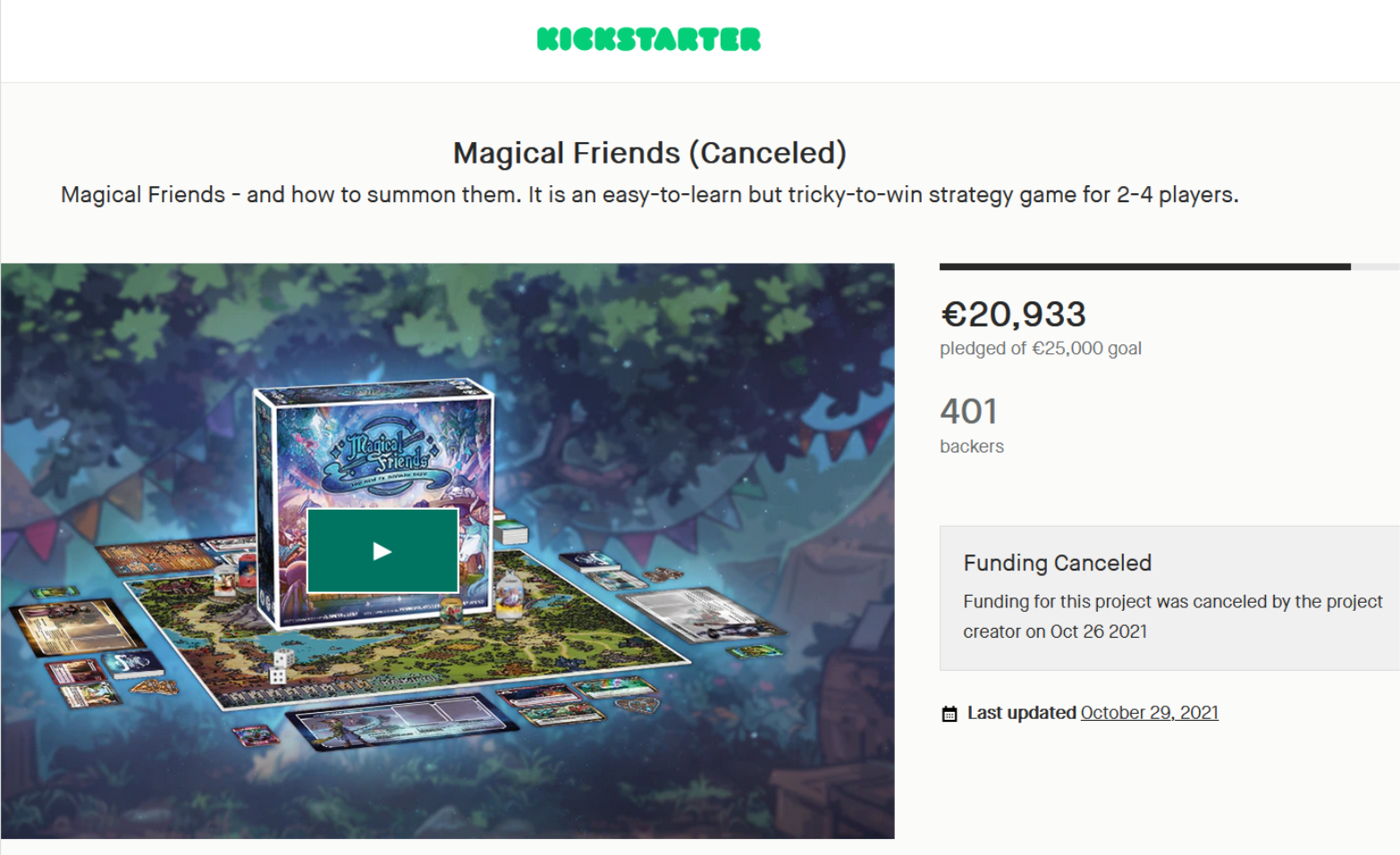
Of course, it would be wonderful to have produced and sold my first game — and with a second print run, an expansion, or a second game, greater success would be likely. But then the game should also be produced really well, and with a €25,000 goal, a few features I’d like to include would still be missing.
So why not set a higher goal from the start? The higher the goal, the later it gets reached — and that’s a big problem. It’s even very likely that we would have raised more money overall if I had set the goal at just €20,000. Why? Because once a goal is reached, the project is considered successful — and successful projects attract more backers. Stretch goals, meaning upgrades for the game, can also only be unlocked once the main goal is reached.
So I chose a goal that was as low as possible while still making it technically feasible to produce the game. At the same time, it needed to remain plausible to cancel the Kickstarter if necessary. If I had found a larger distribution partner, I might not have canceled the Kickstarter at all.
In a way, the Kickstarter goal is also a marketing tool — and what didn’t work so well in terms of marketing is something I’ll talk about in the next entry.
What’s your opinion on Kickstarter funding goals? Leave me a comment.