
33 – First Convention Booths
33 - First Convention Booths
A big decision has been made! I’ve booked convention booths for Magical Friends at both BerlinCon and SPIEL in Essen this year. Together with my two wonderful illustrators, Nessi and Hannah, we won’t just be attending the conventions — you’ll actually be able to meet us there!
17. - 19. September
Station Berlin
https://berlin-con.de/
The decision wasn’t an easy one. As I’ve mentioned before, convention booths are very expensive when you don’t yet have anything to sell at the booth. The most interesting aspect of conventions, however, is the long‑term connections you can build. Back in 2019, I was able to connect with 19 board‑game manufacturers. That helped me tremendously in understanding how factories operate and what to expect in contracts.
The plan is for the Kickstarter campaign to launch at the beginning of October. That means at BerlinCon (mid‑September), the campaign will be prepared and announced. We’ll also use the event to test the booth decorations for SPIEL. During SPIEL, our campaign will already be running — in fact, it will be right around the halfway point, which is usually a quieter phase in a Kickstarter. I’m very curious to see what impact SPIEL will have on the campaign!
https://www.spiel-messe.com/de/
I might be able to build interesting connections with publishers we could work with after the Kickstarter campaign. There will certainly be reviewers there as well who may want to promote the game on-site or before the campaign ends. And hopefully we’ll meet lots of wonderful fans at the conventions who will accompany us a bit on our journey. For Hannah and Nessi, there may even be new clients for future projects.
We’re definitely already super excited and really looking forward to the conventions. We also have a few exciting ideas for how we can make our booth interesting. It’s sure to be a lot of fun!
Will we see you at the convention? Is there anything—besides the current prototype—that we should definitely show at our booth?
32 – Kickstarter Preparations
32 - Kickstarter Preparations
There’s naturally a lot to prepare for the Kickstarter launch. Above all: marketing. Review prototypes are on their way, and social media posts are starting up again. But the Kickstarter page itself also needs to look great and requires banners, GIFs, and videos.
For the introduction of the Kickstarter video, I came up with three short clips that each tell a little bit about what Magical Friends is all about. Why three clips? Each one is only about 20 seconds long, which also makes them perfect for Facebook ads. We’ll try our luck on TikTok as well.
In the first clip, viewers will learn something about the goal of the game; the second clip focuses on one of the main tasks in the game; and the third is meant to reflect the action and chaos that unfold during play.
First, I created storyboards together with my illustrators, Hannah and Nessi. I explained to them that in the first clip, I’d like the wizards to learn about the Midsommar competition at the marketplace, a rivalry breaks out between them, and they immediately set off to prepare for the contest.
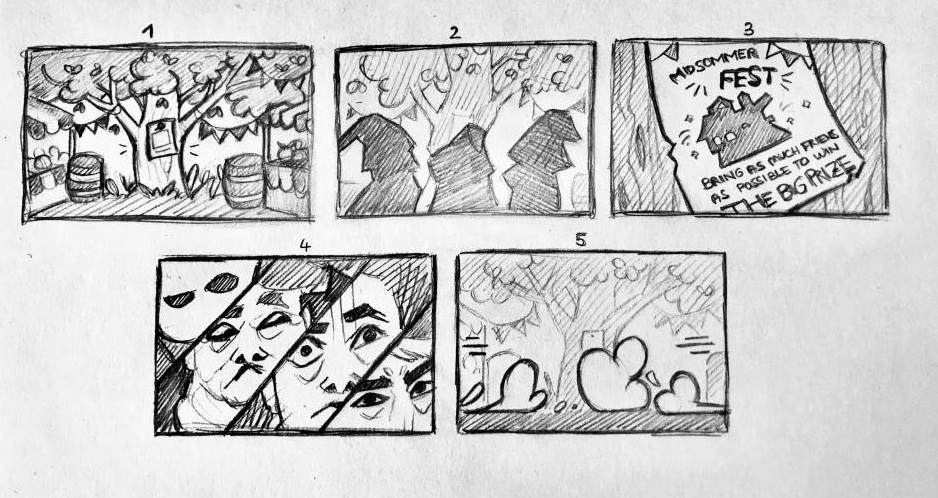
The clips shouldn’t contain much more than five images, because the more images there are, the more time‑consuming the whole project becomes. With five images and various animatable layers, you can already create a lovely little video.
This is what the final concept looked like:
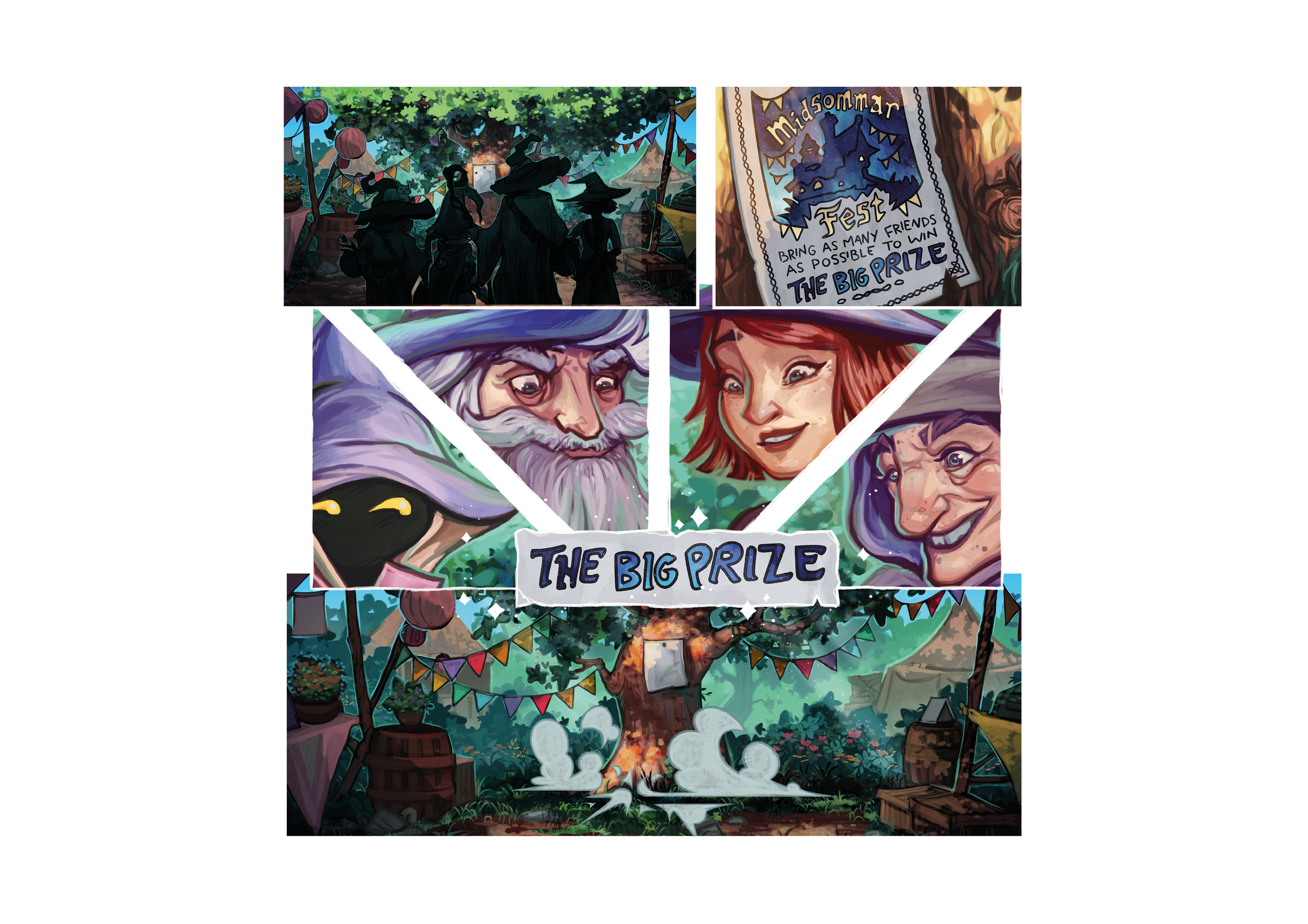
Its also a nice comic!
With this, we can create our own video clip, have a piece of a larger intro, and at the same time a cute little comic.
At the moment, we’re working on sound and text for the video. It already looks very cool. More on that as soon as it’s finished.
Of course, there are many different approaches to creating videos like this — some simpler, some much more elaborate. What do you think of our plan? Leave us a comment.
31 – Reviews and Previews
31 - Reviews and Previews
… are extremely important for introducing an unknown game to the world. There are a huge number of great reviewers on various social media platforms, magazines, podcasts, and of course on YouTube. Today I’d like to give you a look at what goes on behind the scenes. One thing to keep in mind is that many of the larger channels only create reviews — meaning they only cover games that are already on the market and accessible to everyone. But there are also some who create previews for games that haven’t been released yet, like my prototype.
Previews, especially in video format, are very time‑consuming. To build a YouTube channel, you need regular uploads so you show up in the search algorithm. Naturally, you also want to play the game a few times beforehand. And to produce a video with the quality people expect on YouTube, you need some equipment, preparation, and often quite a bit of editing. Since you know how many games are released on the market or on Kickstarter, you can imagine how much work there is. Many do it out of passion, but for some it becomes a profession. That’s why some of the larger channels charge a fee for reviews/previews — and that’s completely understandable.
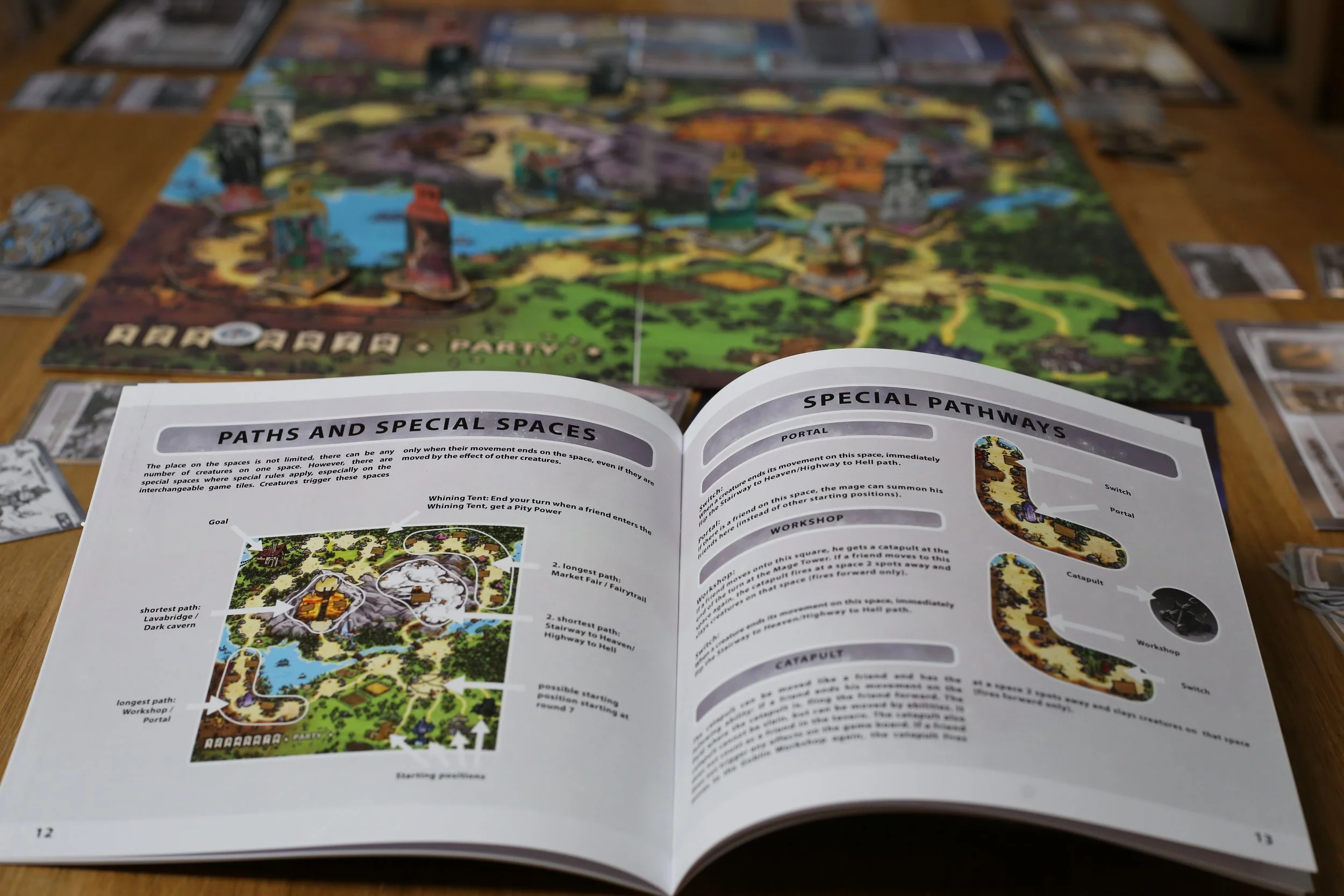
But there are also many people who create previews as a hobby and are simply excited to have a prototype on their table and support designers. The feedback from the board‑gaming community has been incredibly positive. So many people responded to my call for previewers that my few prototypes probably won’t reach everyone before the Kickstarter begins. I just hope they make it to several people at all, since they’re being passed from one player to the next. With so much shipping, something can easily happen to a game. Two English prototypes are now on their way to the USA, one to England, and two within the EU — and three German prototypes are traveling around Germany and Austria. I’m very curious to see how far their journey will take them.
I’ll definitely keep you updated. If you have questions about this topic, I’d be happy to answer them in the comments — as long as I’ve already gained some experience with it.
19 - Call to Action
19 - Call to Action
One of the most important parts of advertising is the “call to action” — the invitation to do something. At the same time, it’s also one of the most difficult parts for me personally. Ads that include a call to action are much more effective than those without. If you look up “call to action,” you’ll quickly find plenty of articles on the topic.
Such a call might be asking the reader or viewer to subscribe to a newsletter, like a post, follow a page, buy a product, or simply join a discussion. It’s an invitation to participate or a request for support. Someone who might not have thought about supporting a product or who doesn’t yet feel part of the community gets a little nudge and reminder. Above all, it clearly highlights the action you want them to take.
The calls to action I mentioned are very different from one another, and they trigger very different reactions in me. I want to create a great game. With advertising, I want to draw attention to it and build excitement. I want to spark interest, but I don’t want to tell anyone what to do. I’d like people to take action because they genuinely like my product. But it doesn’t feel good to ask a stranger for support.
It’s a good thing I’m already writing posts before the big advertising push, because calls to action are genuinely hard for me, and I need to learn how to do them. For example, I’ve gotten used to asking questions in my posts to invite people to participate. That actually feels completely fine and fitting, though it still takes some getting used to. It’s probably easier because I’m not really asking for support yet. It’s a request to do something, but it doesn’t require any real commitment — like signing up for a newsletter or spending money.
When I start asking for more support, everyone can still decide for themselves whether they want to give it or not. But I’m putting someone in a position where they might have to say no, and that can be uncomfortable for some people. That’s probably why it’s so hard for me. We’re used to saying no to ads by now, but you still don’t want to be perceived as “advertising.” You don’t want to come across like a big corporation trying to push products on people just to make money. But I do need support, and it is okay to ask for it. A project like this simply can’t be done alone in a meaningful way. And honestly, I’m not asking for anything huge — and thanks to anonymity, it shouldn’t be difficult for anyone to say no. I need to remind myself of that more often. Depending on your moral compass, advertising can be quite tricky.
18 - Paid Advertisment
18 - Paid Advertisment
Especially if you don’t want to sell only locally, you won’t be able to avoid paid advertising. Of course, organic advertising (spread through word of mouth and enthusiasm) is better in almost every way, but it will never reach the same audience. Why do I say “in almost every way”? Organic advertising takes an enormous amount of time. Paid advertising is also very inexpensive, especially when it points to a great product — that’s when it becomes truly efficient.
It’s also important to keep the right target group in mind. For example, you can place ads on BoardGameGeek, the largest platform for board games, or in other specialized forums. Or on various social media platforms.
For board games on Kickstarter, Facebook advertising actually seems to be the most efficient. At least, that’s what you read in board game design groups and blogs. The advantage here is mainly that you can define very precisely which target groups will see your ads. Apparently, you can also run very effective A/B tests. That means: I can show one version of the ad with slightly different wording to 100 people, and another version to a different group of 100 people. Based on their reactions, I can see which wording works better. This allows you to optimize your posts.
However, I’ve often read that ads on BoardGameGeek tend to work better for more complex games, and that otherwise the advertising there is relatively expensive.
You should be especially careful when it comes to pricing. It’s a tricky topic. Depending on the type of ad, you usually pay differently. Often it’s based on impressions — meaning how many people saw the ad. But just because an ad was shown 1,000 times doesn’t mean everyone is interested, or that they click for more information, or that everyone who clicks signs up for the newsletter, or that everyone who gets that far is actually willing to buy the game.
Photo by Andre Benz on Unsplash
So if I pay €1.70 per click on my ad, but only every tenth click leads to a purchase, that means I paid €17 in advertising for that customer. If my profit margin is €18, that customer is still a profit! Naturally, larger and more expensive games give you more room to work with. And more customers might allow me to produce a larger print run, which makes manufacturing cheaper.
There are also several positive effects of advertising that are difficult or even impossible to measure. Clicks that lead to your site bring you traffic, and you appear more often to other potential customers. People might share information about your game even if they don’t buy it themselves. And you can find fans who bring life to your pages or help you in other ways. It also generally helps when people have already seen or heard about a product before. Maybe I don’t click the first time I see an ad, but the next time I read something about the game, I might. Sure, there may be people who get annoyed by ads and therefore refuse to buy the product — but who knows whether they would have ever seen it, and then bought it, without the ad? So this point probably doesn’t weigh too heavily. As I said, these effects are very hard to measure, but they are mostly very positive side effects of advertising.
I haven’t run any paid ads for my game yet. I’ll report more once I have. These are primarily things I’ve found online or learned in marketing seminars and during my psychology studies. I’m sure some of you can add more precise insights. I — and certainly other readers — would really appreciate your comments!
Update 1: In the meantime, I have run ads, but I wasn’t able to track them properly. That makes it hard for me to judge how effective they were. There are trackers you need to install on the page your ad links to. Unfortunately, I didn’t have enough time to look into this properly.
Update 2: I unfortunately can’t say how effective Facebook advertising will still be in 2026. I know (though only from my personal circle) that hardly any of my friends use Facebook anymore since so many AI-generated posts started appearing there.
17 - Reviews and Previews
17 - Reviews und Previews
With the large number of new board games released every year, many board gamers look at reviews before making a purchase. This primarily includes reviews in magazines, board game blogs, podcasts, and above all video reviews on YouTube.
These are also excellent ways to reach players for Kickstarter campaigns. It is often recommended to start building relationships with reviewers as early as possible, since they frequently need some lead time to produce content—especially when it comes to YouTube videos. However, I have found that this approach is not always ideal when you are an unknown board game designer.
There are many board gamers who are working on a board game idea, but many of these ideas are never realized, or only after years. As someone who writes reviews myself, I can understand why you might not want to schedule time for someone from whom nothing may ever materialize. It therefore helps to already have something tangible to show, and depending on the scope of the game, it can take quite a while until you have something where the design and illustrations already look appealing. Initial contacts can also be made very effectively at conventions and, of course, when you are already part of the reviewer’s community.

Photo by Markus Winkler on Unsplash
In addition, it is important to research what kind of content is being produced. Does the channel focus on certain genres or mechanics that fit my game? Are previews shown from time to time—that is, games that are not yet available for purchase—or only games that are already on the market? Some creators also show games that are clearly not finished yet; others do previews as well, but only if the preview prototype already looks very polished.
It is also important to note that some reviewers or previewers charge money to produce their content. This is understandable, as there is often a great deal of work involved. However, there are also many who are happy to create content for free, as long as the game is interesting to them.
It is also worth considering providing reviews in different languages. On Kickstarter, you can usually assume that at least 60% of customers are English-speaking, so English-language reviews are definitely essential. Since I also plan to produce a German version, German should of course not be missing either. If additional languages can be included beyond that, it certainly won’t hurt—provided you can distribute the game well in those regions.
Do you also like to watch reviews? If so, which formats do you prefer, and which reviewers do you particularly enjoy? I’m curious to hear which ones you mention—there are so many, and you keep discovering new great channels all the time.