
22 - Illustrations and Production (Bleed and Margin)
22 - Illustrations and Production (Bleed and Margin)
When you start planning illustrations for your game, it’s a good idea to familiarize yourself with production standards. Doing so can save you a lot of work later on.
Panda Game Manufacturing even provides a Design Guide Book for this, which is incredibly helpful. In this post, I’ll talk about bleed and margin (trim area and safety area), and in the next one I’ll cover printing plates. However, design templates aren’t the same for every manufacturer.
You can assume that most manufacturers work with a bleed and margin of 3 mm. But what does that mean?
In this image of our card, I’ve drawn a red line. It represents the bleed. The purple line marks the margin. The black line shows the actual size of the card and the intended visible area.
The card is printed and then die‑cut. But the machine has a certain tolerance — small deviations that simply happen. The cut won’t always be exactly where the black line is; it might be slightly higher or lower, a bit to the left or right. Normally, these deviations don’t reach the full 3 mm. If they did, customers would probably complain.
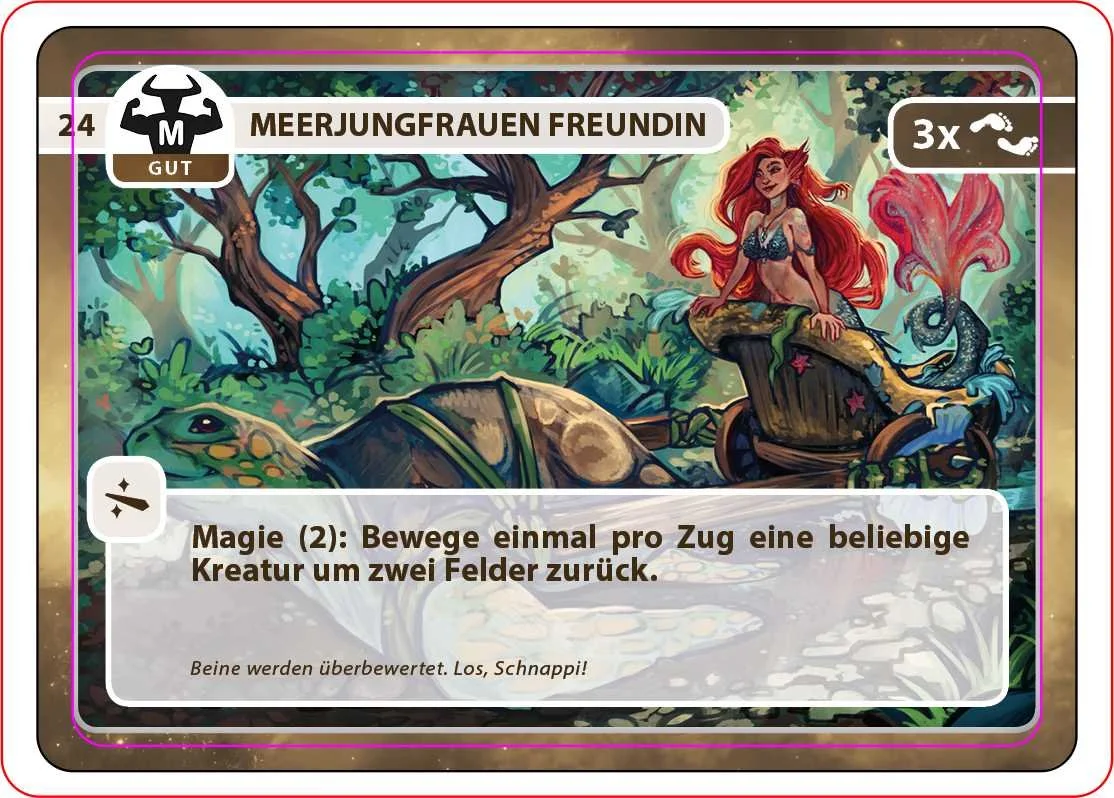
In this case, the colored border of the card needs to extend all the way to the red line (the bleed). Otherwise, if the cut shifts, you’d end up with a white edge on one or two sides. Even a tiny white edge would be noticeable and unpleasant. But if the cut shifts slightly to the left, that also means the right side will be cut deeper into the black area. That’s why you need to respect the margin (purple). The area between the black and purple lines shouldn’t contain any important information. In our example, the card number 24 would be cut off if the cut were actually 3 mm too far to the right.
Both bleed and margin are factors that must be considered for any printed and cut object. So especially with cards, you need to choose a design where bleed and margin won’t cause problems. The same applies to die‑cut cardboard components. With certain shapes, it’s not easy to maintain proper bleed and margin.
If I’ve forgotten something important in my explanation, please leave me a comment. And if you have any questions, feel free to ask — I’m sure you’re not the only one who would benefit from the answer.
6 - Where can I find manufacturers, and who should produce my board game?
Upon request, I'll continue with the topic of pricing in this blog post. How do I determine the production costs of the game? Through quotes from manufacturers. And where can they be found?
There are actually plenty of manufacturers that produce board games, and not all of them are easy to find. To find some, I visited the booths at Spiel 2019 with my prototype and outlined which components I needed using it as an example. While I’m sure I missed many manufacturers, I managed to establish contact with 17 companies. That’s definitely enough for a good overview. Three were from Europe (Germany, Poland, and the Czech Republic), while the other 14 were from China. Of these, three never sent me a quote, leaving me with one German and 13 Chinese companies.
The first 14 quotes were overwhelming at first. So many different materials, various minimum order quantities, tiered pricing for print runs, special conditions for packaging and shipping, and sometimes even possible fulfillment services (shipping directly to Kickstarter backers—more on this in the next blog post). This led to prices that were not directly comparable at first glance. Usually, the prices are also listed individually for each component. To bring some clarity to the material chaos, it was time to pull out all the demo packages from Essen again.

Descriptions can initially be confusing.
Even though different manufacturers sometimes use different terms for certain things, the demo packages helped me get a clearer picture. Comparing the quotes also gave me an overview of which conditions are more standard in the industry and which are not. It also highlighted issues I hadn’t considered before that needed addressing with some manufacturers. With a second quote where I specified preferred materials, discussed any missing components, and standardized the print runs (e.g., 1,000/2,000/5,000 units), I was finally able to compare prices. And they vary widely—by about ±50% from the average price.
However, price alone isn’t everything. Communication with some companies was significantly better than with others. I had no board game references for some, and reviews from board game design groups and forums were a crucial factor in my decision-making. Some companies also specialize in certain components, such as miniatures, specialty dice, chips, coins, or game mats.
Deciding on one of the final five favorites was incredibly difficult. Panda has the best reputation in terms of quality and service but is very expensive and demands larger print runs. Other companies with bigger names were almost equally good in quality, offered significantly better prices, and provided excellent service. Ultimately, I chose LongPack. If something were to interfere, I could still fall back on Magicraft. Feedback on these companies is excellent, the prices are good, and communication was outstanding. However, the components needed and how comfortable one feels with a company may also play a role. The decision was truly tough and lengthy—370 emails were exchanged in total.
If you’re wondering what happened to the German company: I didn’t feel as comfortable with them. I also got the impression that they were reluctant to produce smaller print runs. The price was about 40% worse, even though some components were missing and not accounted for. Certain components made of other materials (e.g., plastic feet for standees) would still have to be ordered from China. Deluxe components for a special Kickstarter version would also have been significantly more complicated and expensive here.
Have you had experiences with board game manufacturers? I—and likely some of the readers—would love to hear your stories. Leave a comment. If you find this blog interesting, feel free to subscribe.

I hope this translation helps! Let me know if you'd like any additional support.