
22 - Illustrations and Production (Bleed and Margin)
When you start planning illustrations for your game, it’s a good idea to familiarize yourself with production standards. Doing so can save you a lot of work later on.
Panda Game Manufacturing even provides a Design Guide Book for this, which is incredibly helpful. In this post, I’ll talk about bleed and margin (trim area and safety area), and in the next one I’ll cover printing plates. However, design templates aren’t the same for every manufacturer.
You can assume that most manufacturers work with a bleed and margin of 3 mm. But what does that mean?
In this image of our card, I’ve drawn a red line. It represents the bleed. The purple line marks the margin. The black line shows the actual size of the card and the intended visible area.
The card is printed and then die‑cut. But the machine has a certain tolerance — small deviations that simply happen. The cut won’t always be exactly where the black line is; it might be slightly higher or lower, a bit to the left or right. Normally, these deviations don’t reach the full 3 mm. If they did, customers would probably complain.
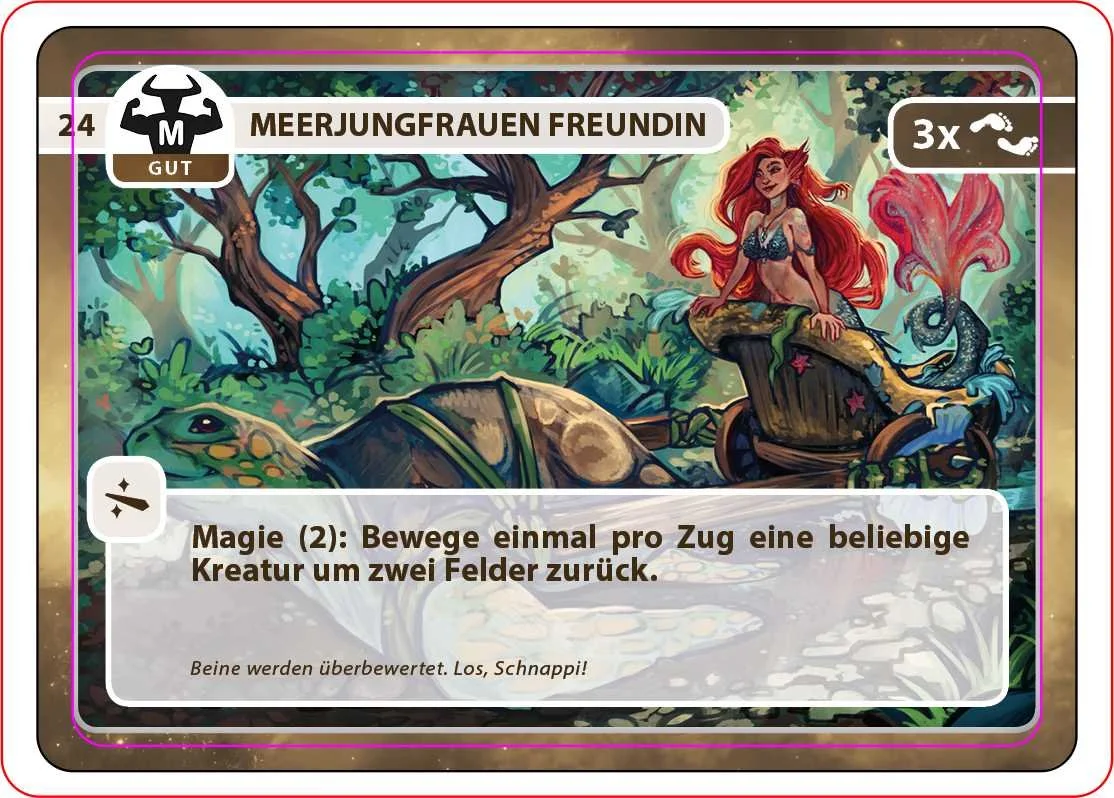
In this case, the colored border of the card needs to extend all the way to the red line (the bleed). Otherwise, if the cut shifts, you’d end up with a white edge on one or two sides. Even a tiny white edge would be noticeable and unpleasant. But if the cut shifts slightly to the left, that also means the right side will be cut deeper into the black area. That’s why you need to respect the margin (purple). The area between the black and purple lines shouldn’t contain any important information. In our example, the card number 24 would be cut off if the cut were actually 3 mm too far to the right.
Both bleed and margin are factors that must be considered for any printed and cut object. So especially with cards, you need to choose a design where bleed and margin won’t cause problems. The same applies to die‑cut cardboard components. With certain shapes, it’s not easy to maintain proper bleed and margin.
If I’ve forgotten something important in my explanation, please leave me a comment. And if you have any questions, feel free to ask — I’m sure you’re not the only one who would benefit from the answer.
