
39 – The Kickstarter and the Marketing
39 – The Kickstarter and the Marketing
If no one knows about a game, they won’t buy it. Without marketing, you won’t get far—at least not until you’ve made a name for yourself. For first‑time creators, it’s especially difficult to judge whether the marketing is sufficient.
Usually, the number of newsletter subscribers is an excellent indicator of how well a Kickstarter will perform. Unfortunately, my number wasn’t as high as I had hoped, and that became noticeable at the start of the campaign. However, I also can’t know in advance how many potential backers I’ll reach in the month leading up to the Kickstarter—because that’s when the most happens.
There were two convention appearances: BerlinCon, two weeks before the Kickstarter, and SPIEL in Essen during the campaign. I had the impression that these conventions brought in many supporters. But if you can’t sell games at the convention yet, the financial cost is very high.
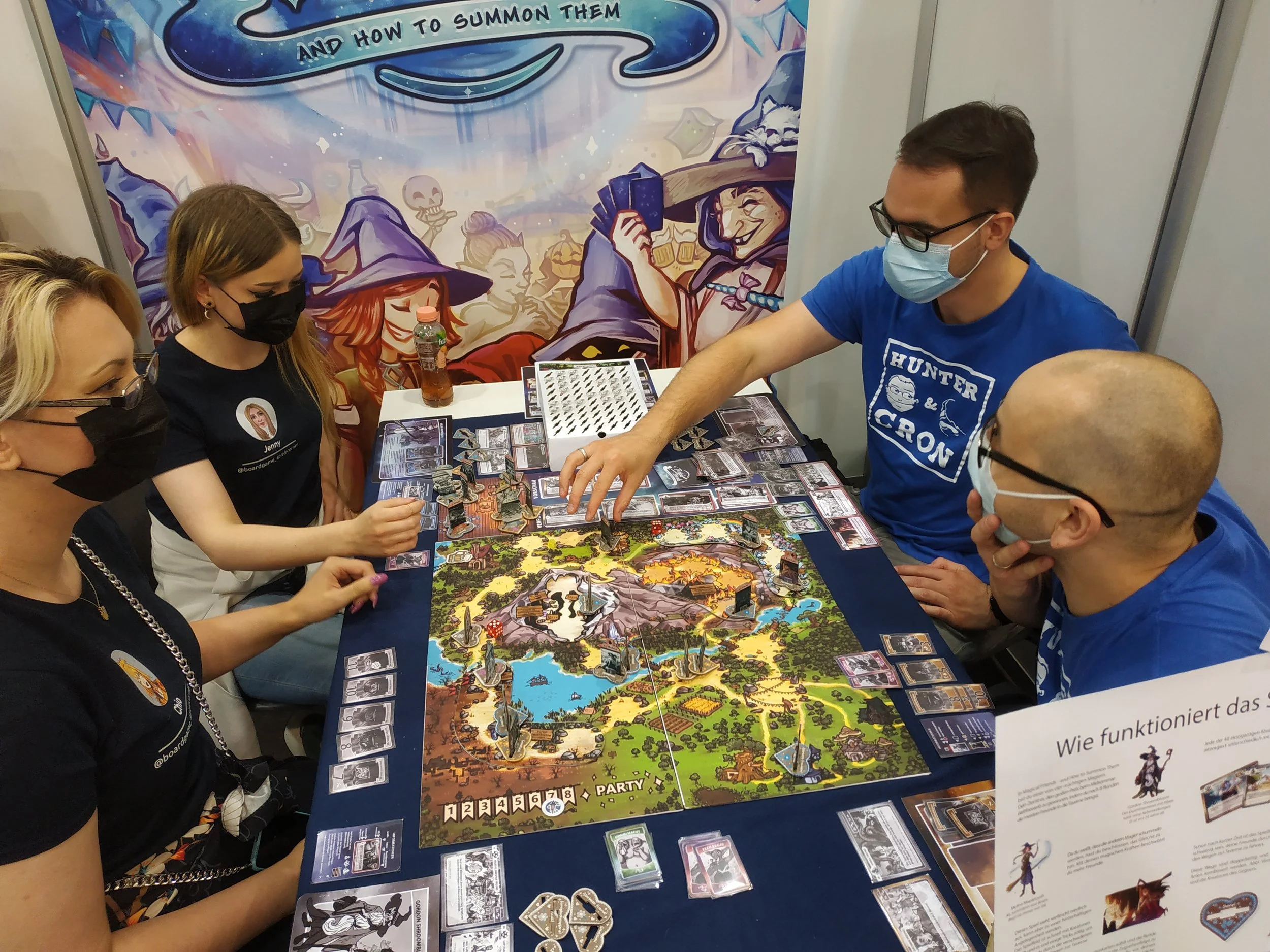
Thanks to the lovely convention players.
You also don’t know beforehand how strongly reviews will influence things. Of course, I could have scheduled them to appear well before the Kickstarter, but you can expect that people who get excited by a review will want to get the game as soon as possible. That’s why it’s usually recommended to release reviews close to the Kickstarter launch. I think that makes sense. But this timing also leaves you uncertain for quite a long time about how many interested people you’re actually reaching.
I did receive a lot of reviews. My eight prototype copies resulted in more than 20 reviews in total, and I’m very happy with the feedback I received.
And of course, there was also Facebook advertising, which reached many people.
However, during the Kickstarter campaign, it quickly became clear that something was missing. Despite the major effort put into the English version and marketing toward English‑speaking board gamers, we apparently didn’t reach enough players. Only about 20% of backers came from the English‑speaking world.
Marketing, however, costs a lot of time and money. To make a Kickstarter campaign look appealing, illustrators and graphic designers are needed again. Behind the scenes, marketing requires a lot of organization, creativity, and time. And the costs shouldn’t be underestimated. The conventions cost around €4,000. Review prototypes (handmade!), shipping, promotional videos for Kickstarter and YouTube added up to another €4,000, and digital advertising consumed another €3,000. That’s not a small amount of money—and yet it’s necessary.
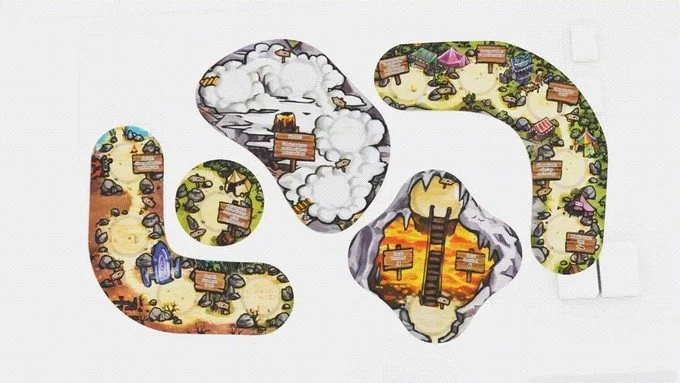
One of many graphics on the Kickstarter Page
Of course, I would much rather invest all that time and money directly into the board game. I can definitely recommend that if you’re making a game, make sure you have someone on your team (or someone you can pay) who handles marketing for you.
With a budget like this, the Kickstarter should have gone better, right?
For a small game, it probably would have been enough, and the Kickstarter would have succeeded without issue. But Magical Friends is not a small game, and that means it competes with big titles on Kickstarter. Especially in October, when many companies launch their campaigns to avoid the Christmas season (Kickstarter isn’t great for Christmas gifts ;) ), you’re competing with larger teams—teams that already have the trust of the Kickstarter community from previous projects, teams with more members and dedicated marketing staff, and companies with much larger budgets.
Your own marketing budget becomes far less efficient when it’s up against massive marketing budgets. When other companies run a lot of ads, mine simply gets drowned out. For new Kickstarter projects, I would definitely not recommend launching in October.
I think a large portion of my backers were people who met me personally. Most backers came from Austria and Germany, where we attended conventions and talked to the most people—people who had the chance to build trust in us. If that’s not the case, people can only rely on the advertising and the offer itself. With a limited budget, they have to choose. They can pick a product they like from a company they trust, with lots of shiny extras in the campaign—or a product they like from an unknown creator, with fewer shiny extras.
A deluxe version brings that special “bling,” but it also carries risk. In reality, it’s just as risky as advertising, and you should probably think of it as a form of advertising. For the second Kickstarter, I’ll carefully consider whether I want to offer a deluxe version.
I’m also not entirely satisfied with my landing page for newsletter sign‑ups. I definitely want to improve it. The platform I’ve been using limits my options too much.
There may also be adjustments to the game’s cover to better show that this is a highly interactive game where players can be mean to each other. Based on the cover, some people expected a family game rather than a hobby game.
It’s definitely easier to advertise something the more finished it is. I’ve noticed that I get much more feedback and interest when the things I post look nicer. So it gets easier with every step. It’s good that Magical Friends is already so far along—that makes the next attempt next year much more pleasant.
Have you had experiences with this topic? Did you see ads for Magical Friends? How do you feel about advertising? In the next posts, I’ll return to talking about design!
38 – The Kickstarter and the Goal
38 – The Kickstarter and the Goal
Some of you are probably wondering why I canceled the Kickstarter at €21,000 when we would have reached €25,000. Realistically, in the final week it likely would have ended somewhere around €27,000–€29,000.
But what’s behind that goal? Technically, it would have been possible to produce a small print run of the game. Sounds good, right? Well… not quite. I could produce 1,500 copies and would have already sold 500 of them. But that would leave almost no buffer for the currently very unstable freight costs. On top of that, the remaining 1,000 copies would still need to be sold — and of course, storing them also costs money. Keep in mind: for a small card game, 1,500 copies fit easily on a single pallet. For a game the size of Magical Friends, it’s more like ten pallets.
Selling the game outside of Kickstarter as a still‑unknown designer is definitely harder and very time‑consuming. If you sell to retailers, the sale price is significantly lower. Typically, you receive about 45% of the net price or 60% of the gross price. With distributors, the price is even lower.
Yes, you could still generate revenue from the remaining games, but so far only the production costs would be covered. I’ve paid all marketing costs myself, and my illustrators should be paid fairly as well. So after selling the games, I might end up with less of a loss than I currently have — but my working time (which continues to increase after the Kickstarter due to production and sales) would not be compensated in the slightest. And let’s not forget: I’ve already put 3,000 hours of work into this game. That’s two years of full‑time work without earning any other income.
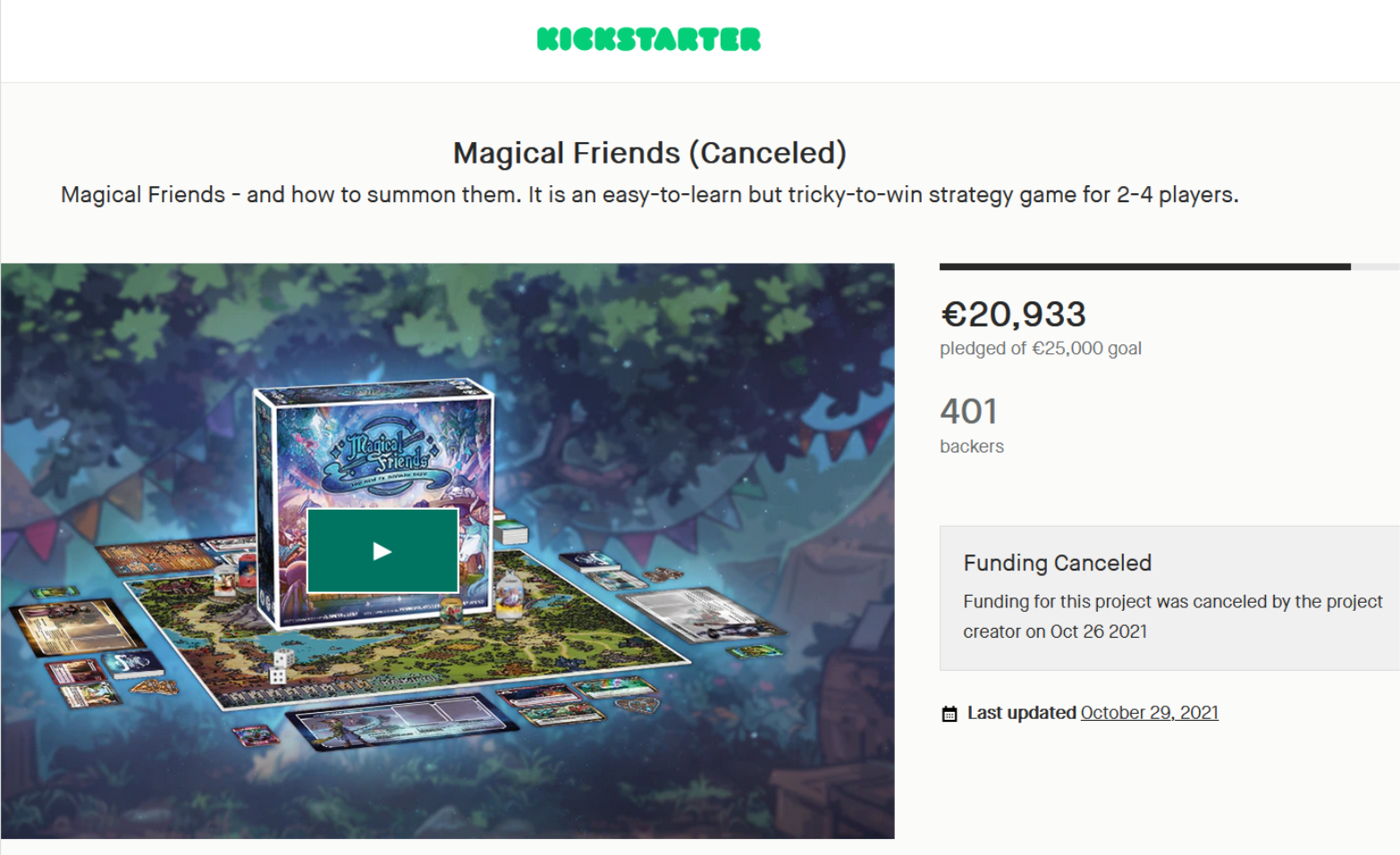
Of course, it would be wonderful to have produced and sold my first game — and with a second print run, an expansion, or a second game, greater success would be likely. But then the game should also be produced really well, and with a €25,000 goal, a few features I’d like to include would still be missing.
So why not set a higher goal from the start? The higher the goal, the later it gets reached — and that’s a big problem. It’s even very likely that we would have raised more money overall if I had set the goal at just €20,000. Why? Because once a goal is reached, the project is considered successful — and successful projects attract more backers. Stretch goals, meaning upgrades for the game, can also only be unlocked once the main goal is reached.
So I chose a goal that was as low as possible while still making it technically feasible to produce the game. At the same time, it needed to remain plausible to cancel the Kickstarter if necessary. If I had found a larger distribution partner, I might not have canceled the Kickstarter at all.
In a way, the Kickstarter goal is also a marketing tool — and what didn’t work so well in terms of marketing is something I’ll talk about in the next entry.
What’s your opinion on Kickstarter funding goals? Leave me a comment.
37 – After the Kickstarter is (unfortunately) before the Kickstarter
37 - After the Kickstarter is (unfortunately) before the Kickstarter
A few months have passed since the last entry on this blog. A lot has happened, and there’s a lot to talk about. Too much to fit into a single blog post — and then there’s the question of where I should even begin …
The Kickstarter campaign was an emotional roller coaster. After working toward this moment for two years, my nerves were already worn thin. Every small setback felt huge, and every small success felt just as huge.
On top of that, an enormous amount of work goes into a Kickstarter campaign. That’s also why there haven’t been any blog entries in recent months. For 10 weeks straight, I was working 60 hours a week with no weekends off. At some point, I simply couldn’t do more — I had reached the limits of my creativity.
Where does all the time go? You spend it on the essential preparations needed to make the Kickstarter page presentable — designing the page, creating videos, preparing the reviews. And then there were the preparations for, and participation in, conventions during that time, like BerlinCon two weeks before the campaign and SPIEL 2021 right in the middle of it.
Natürlich wurde in jeder freien Minute Werbung gemacht. Postings auf Social-Media-Plattformen wollten hochgeladen, Reviews geplant und angekündigt werden. Man muss sich um bezahlte Werbung auf Facebook und Co kümmern und jede Option nutzen, die man finden kann, um das Spiel zu promoten. Außerdem bekommt man auf einmal viel Aufmerksamkeit von Herstellern, Fullfillment-Services und Publishern. Und dann war da noch die Kampagne selbst. Ich musste immer aktiv sein und möglichst viele Interaktionen setzen.
Ich habe zwar Illustratorinnen, die mich mit den Grafiken und auch auf den Messen unterstützen, ansonsten kümmere ich mich allerdings allein um all diese Dinge. Und auch wenn ich gerne kreativ bin, hat Kreativität auch ihre Grenzen, vor allem wenn so viele dieser Dinge sehr viel davon benötigen. Das war auf jeden Fall sehr erschöpfend.
Auch wenn es sehr schade ist, dass der Kickstarter nicht geklappt hat, die Pause tut jetzt auch mal gut. Dieses Wochenende hatte ich zum ersten Mal seit Langem ein freies Wochenende mit Freunden und Brettspielen ... und jeder Menge Kuchen, und das war hervorragend. :-)
Nun habe ich noch nicht viel über die Kampagne und den Abbruch erzählt, dazu mehr beim nächsten Mal. Es gab viele Erfahrungen, die ich machen durfte, darunter auch einige sehr positive. Magical Friends geht nächstes Jahr auf jeden Fall in die nächste Runde, so viel ist sicher.
Ich werde euch in den nächsten Einträgen viel zu erzählen haben, außerdem möchte ich alte Einträge mit den neuen Erfahrungen ergänzen, das werde ich aber auch immer in den neuen erwähnen.
Welche Fragen zu Kickstarter oder zum Abbruch würden dich denn am meisten interessieren? Schreib uns einfach einen Kommentar und ich werde entweder dort oder in einem eigenen Blog-Eintrag antworten.
Update: Das ist natürlich schon ein alter Blog Eintrag. Das Spiel ist natürlich schon veröffentlicht. Der Eintrag hat aber trotzdem Relevanz, da es eben auch passieren kann das ein Kickstarter abgebrochen wird.
33 – First Convention Booths
33 - First Convention Booths
A big decision has been made! I’ve booked convention booths for Magical Friends at both BerlinCon and SPIEL in Essen this year. Together with my two wonderful illustrators, Nessi and Hannah, we won’t just be attending the conventions — you’ll actually be able to meet us there!
17. - 19. September
Station Berlin
https://berlin-con.de/
The decision wasn’t an easy one. As I’ve mentioned before, convention booths are very expensive when you don’t yet have anything to sell at the booth. The most interesting aspect of conventions, however, is the long‑term connections you can build. Back in 2019, I was able to connect with 19 board‑game manufacturers. That helped me tremendously in understanding how factories operate and what to expect in contracts.
The plan is for the Kickstarter campaign to launch at the beginning of October. That means at BerlinCon (mid‑September), the campaign will be prepared and announced. We’ll also use the event to test the booth decorations for SPIEL. During SPIEL, our campaign will already be running — in fact, it will be right around the halfway point, which is usually a quieter phase in a Kickstarter. I’m very curious to see what impact SPIEL will have on the campaign!
https://www.spiel-messe.com/de/
I might be able to build interesting connections with publishers we could work with after the Kickstarter campaign. There will certainly be reviewers there as well who may want to promote the game on-site or before the campaign ends. And hopefully we’ll meet lots of wonderful fans at the conventions who will accompany us a bit on our journey. For Hannah and Nessi, there may even be new clients for future projects.
We’re definitely already super excited and really looking forward to the conventions. We also have a few exciting ideas for how we can make our booth interesting. It’s sure to be a lot of fun!
Will we see you at the convention? Is there anything—besides the current prototype—that we should definitely show at our booth?
32 – Kickstarter Preparations
32 - Kickstarter Preparations
There’s naturally a lot to prepare for the Kickstarter launch. Above all: marketing. Review prototypes are on their way, and social media posts are starting up again. But the Kickstarter page itself also needs to look great and requires banners, GIFs, and videos.
For the introduction of the Kickstarter video, I came up with three short clips that each tell a little bit about what Magical Friends is all about. Why three clips? Each one is only about 20 seconds long, which also makes them perfect for Facebook ads. We’ll try our luck on TikTok as well.
In the first clip, viewers will learn something about the goal of the game; the second clip focuses on one of the main tasks in the game; and the third is meant to reflect the action and chaos that unfold during play.
First, I created storyboards together with my illustrators, Hannah and Nessi. I explained to them that in the first clip, I’d like the wizards to learn about the Midsommar competition at the marketplace, a rivalry breaks out between them, and they immediately set off to prepare for the contest.
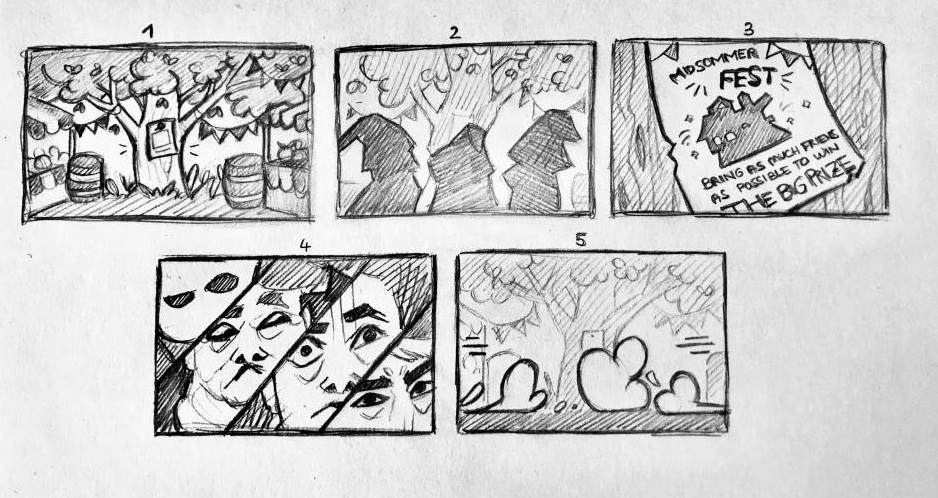
The clips shouldn’t contain much more than five images, because the more images there are, the more time‑consuming the whole project becomes. With five images and various animatable layers, you can already create a lovely little video.
This is what the final concept looked like:
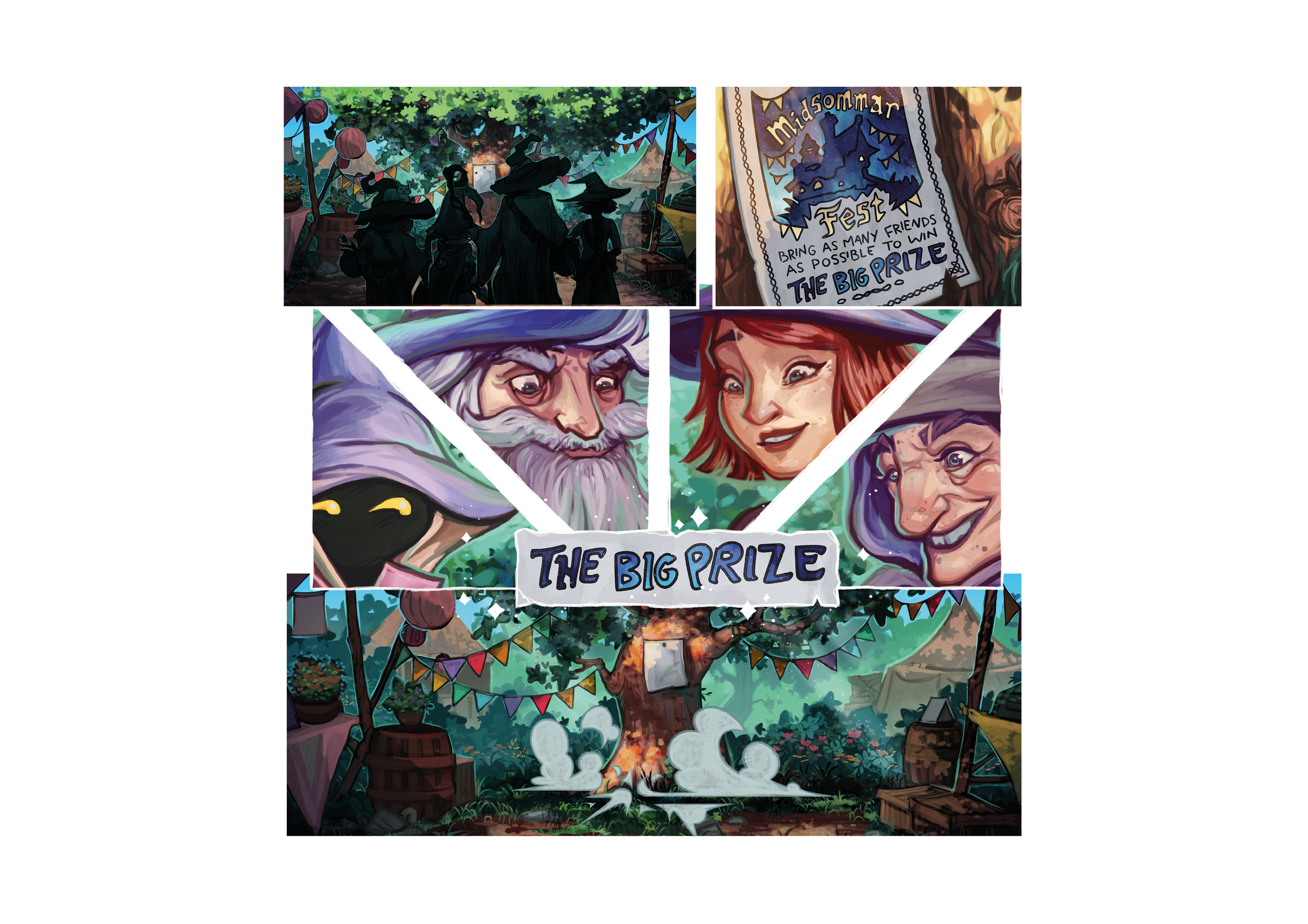
Its also a nice comic!
With this, we can create our own video clip, have a piece of a larger intro, and at the same time a cute little comic.
At the moment, we’re working on sound and text for the video. It already looks very cool. More on that as soon as it’s finished.
Of course, there are many different approaches to creating videos like this — some simpler, some much more elaborate. What do you think of our plan? Leave us a comment.
31 – Reviews and Previews
31 - Reviews and Previews
… are extremely important for introducing an unknown game to the world. There are a huge number of great reviewers on various social media platforms, magazines, podcasts, and of course on YouTube. Today I’d like to give you a look at what goes on behind the scenes. One thing to keep in mind is that many of the larger channels only create reviews — meaning they only cover games that are already on the market and accessible to everyone. But there are also some who create previews for games that haven’t been released yet, like my prototype.
Previews, especially in video format, are very time‑consuming. To build a YouTube channel, you need regular uploads so you show up in the search algorithm. Naturally, you also want to play the game a few times beforehand. And to produce a video with the quality people expect on YouTube, you need some equipment, preparation, and often quite a bit of editing. Since you know how many games are released on the market or on Kickstarter, you can imagine how much work there is. Many do it out of passion, but for some it becomes a profession. That’s why some of the larger channels charge a fee for reviews/previews — and that’s completely understandable.
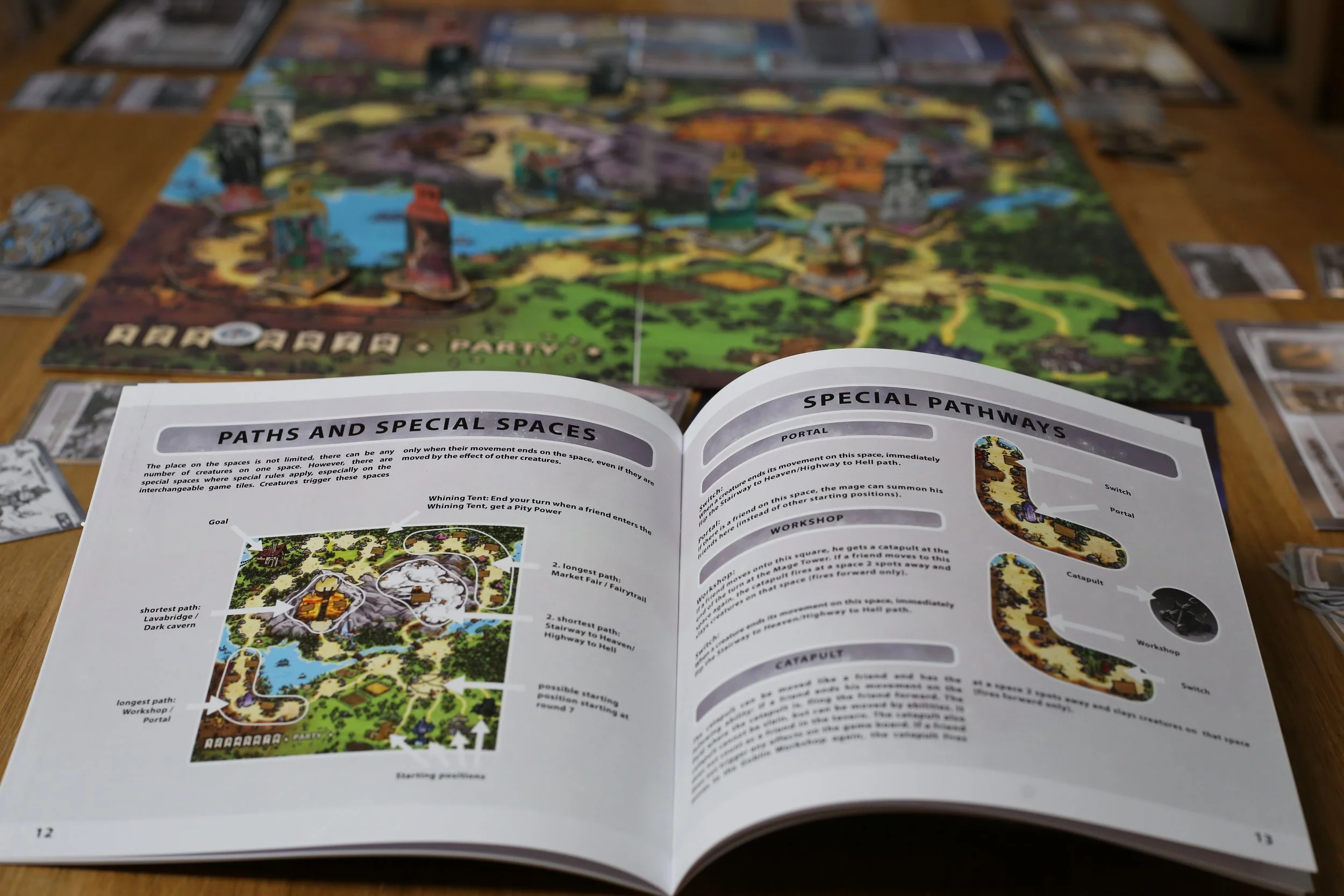
But there are also many people who create previews as a hobby and are simply excited to have a prototype on their table and support designers. The feedback from the board‑gaming community has been incredibly positive. So many people responded to my call for previewers that my few prototypes probably won’t reach everyone before the Kickstarter begins. I just hope they make it to several people at all, since they’re being passed from one player to the next. With so much shipping, something can easily happen to a game. Two English prototypes are now on their way to the USA, one to England, and two within the EU — and three German prototypes are traveling around Germany and Austria. I’m very curious to see how far their journey will take them.
I’ll definitely keep you updated. If you have questions about this topic, I’d be happy to answer them in the comments — as long as I’ve already gained some experience with it.
30 – When You Finish Multiple Prototypes…
30 - When You Finish Multiple Prototypes…
… you’re busy for quite a while. My set of review prototypes kept me fully occupied for the last three weeks. And they really had to get done, because the 12 m² of cardboard and 14 m² of paper were taking up a huge amount of space in my apartment.
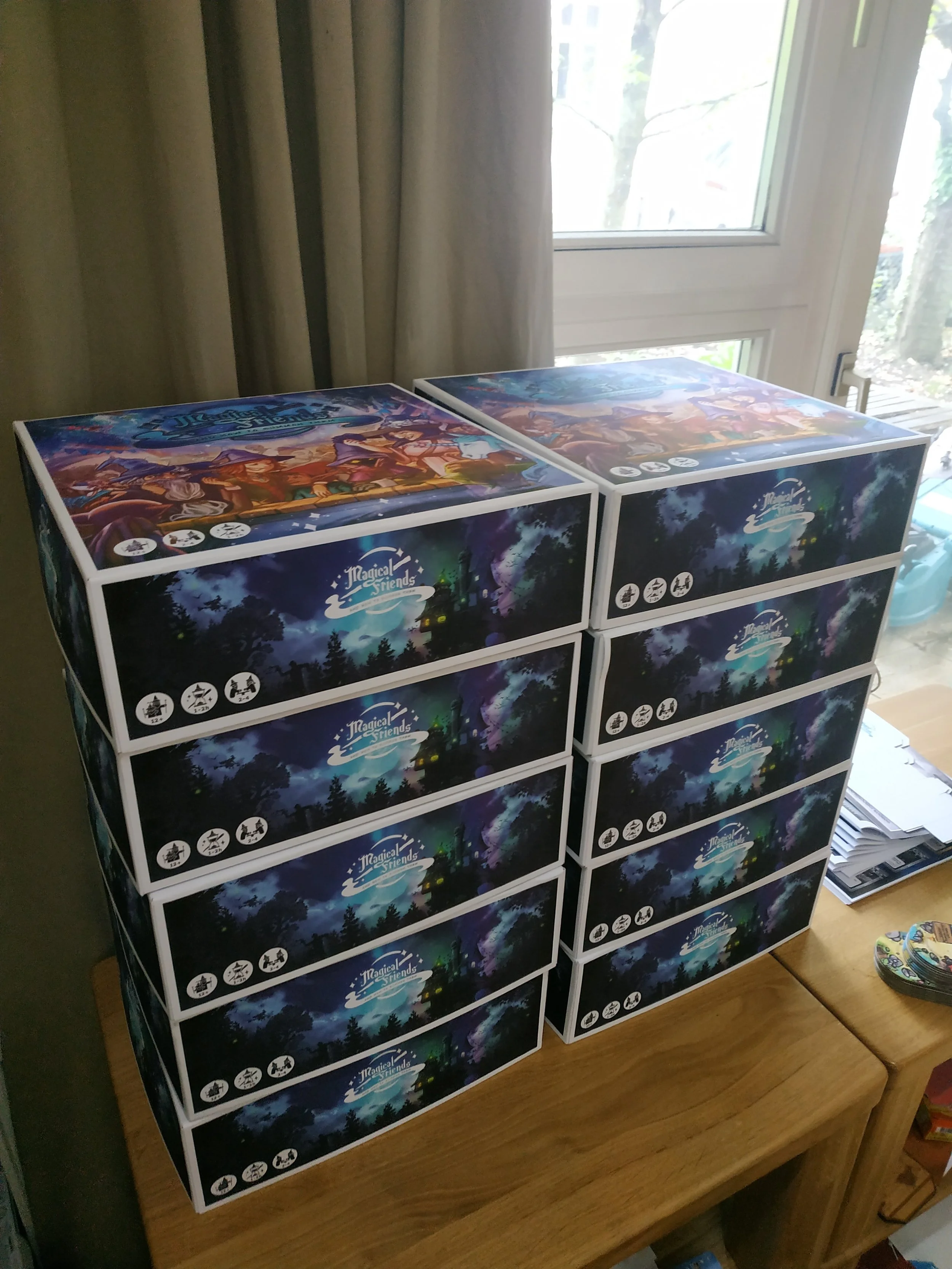
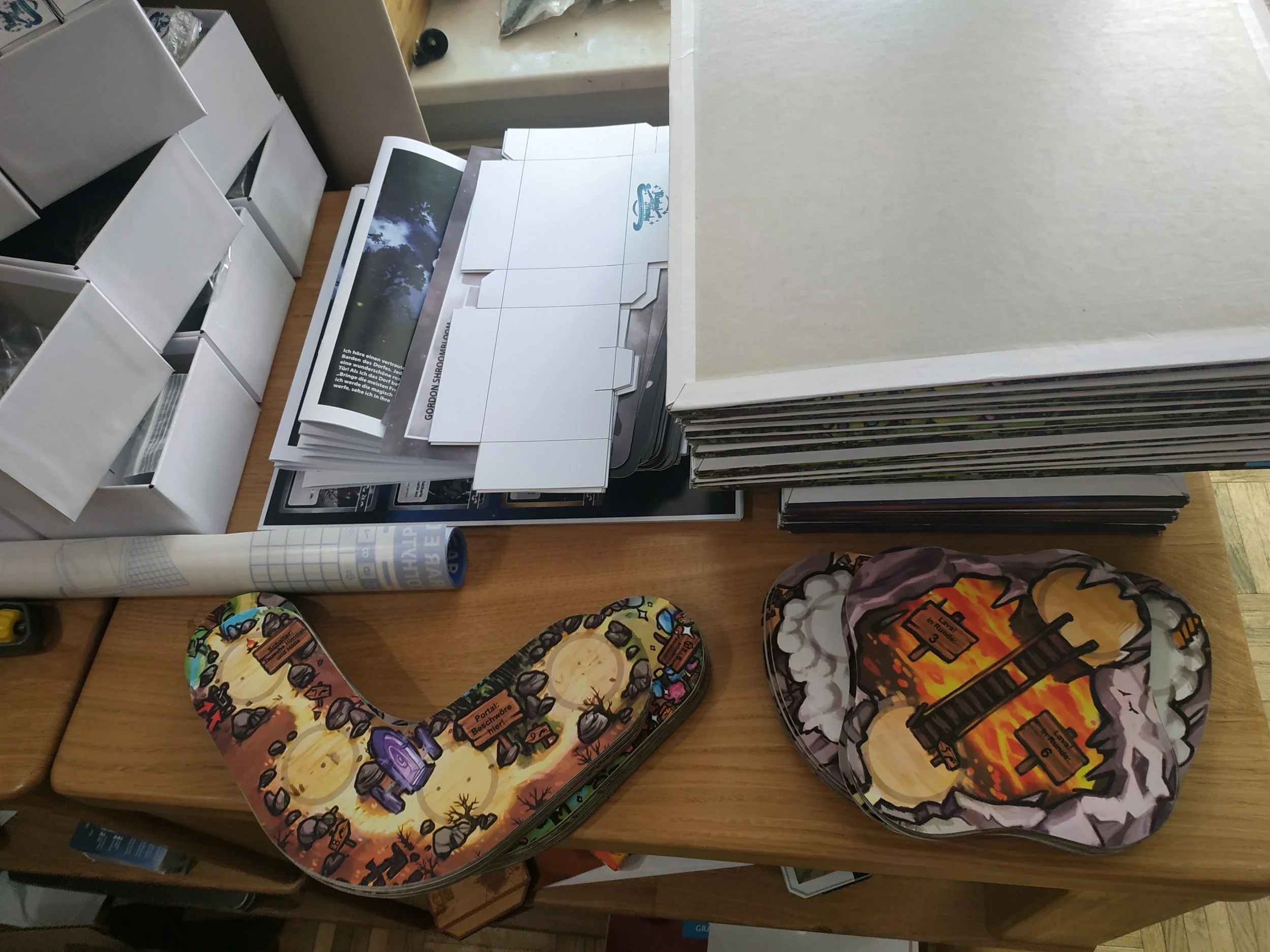
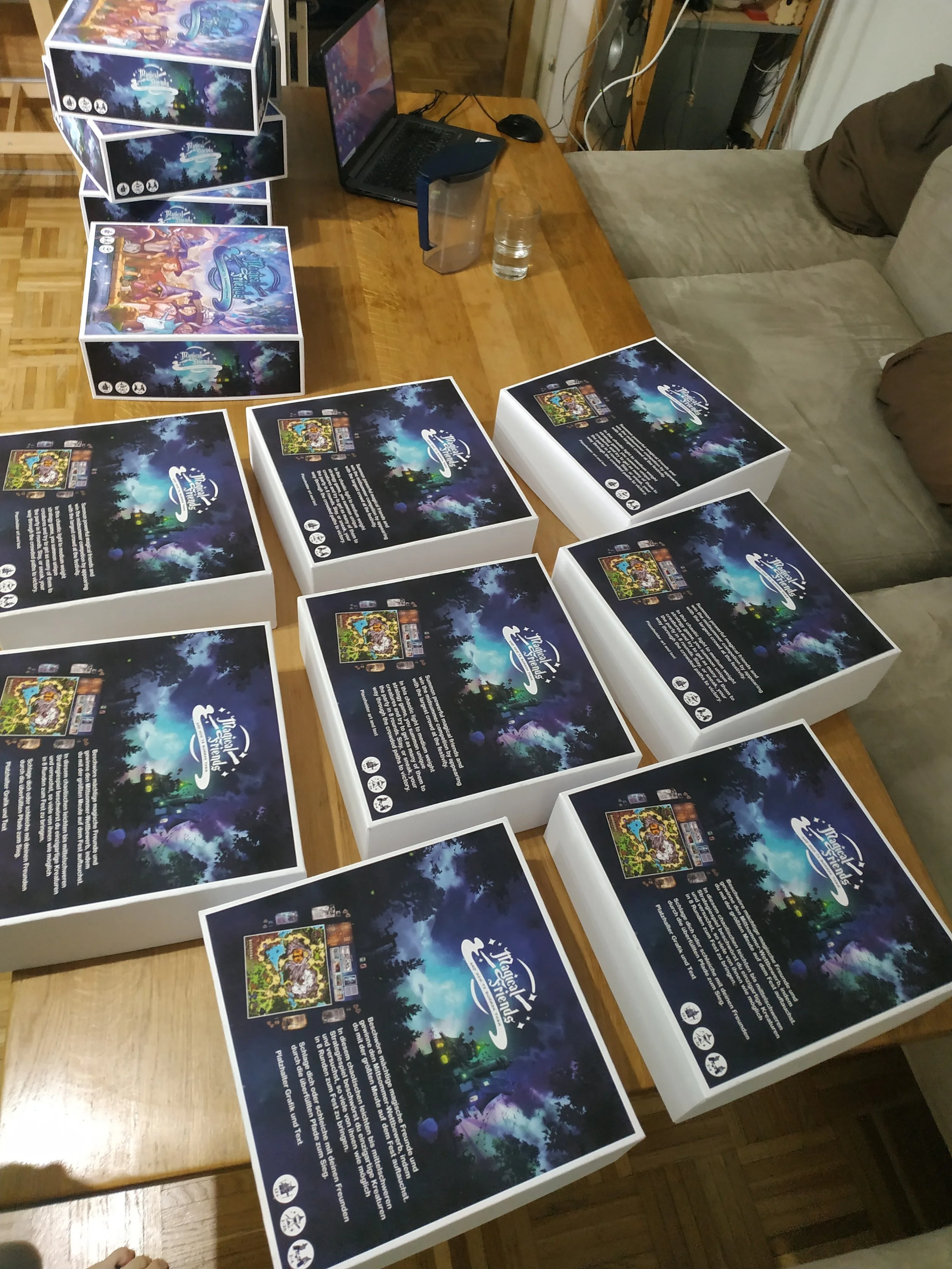
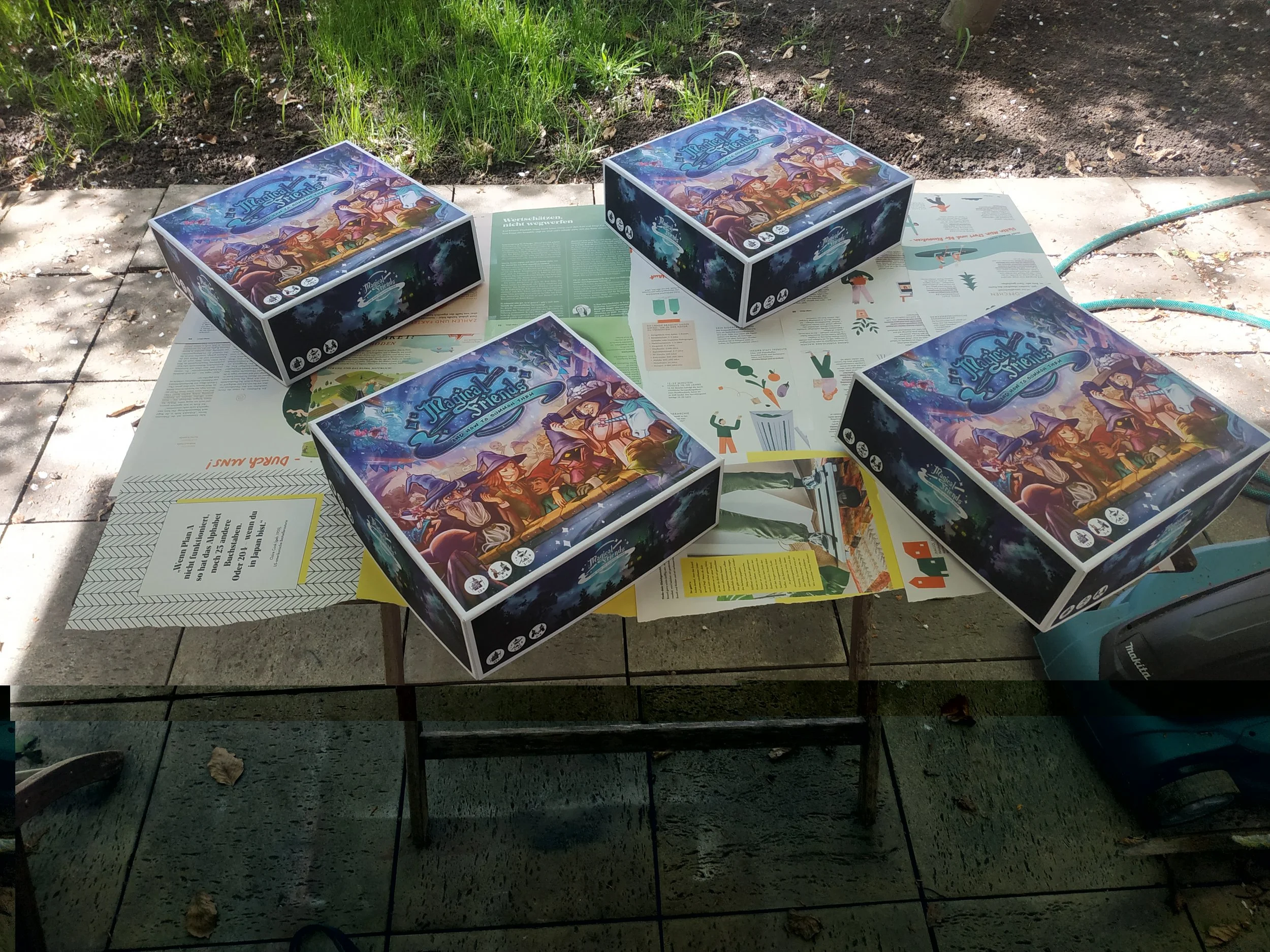
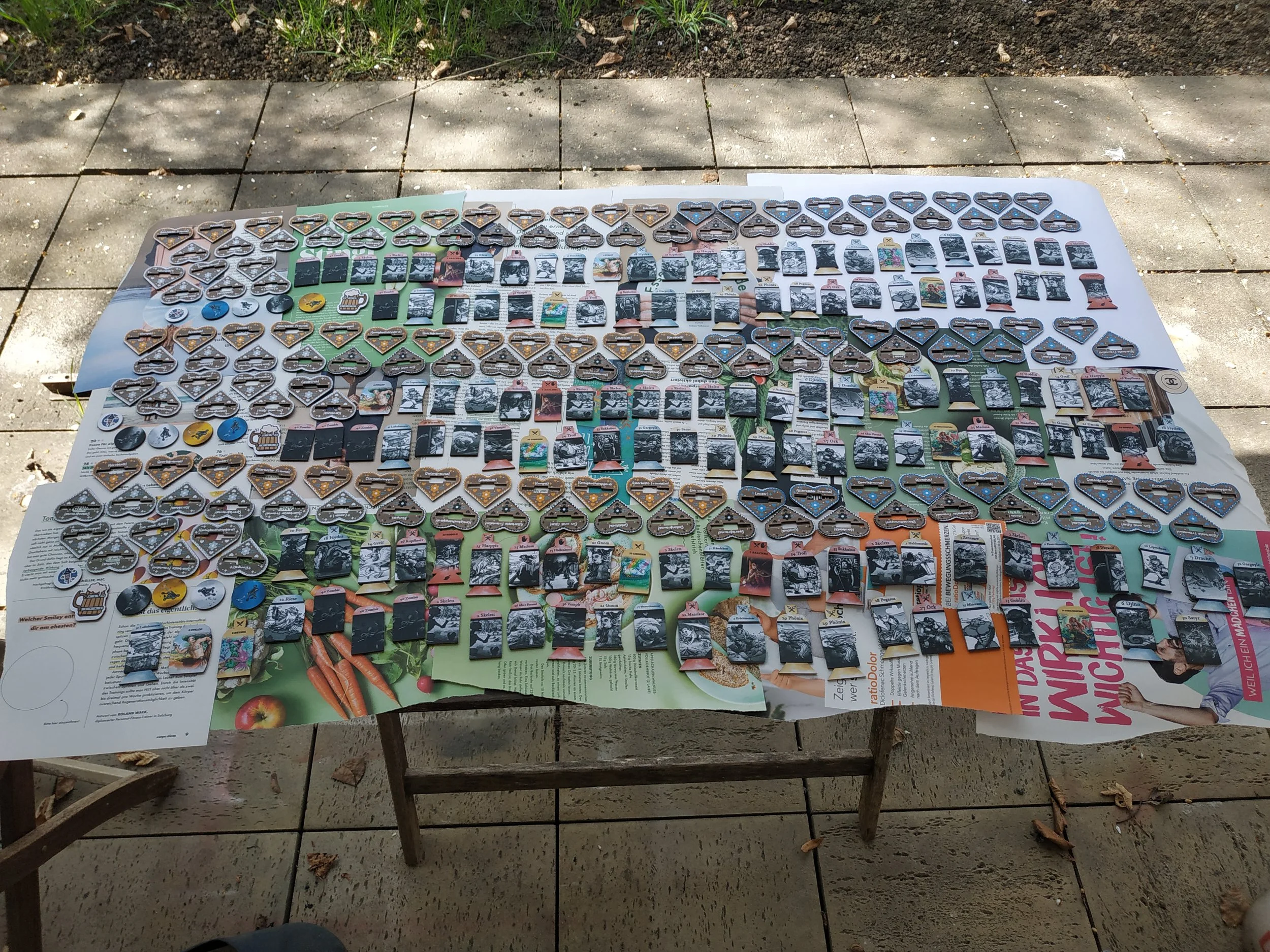
Creature standees and color hearts for 3 games
Matte varnish for the boxes so they’re less sensitive to water
Boxes drying and waiting to be filled
Components ready for packing
If I hadn’t made them myself and had ordered them from my manufacturer instead, 10 prototypes would have cost me €2000–3000. I also would have had to wait around 2–2.5 months for them. On top of that, I would have had to interrupt my illustrators’ work to adjust some graphics for printing — all for prototypes where many illustrations aren’t even in full color yet. Prototypes from a manufacturer aren’t always that expensive, but my game — even without miniatures or complex plastic components — is quite elaborate and definitely not small. The materials cost me about €55 per game, and in total I processed around 650 individual parts (cardboard, cards, paper, stickers, card sleeves…).
The finished mountain of games
They still take up a lot of space, but seeing them completed is a huge relief. Now it’s time to ship them out. I’m excited to see what happens next.
Do you have any questions about crafting prototypes? Just leave a comment — I’d love to hear from you!
29 - When the Prototype Turns Out Beautiful … (finished)
29 - When the Prototype Turns Out Beautiful … (finished)
… you immediately want to show it to everyone! I mean everywhere — on all channels! But even then, a little patience is needed. It would be a shame to post mediocre photos online when you’ll have really good ones just a week later.
For the photos, I borrowed a friend with a good camera and professional lighting. You shouldn’t underestimate how much time that takes. For about 45 nice photos (after sorting), showing the game, the atmosphere, and the components, we needed an entire day.
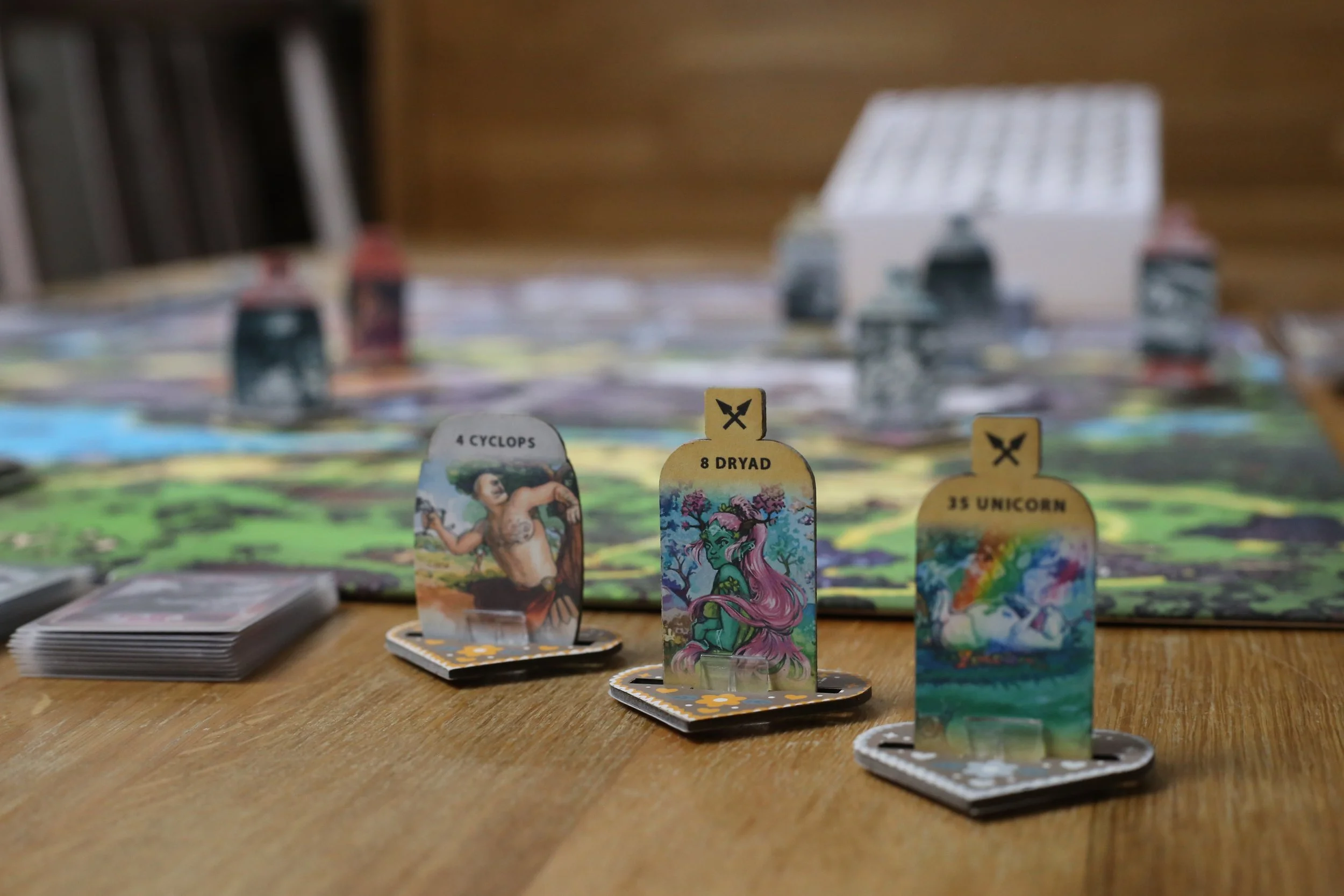
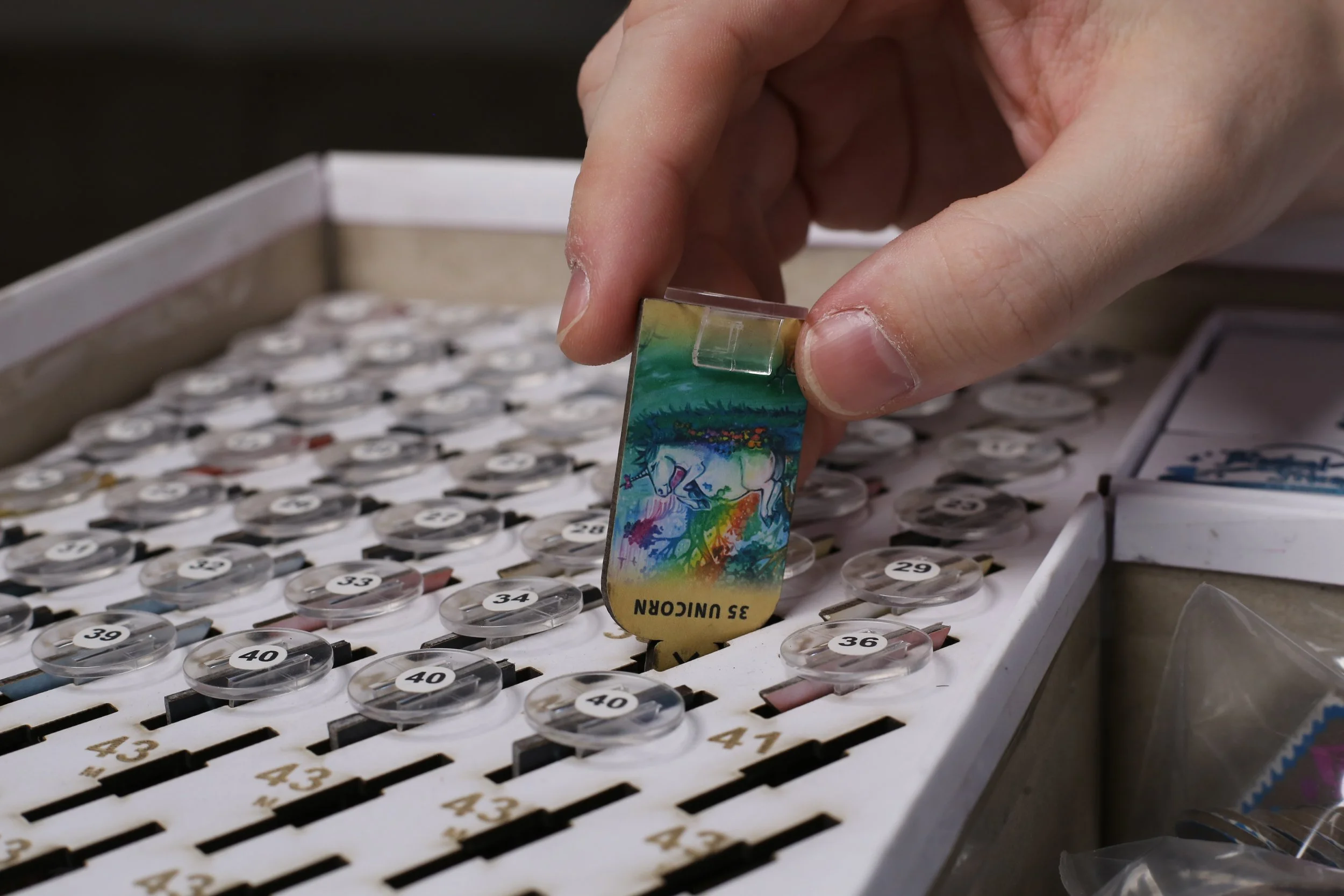
Depending on the components or the game setup, we rearranged the table and lighting countless times. It really helps to plan ahead which components you want to show from which angle, and to organize the photo sequence based on those angles. Constantly setting up and taking down the game board would waste a lot of time.
Even if everything is handmade, you shouldn’t underestimate the cost and effort. I spent about €55 on raw materials (though two‑thirds of that was from the copy shop). The time I needed to build everything: about three days. Most of that was due to the drying times of the spray adhesive. With bookbinding glue, the gluing process is much faster.
If you still have any questions, feel free to ask. I’m also very happy about any other feedback. That’s it for now regarding the prototype.
28 - When You Want the Prototype to Look Pretty … (Part 5: Cardboard Tokens / Markers / Standees)
28 - When You Want the Prototype to Look Pretty … (Part 5: Cardboard Tokens / Markers / Standees)
With my cardboard components, things get pretty difficult using regular tools. The shapes of my tokens are a bit more complicated than simple rectangles.
As you can already see, these shapes are much harder to cut out of cardboard with a knife — at least if you want them to still look nice afterward.
Unfortunately, the print quality for these cardboard pieces isn’t great. I used my home printer and sticker paper, but it’s good enough for a prototype.
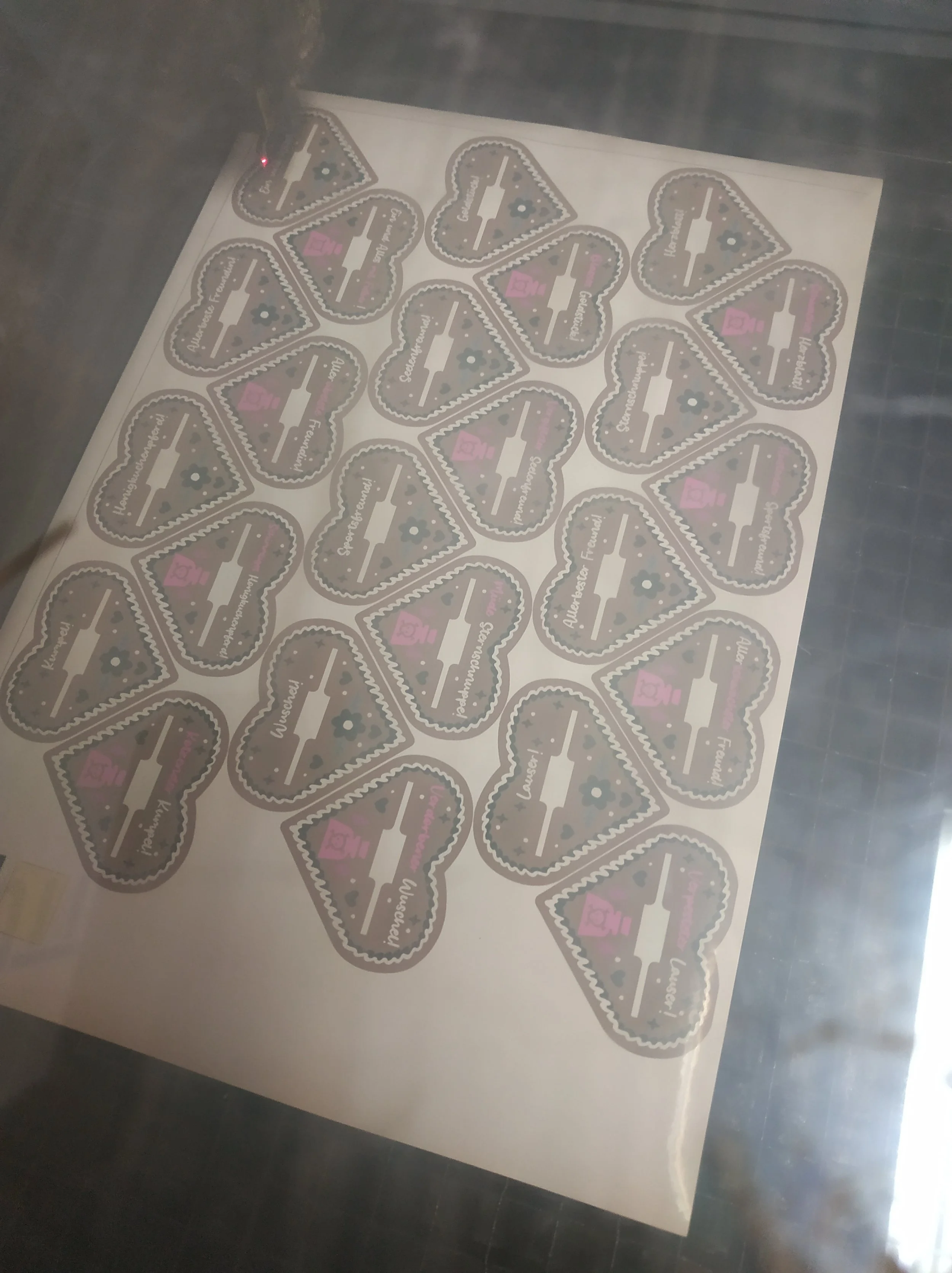
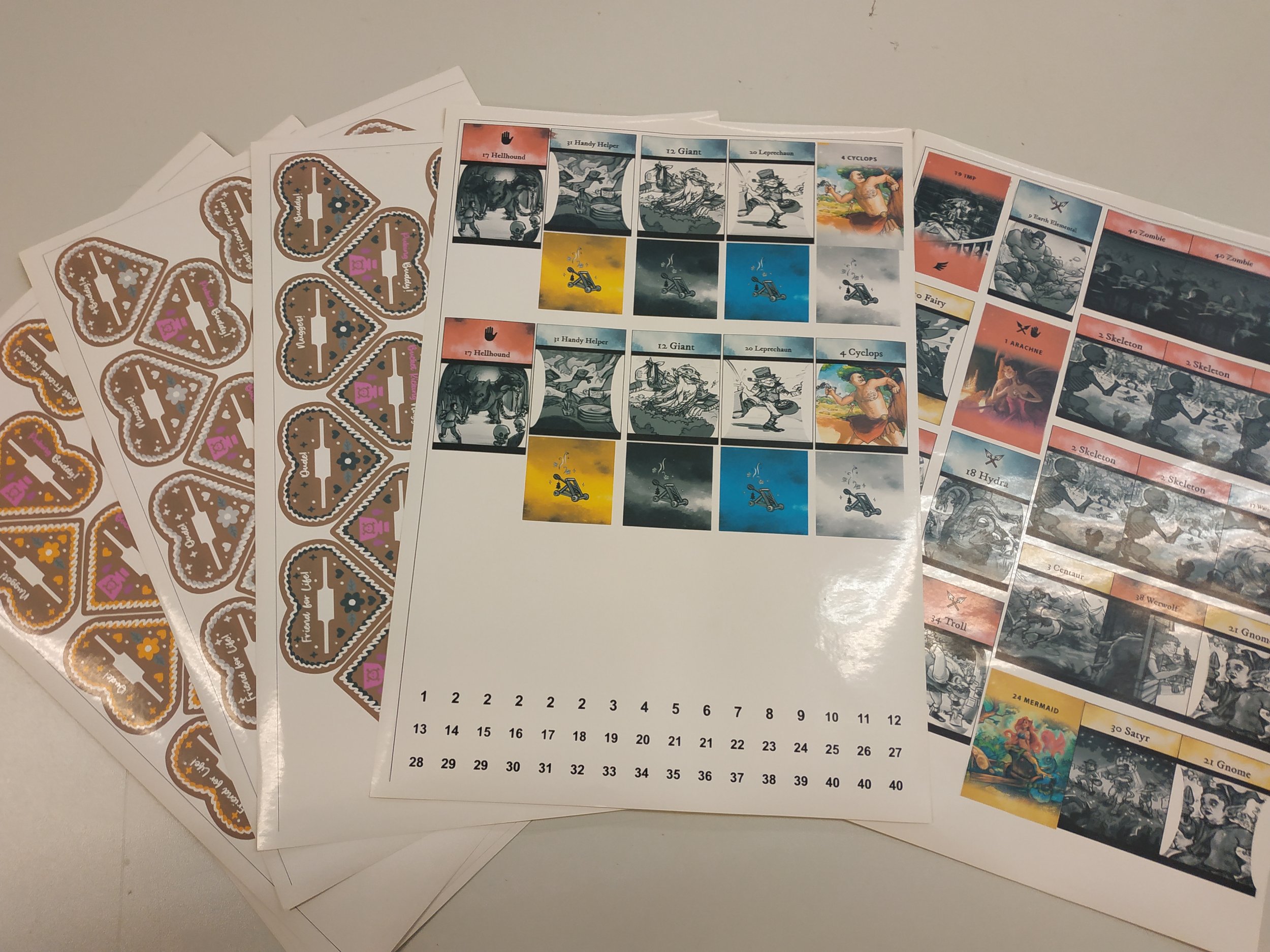
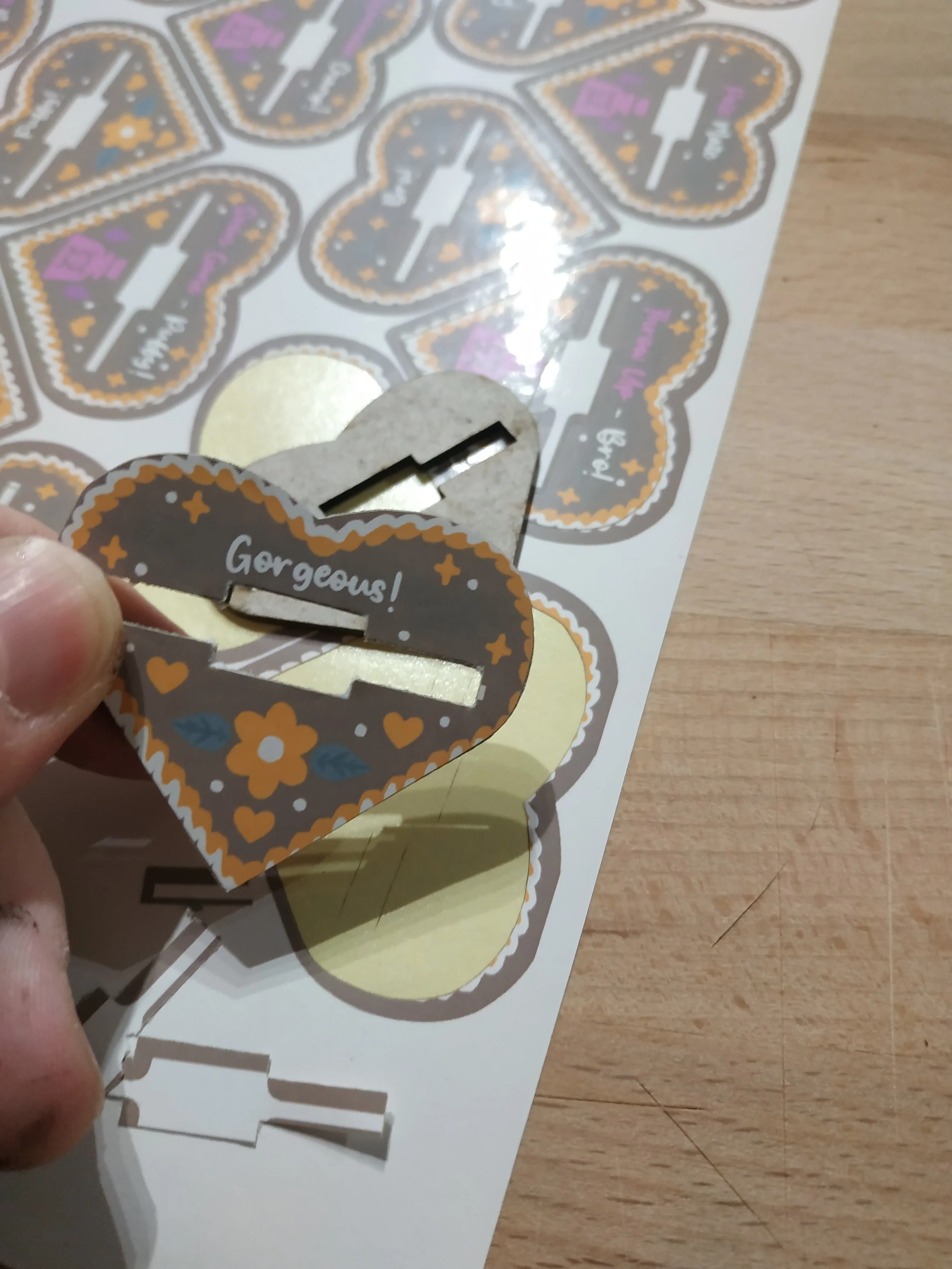
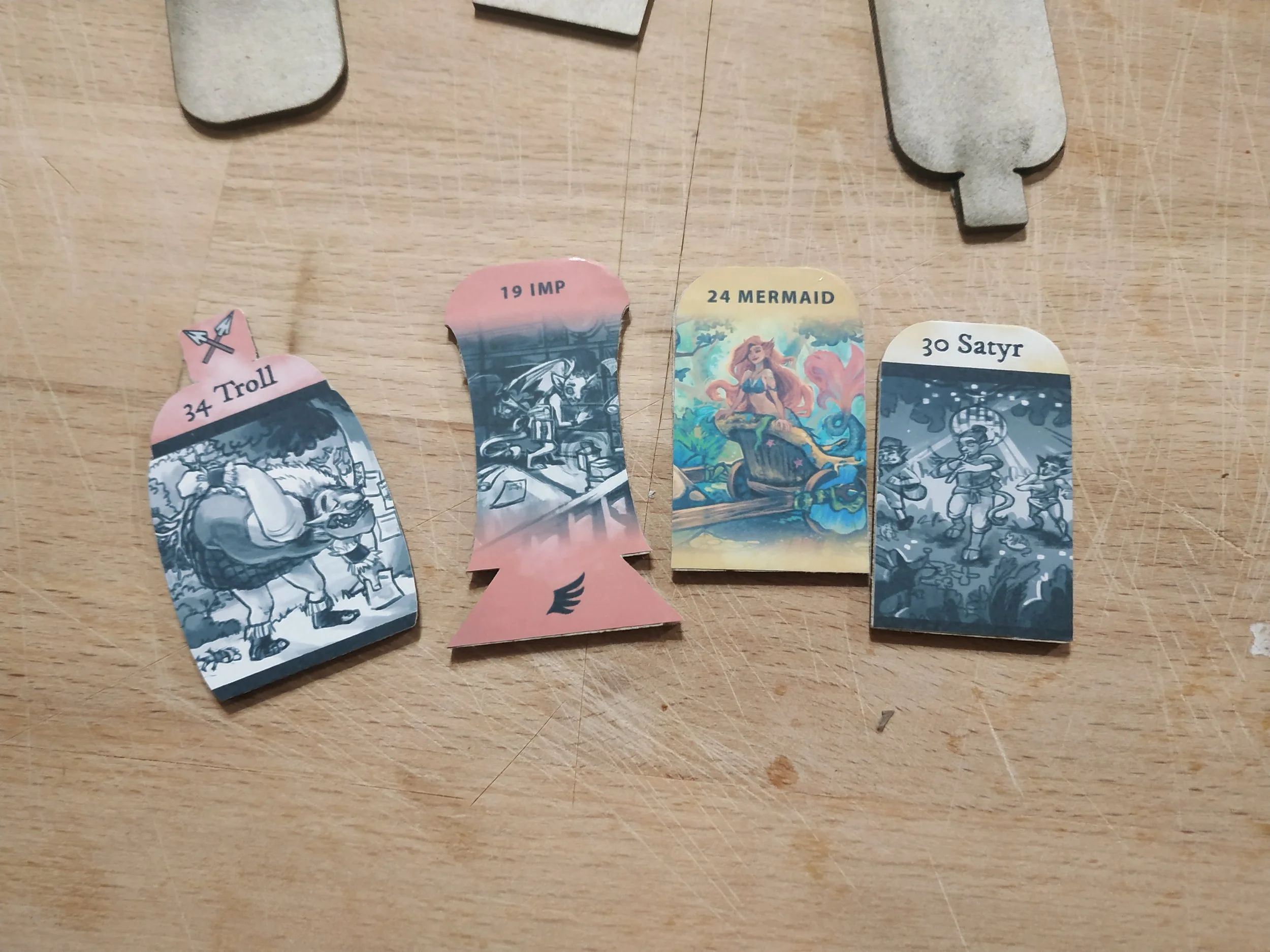
I cut both the cardboard pieces and the stickers with a laser cutter. Because of that, bleed and margin are important here as well. With these irregular shapes, bleed and margin are trickier, so we decided on a color gradient that still looks good even if it’s slightly misaligned. Even though the laser is very precise, I still have to align everything manually — and every tiny inaccuracy becomes noticeable.
After cutting, I simply stuck the stickers onto the cardboard. Yes, it’s tedious and takes a while, so it’s best to put on a show in the background. But the result is fairly precise and looks reasonably good.
2 mm cardboard is not easy to work with — a laser cutter helps tremendously. Do you have any other ideas on how to achieve something like this with a reasonable amount of effort? I’m open to suggestions.
27 - When You Want the Prototype to Look Pretty … (Part 4: Game Board)
27 - When You Want the Prototype to Look Pretty … (Part 4: Game Board)
There are certainly several ways to print and mount a game board. For some reason, I wanted to make mine in four parts so that every edge would be overlapped and therefore more stable.
If you do it the way I did, you really need to think carefully about where and in which direction the board will fold. On the edges where the board sections connect, I extended the flap to create more gluing surface. When dividing the artwork, I also had to make sure the images lined up cleanly at the edges. The artwork should always extend slightly beyond the cut line (I used 1–2 mm). If you don’t manage to glue the artwork on perfectly, you’ll end up with white edges — and that doesn’t look very nice. As far as I know, preparing files for actual production is much easier.
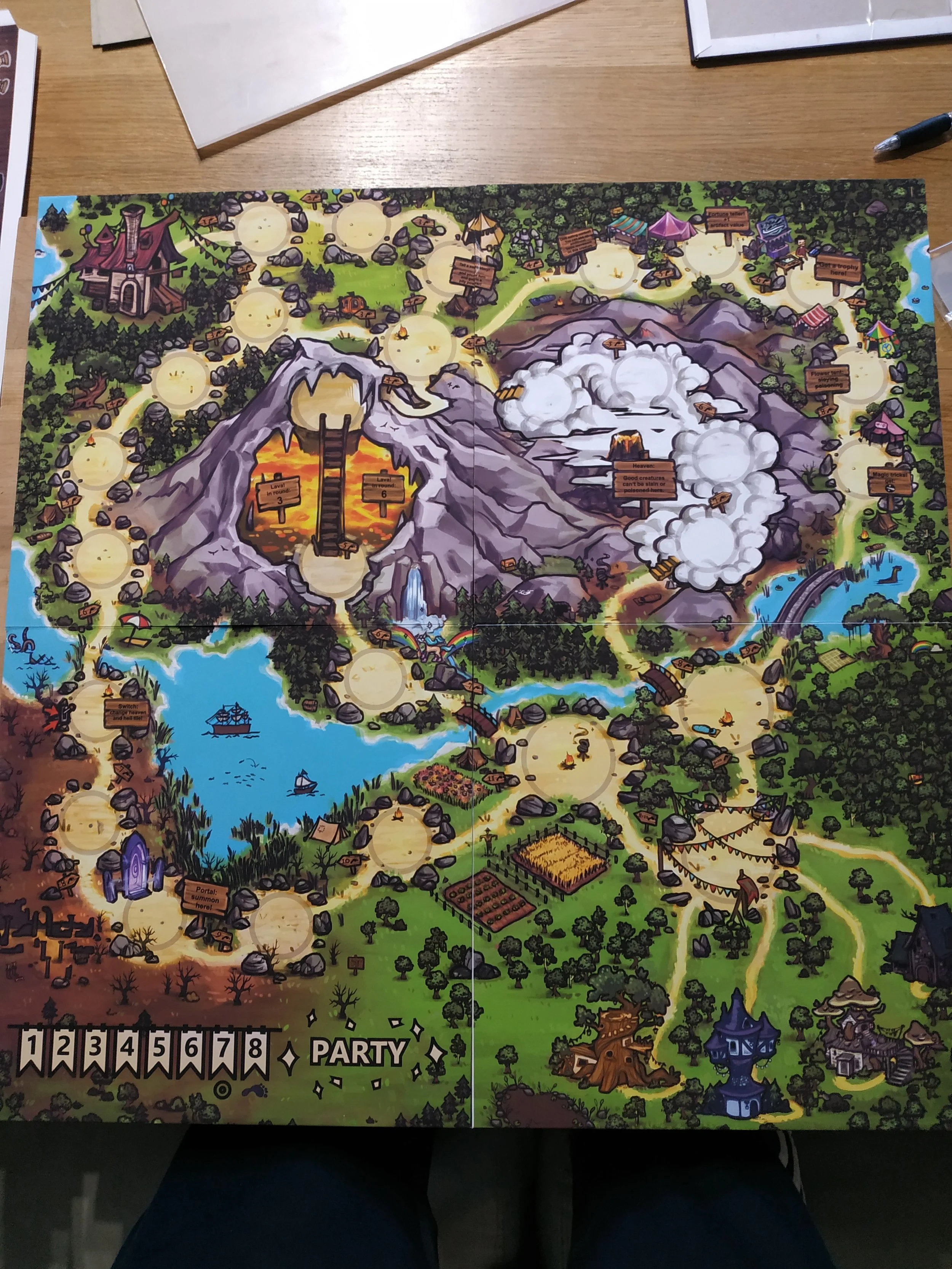
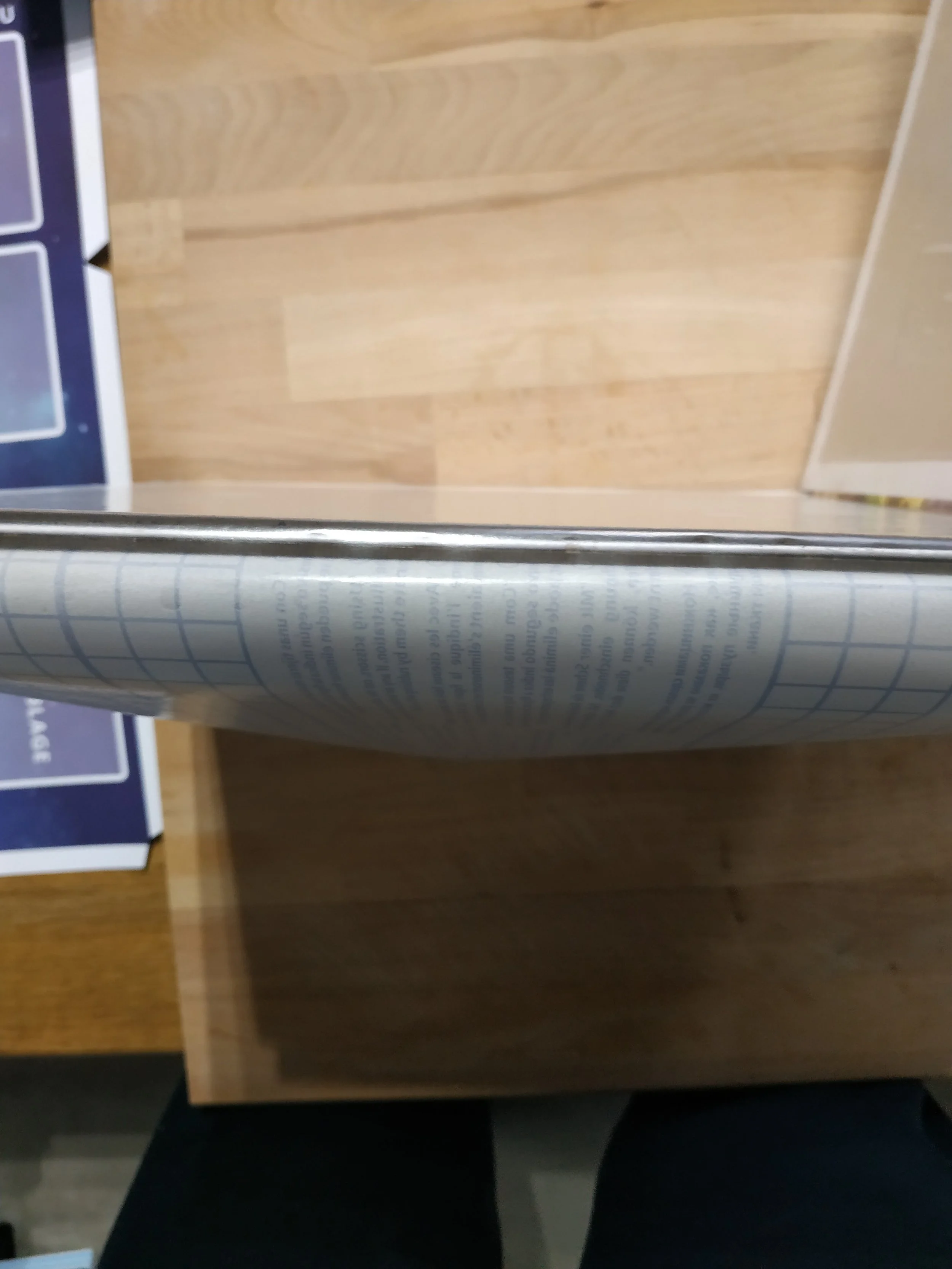
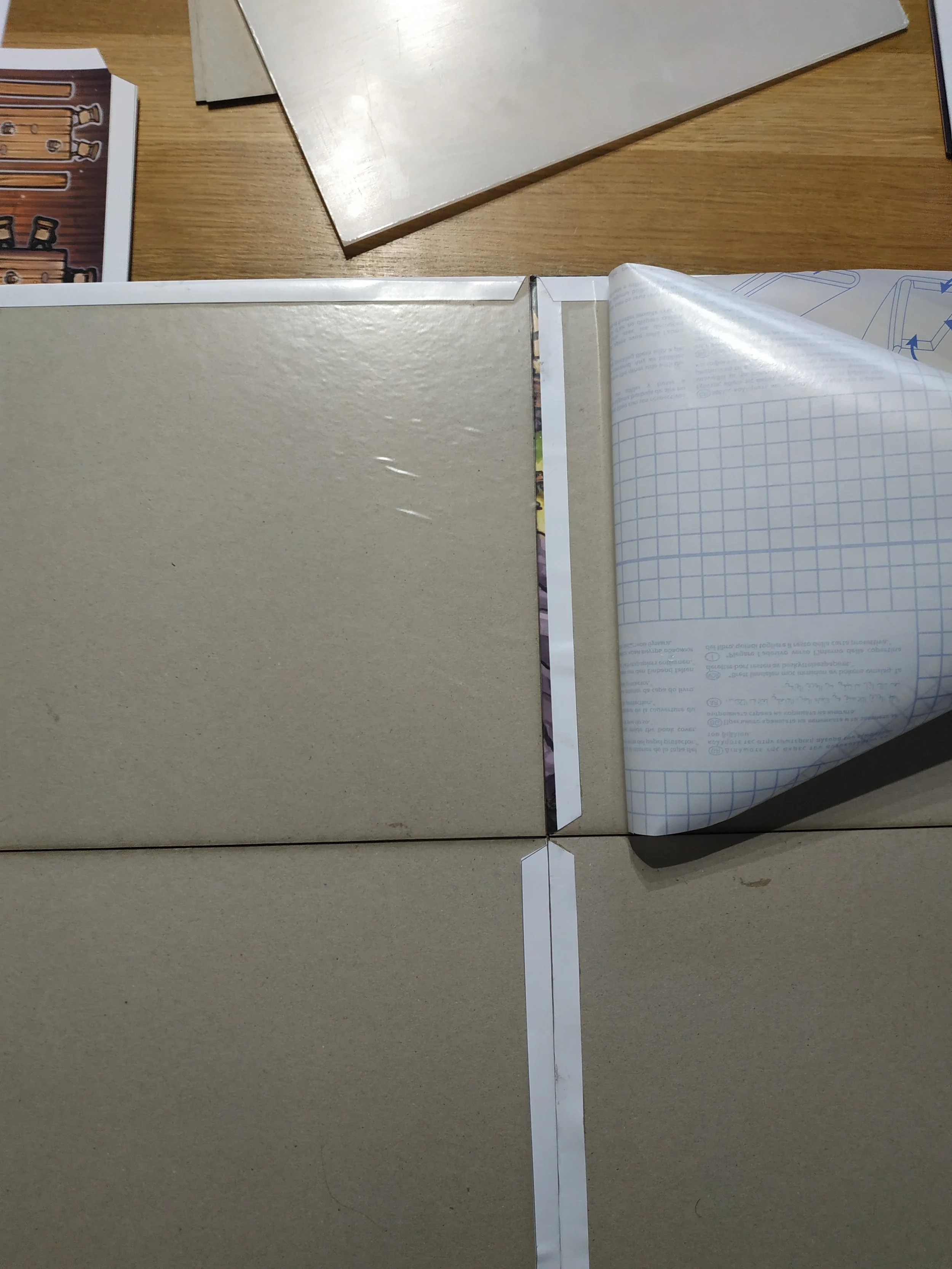
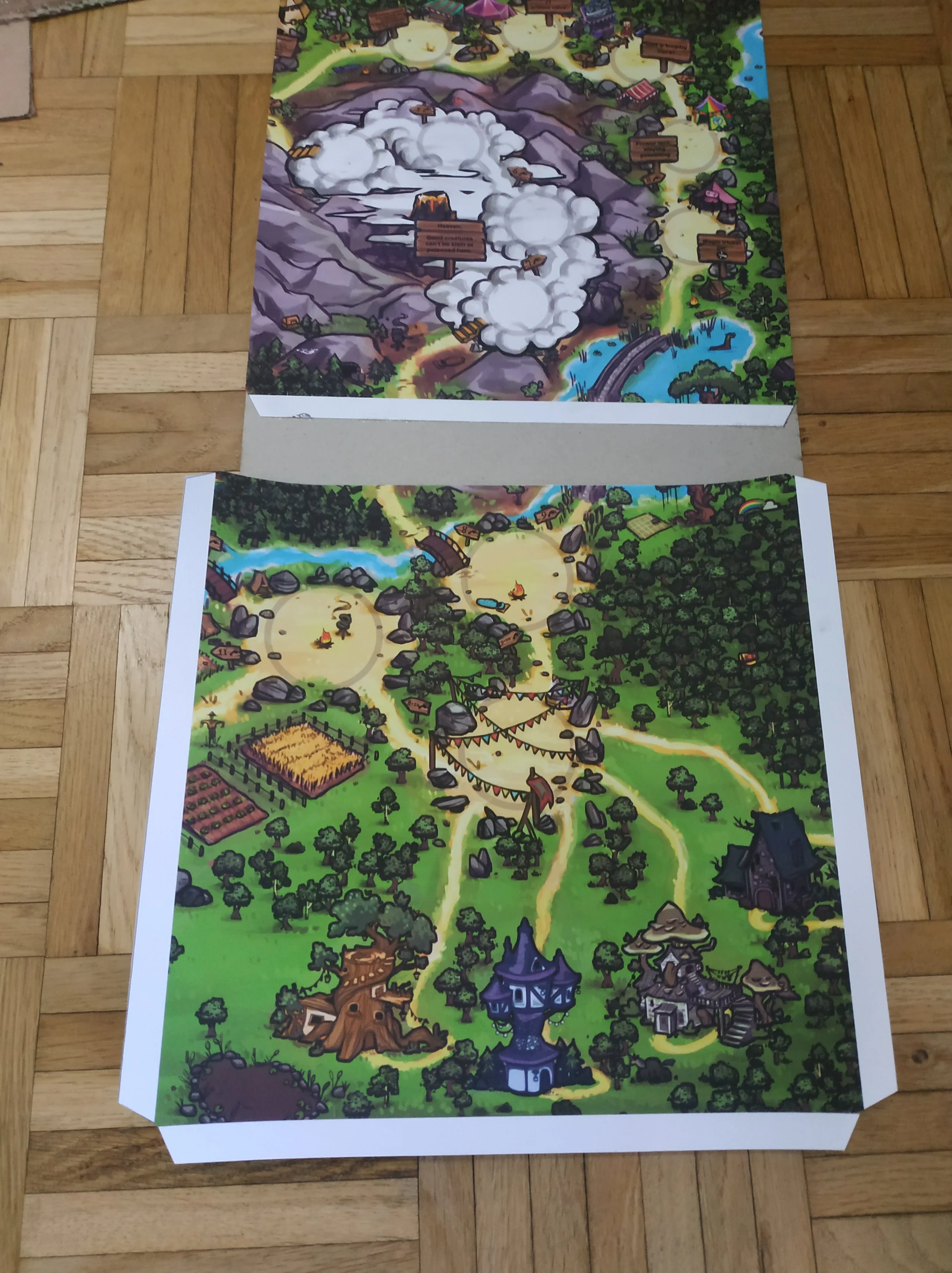
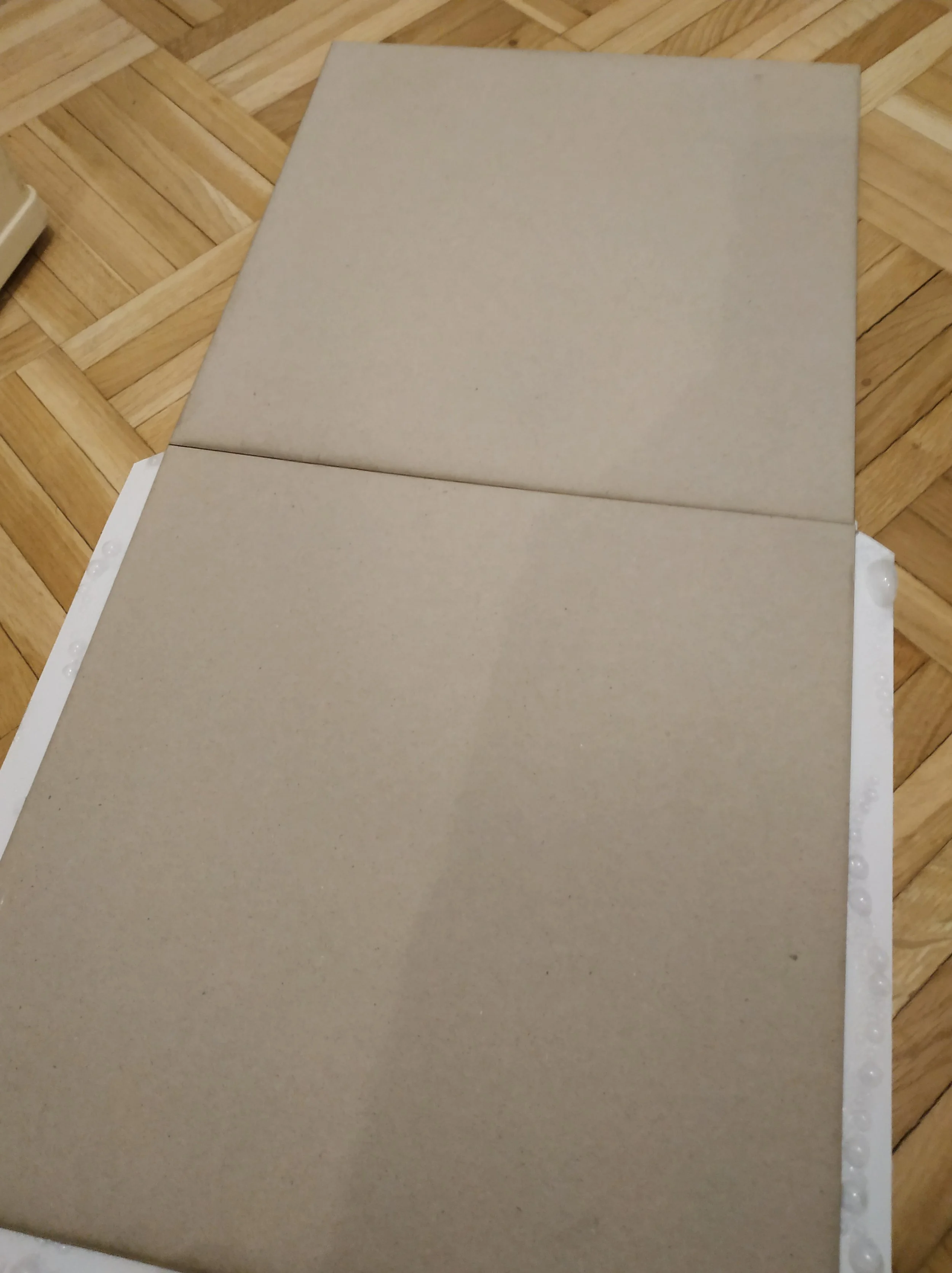
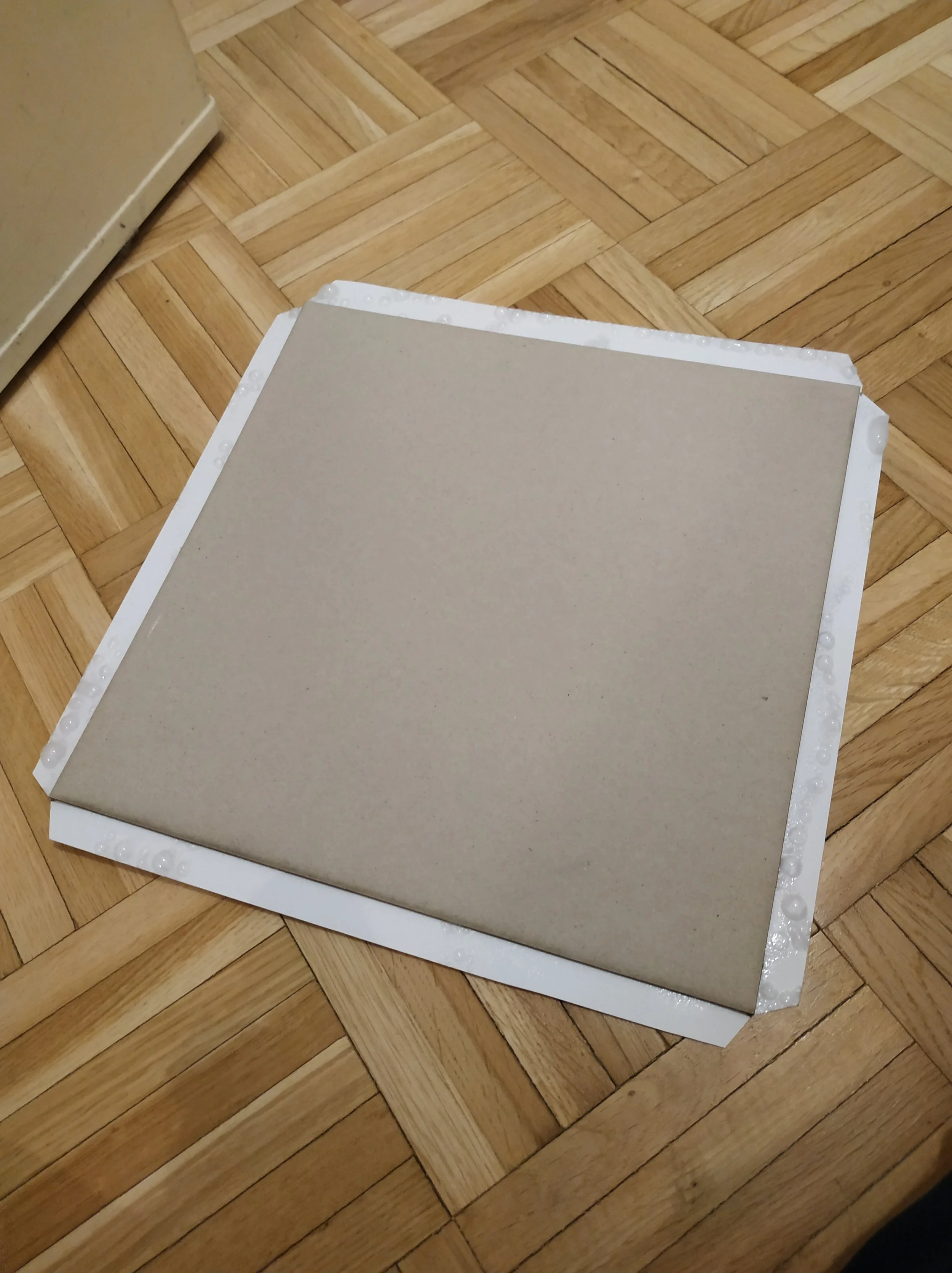
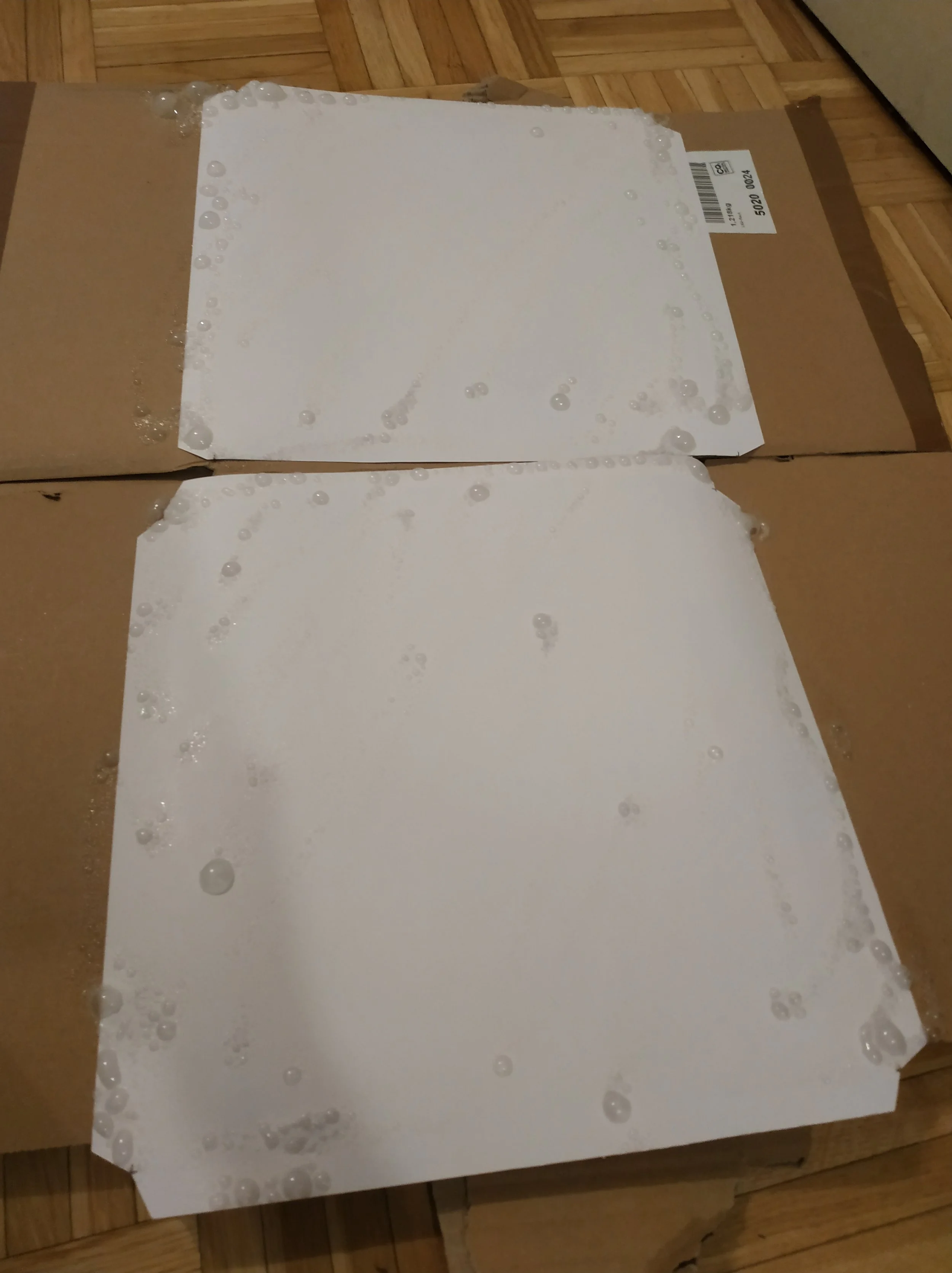
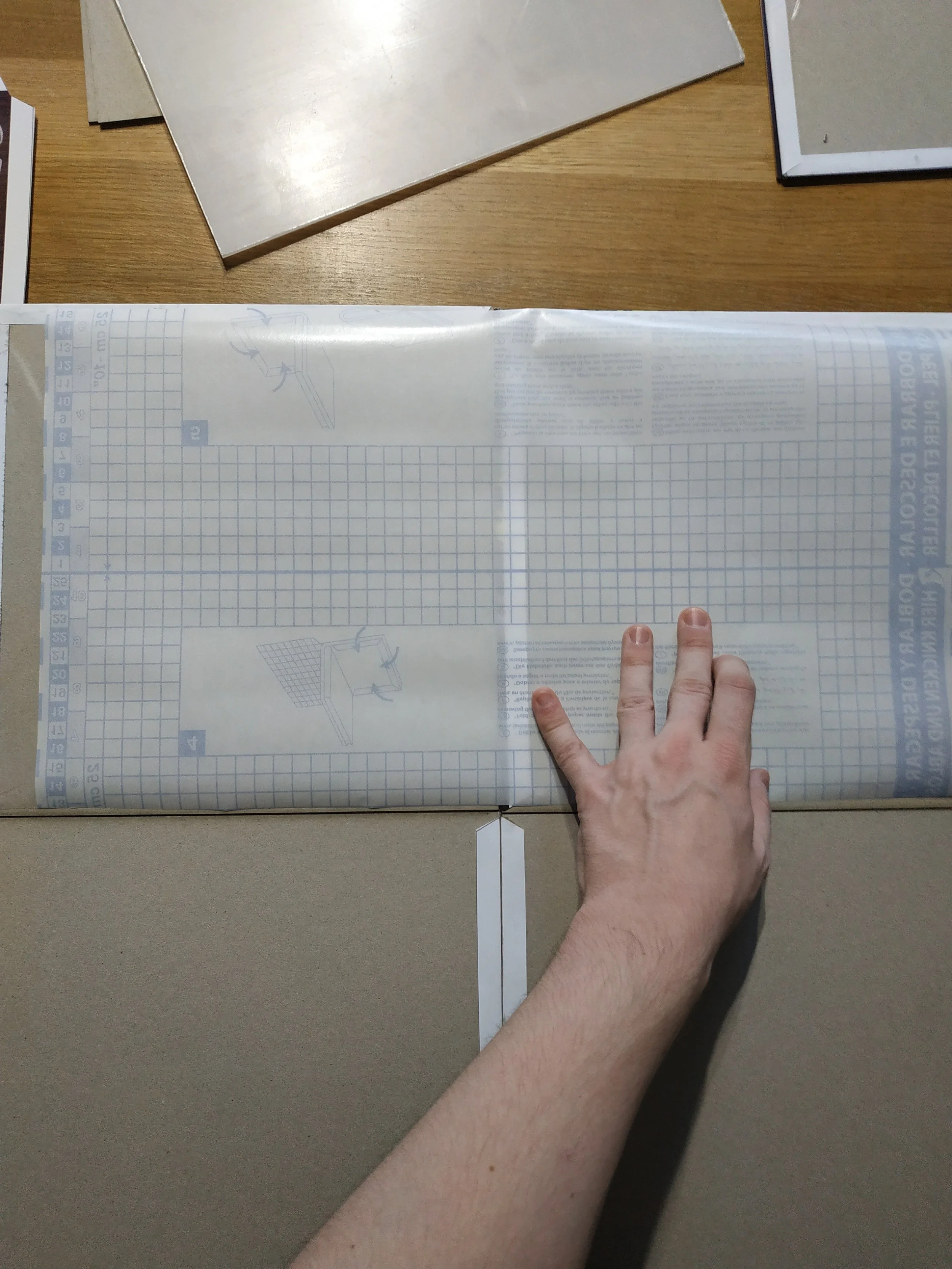
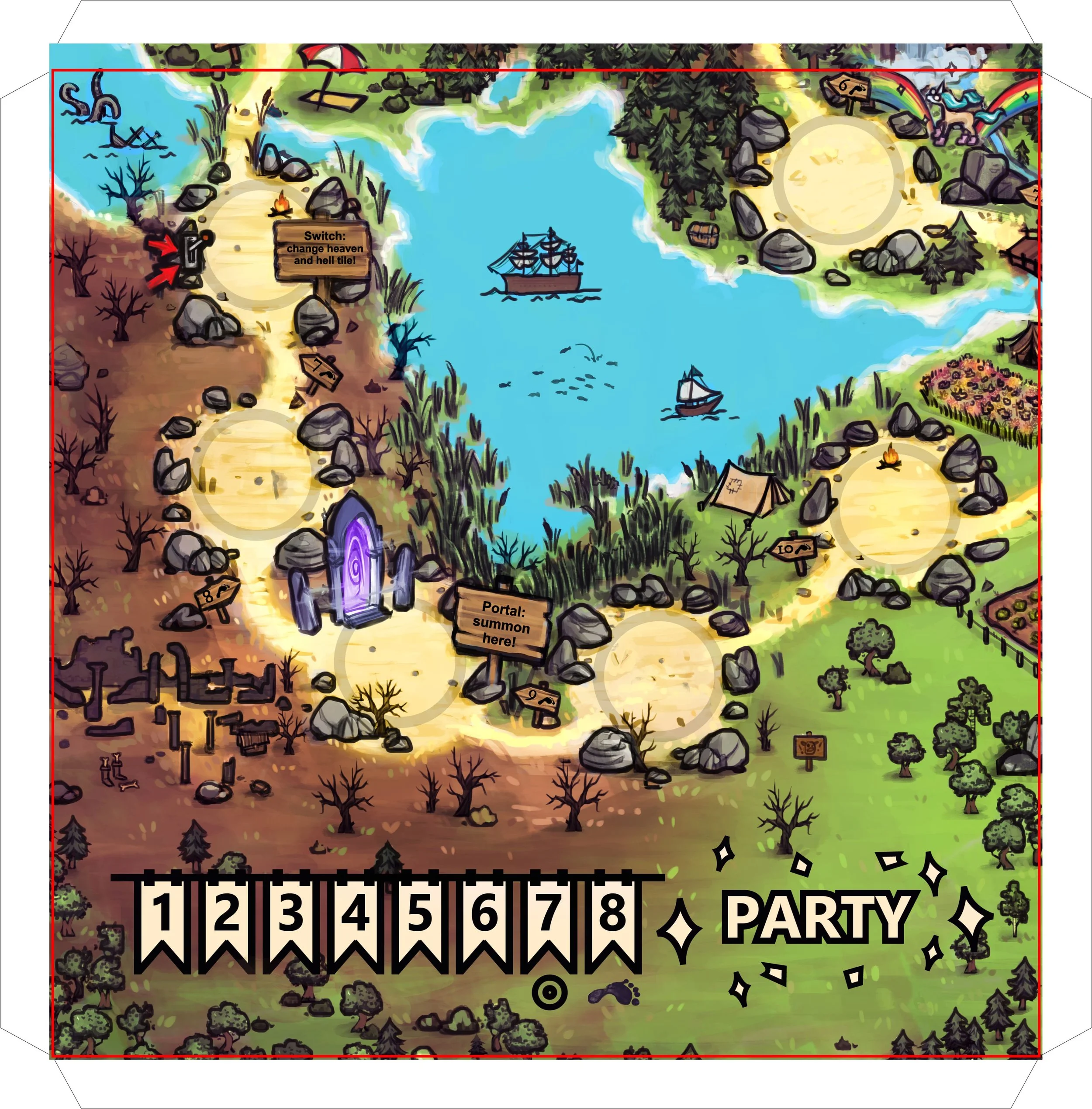
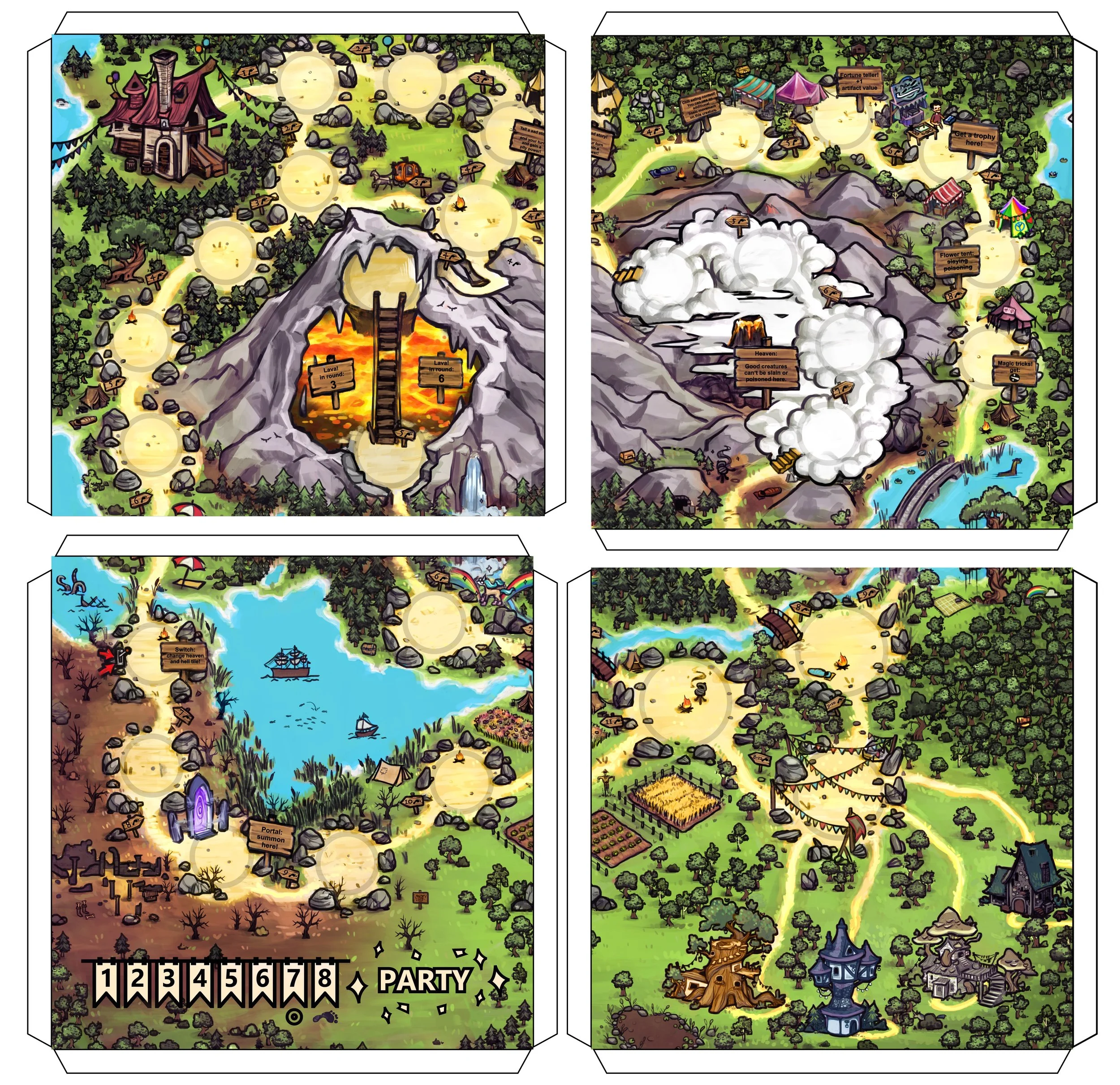
I sprayed the back of the prints with spray adhesive again and carefully glued the first cardboard piece in place. Then I aligned the next piece along the correct edge, glued it down, and let it dry. After that, I glued the next print over it. For later prototypes, I switched to bookbinding glue, and both the process and the results were much better.
On the back, I reinforced the board with book-cover film. This strengthens the folding edges and also supports the edge that folds in the opposite direction. Otherwise, the board wouldn’t hold together. It’s important to glue the edges correctly — if a section is meant to fold, the film must be glued across the fold (see image 3).
Overall, I’m very happy with the result. If you look closely, you can tell the board is handmade, but it looks good, is sturdy, and feels nice. You get a reliable impression of the material, which was the whole point.
I’m sure you can think of other ways to build a game board like
26 - When You Want the Prototype to Look Pretty … (Part 3: The Box)
26 - When You Want the Prototype to Look Pretty … (Part 3: The Box)
Crafting a nice box is definitely more difficult than cutting out playing cards. But once you finally hold it in your hands, it’s an amazing feeling.
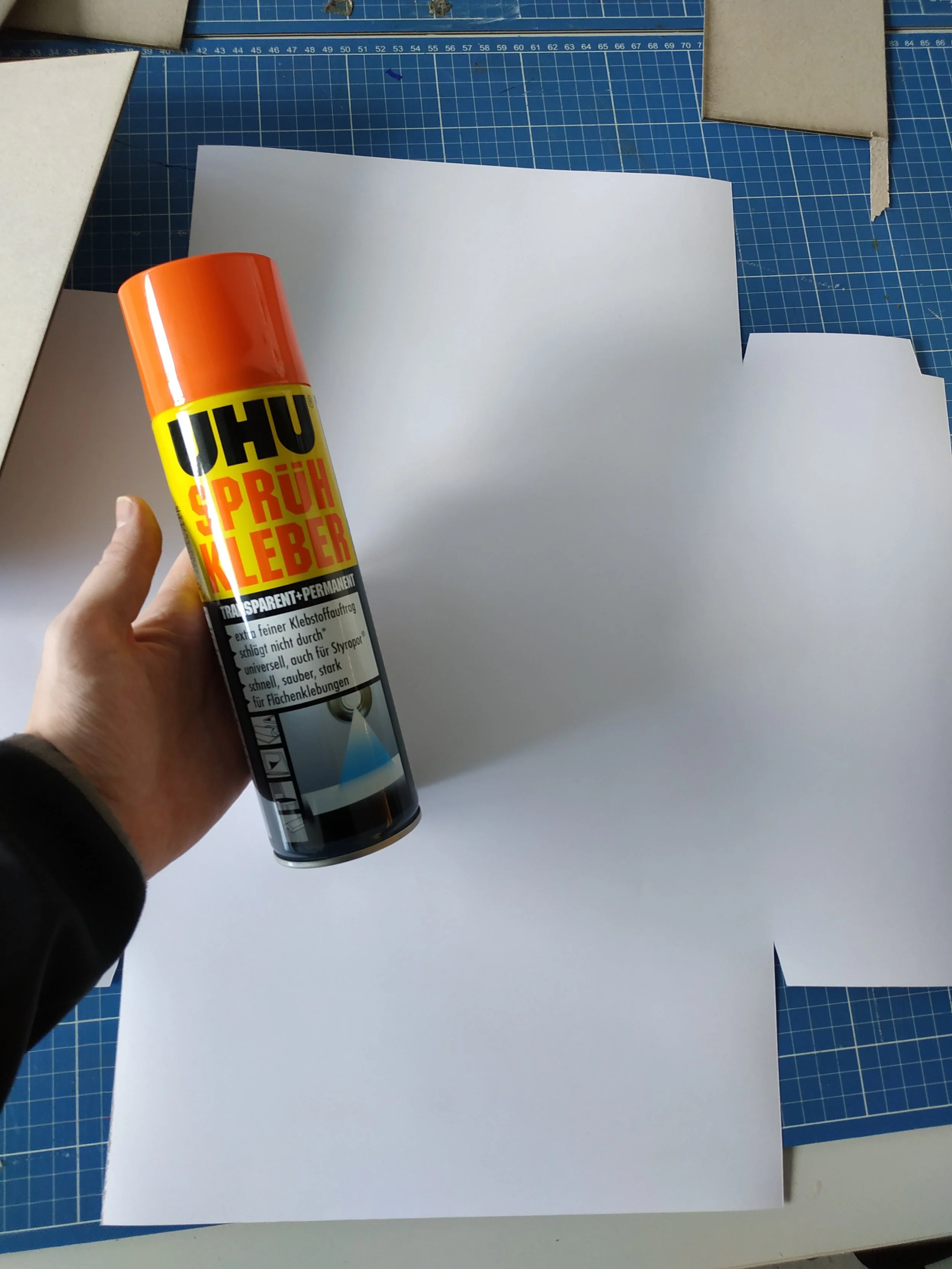
Usually, a game box is made by gluing printed paper onto cardboard. As mentioned in the first part of this series, I used 160 g poster paper for this. Slightly heavier paper is important because the corners of the box are held together only by the glued paper. The lid should be larger than the bottom. With 2 mm cardboard plus 160 g paper, I added a total of 7 mm to the lid’s dimensions.
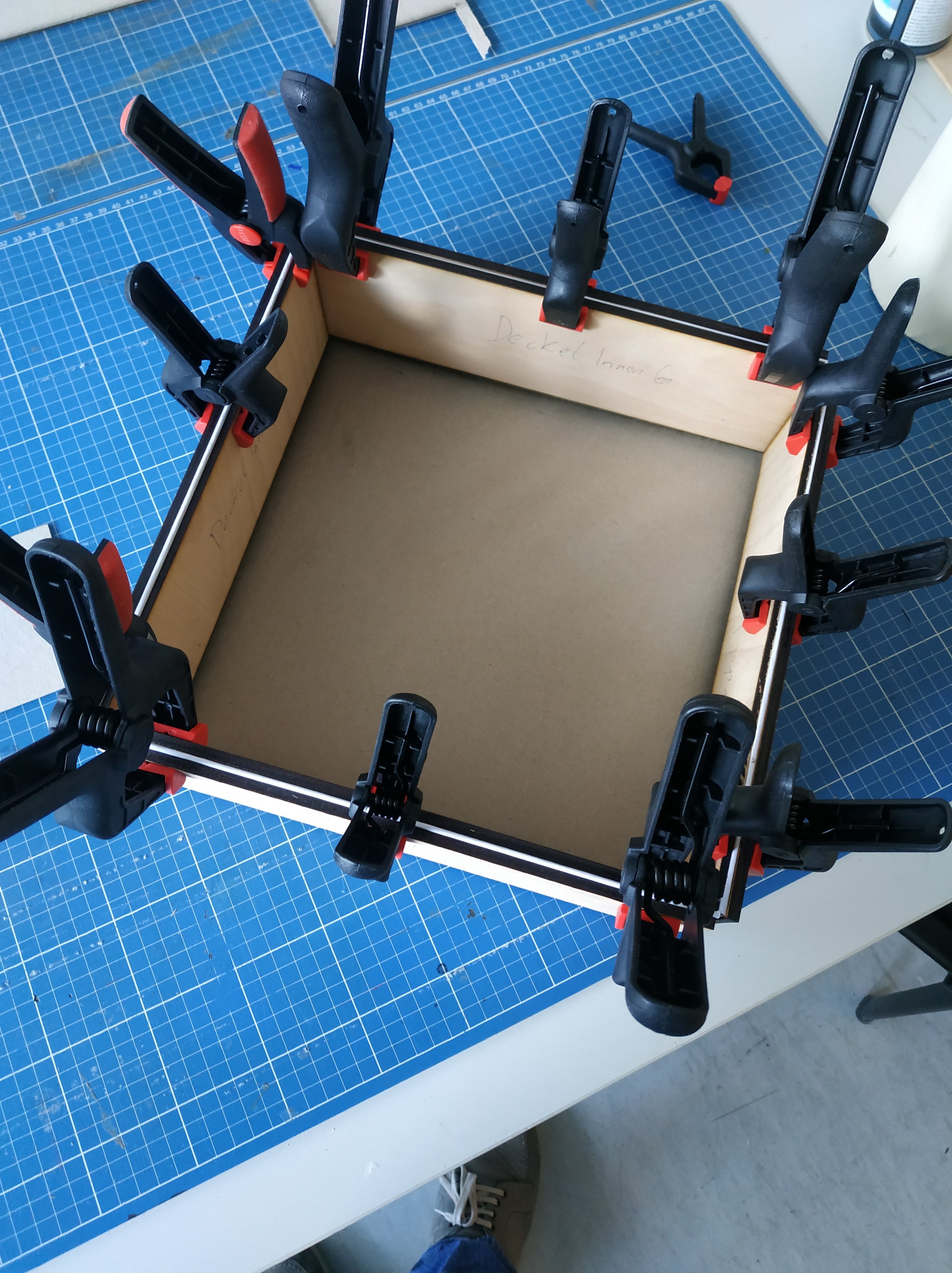
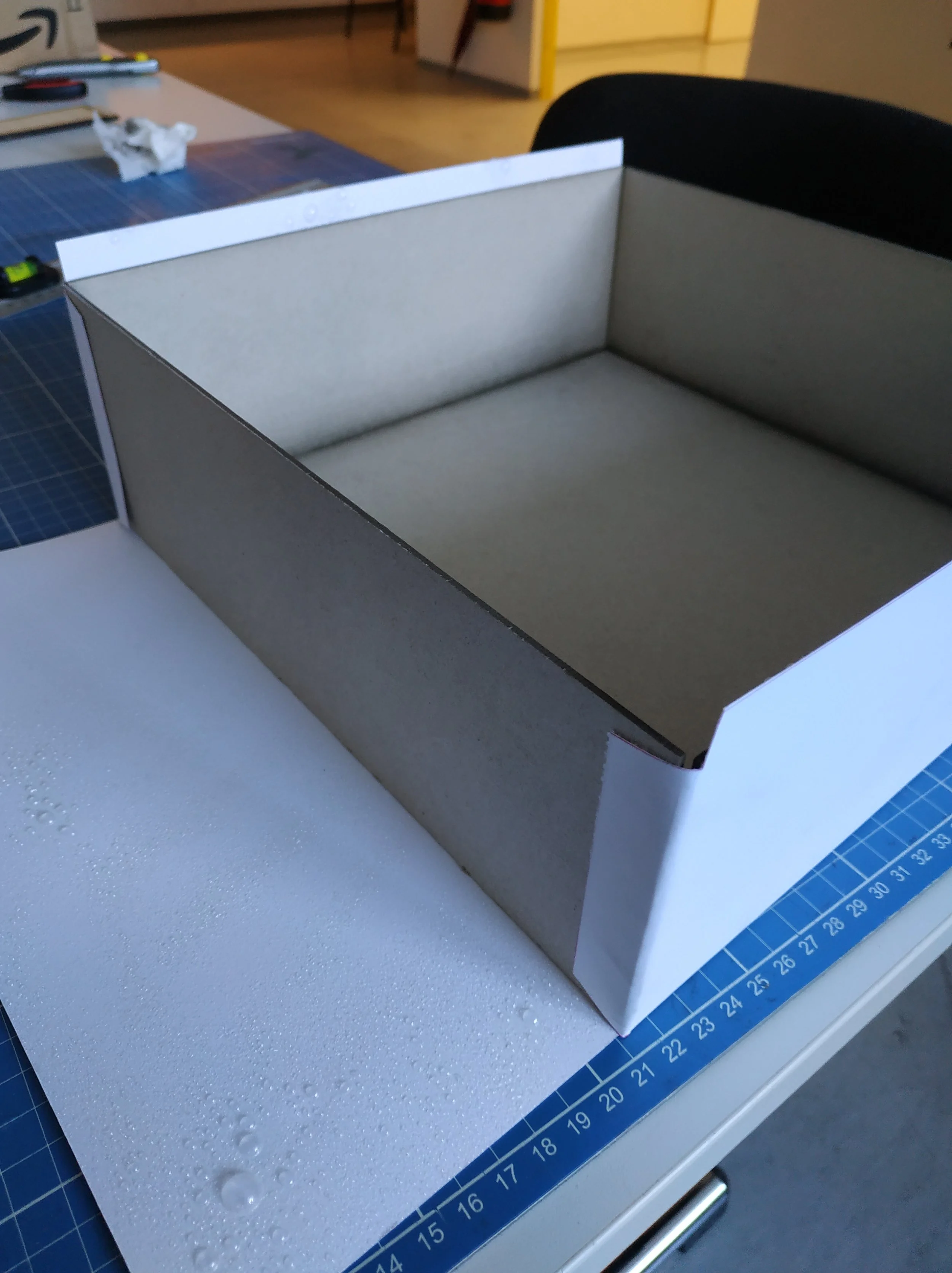
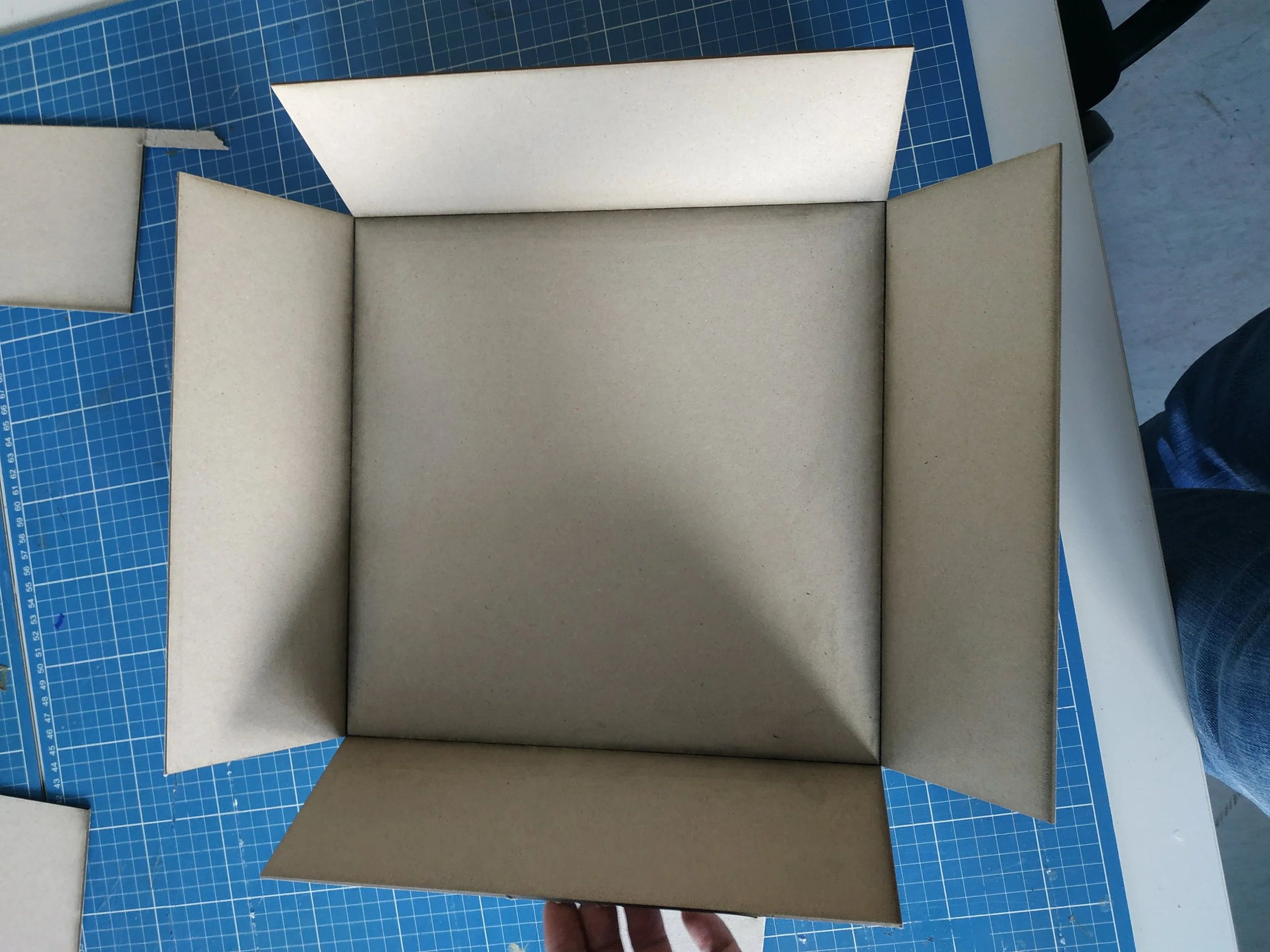
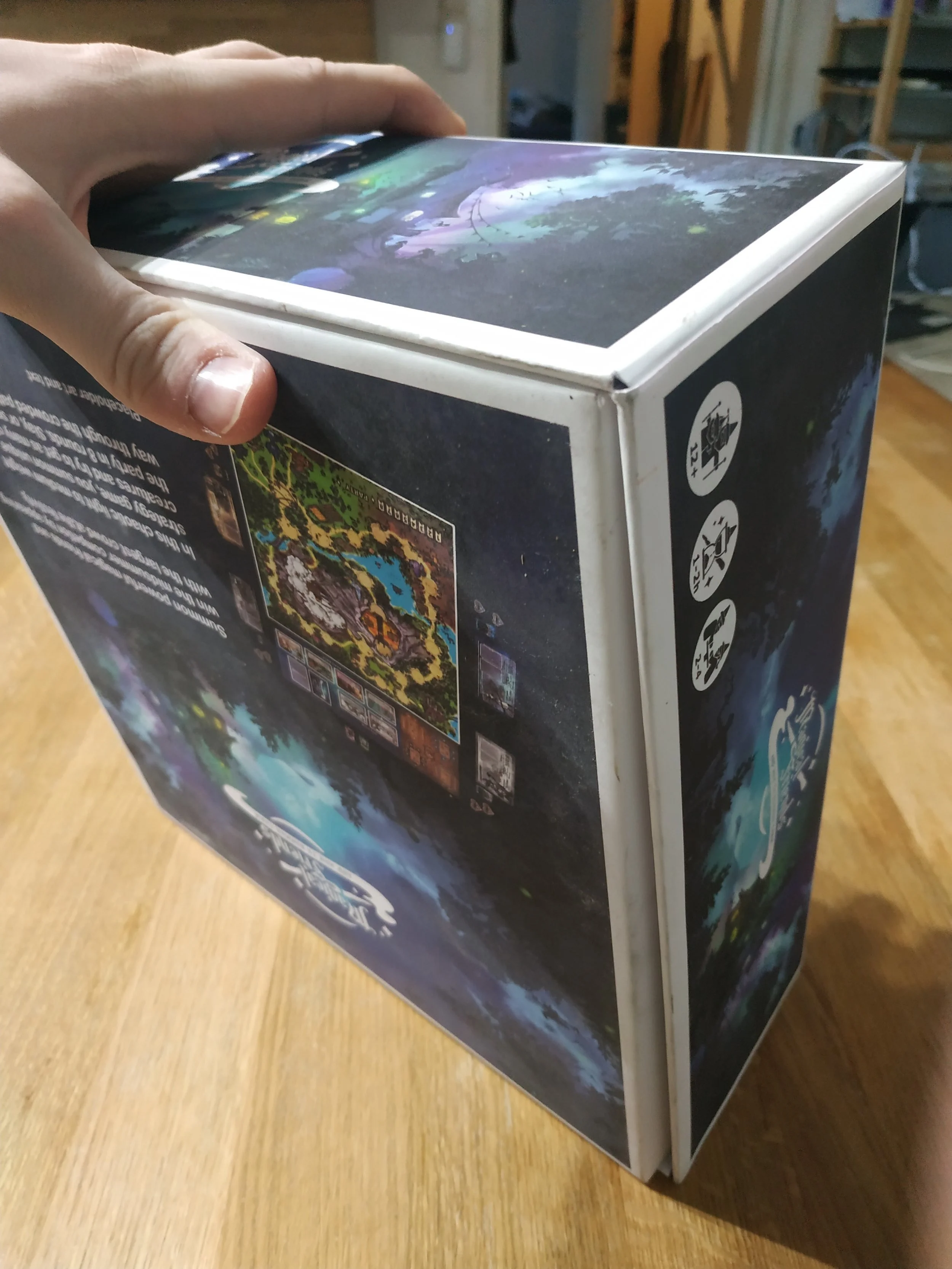
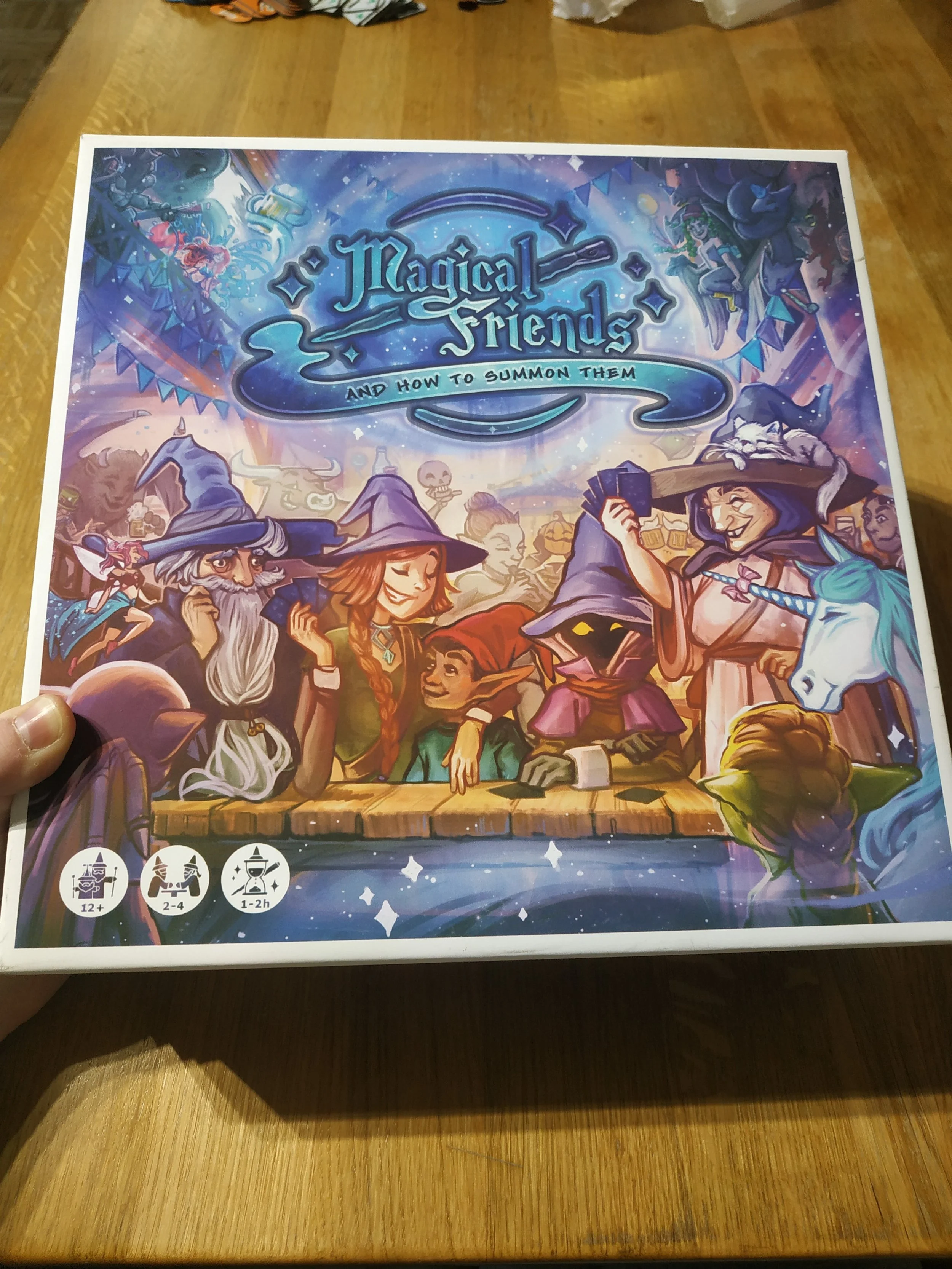
I use 2 mm greyboard. I cut the cardboard using a laser cutter at an open workshop in Salzburg. Along the fold lines, I lightly engraved the material so the board could be bent 90°. Of course, I know not everyone has access to a laser cutter. The cardboard can also be cut with a sharp knife. The box flaps can be cut out and glued manually as well — the paper will hold the flaps together.
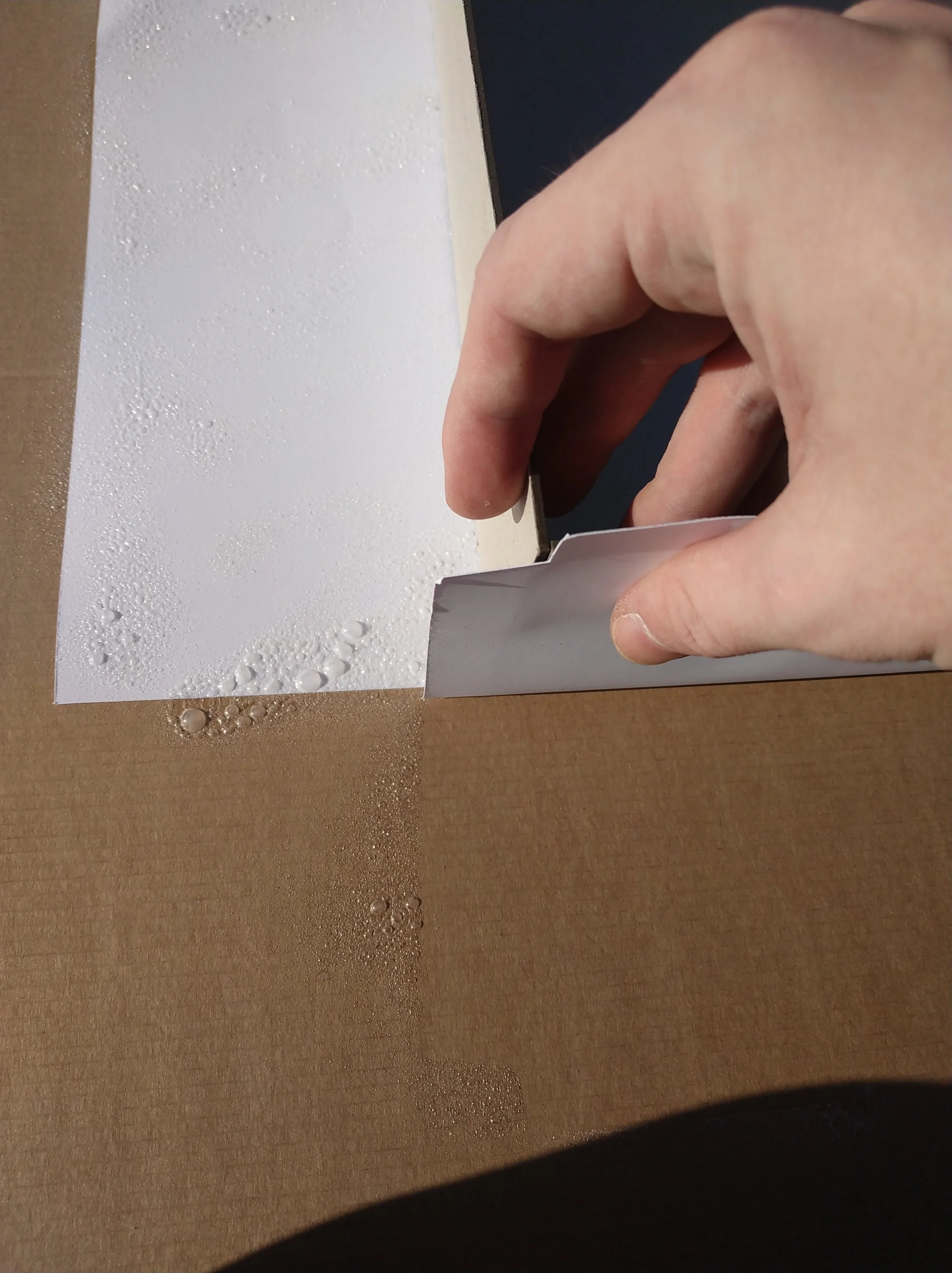
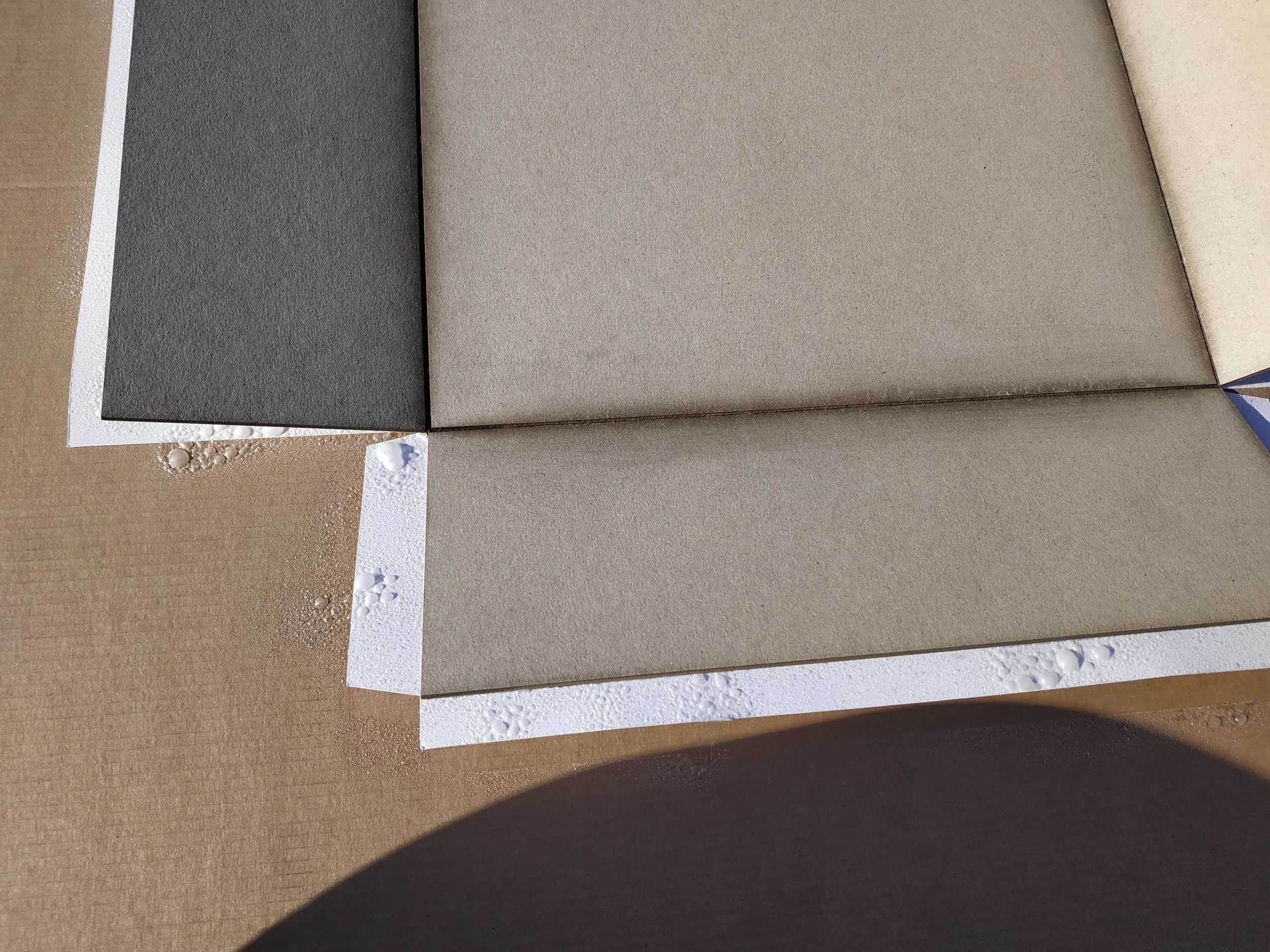
I sprayed the back of the cover paper with spray adhesive, placed the cardboard in the center, and pressed it down firmly. I used the corners of the cardboard as alignment points. You need to be careful here, because not all flaps should touch the glued paper immediately. First, press down the sides where the corner‑flaps are attached. These corner‑flaps should be glued to the adjacent sides at a 90° angle before being glued down under the outer paper layer. After that, the sides should be pressed well and left to dry.
I’m very happy with how the box turned out, but spray adhesive is not pleasant to work with. You have to be careful not to get glue residue on the print, and it takes a long time to dry. Spray adhesive is also not ideal during winter months, since it shouldn’t be used in cold environments. For the remaining eight prototypes I made for shipping, I used bookbinding glue instead. Using bookbinding glue was much more pleasant, and the results were far better. Press once firmly, and the bond holds very quickly. If you ever make your own boxes, I would absolutely recommend bookbinding glue!
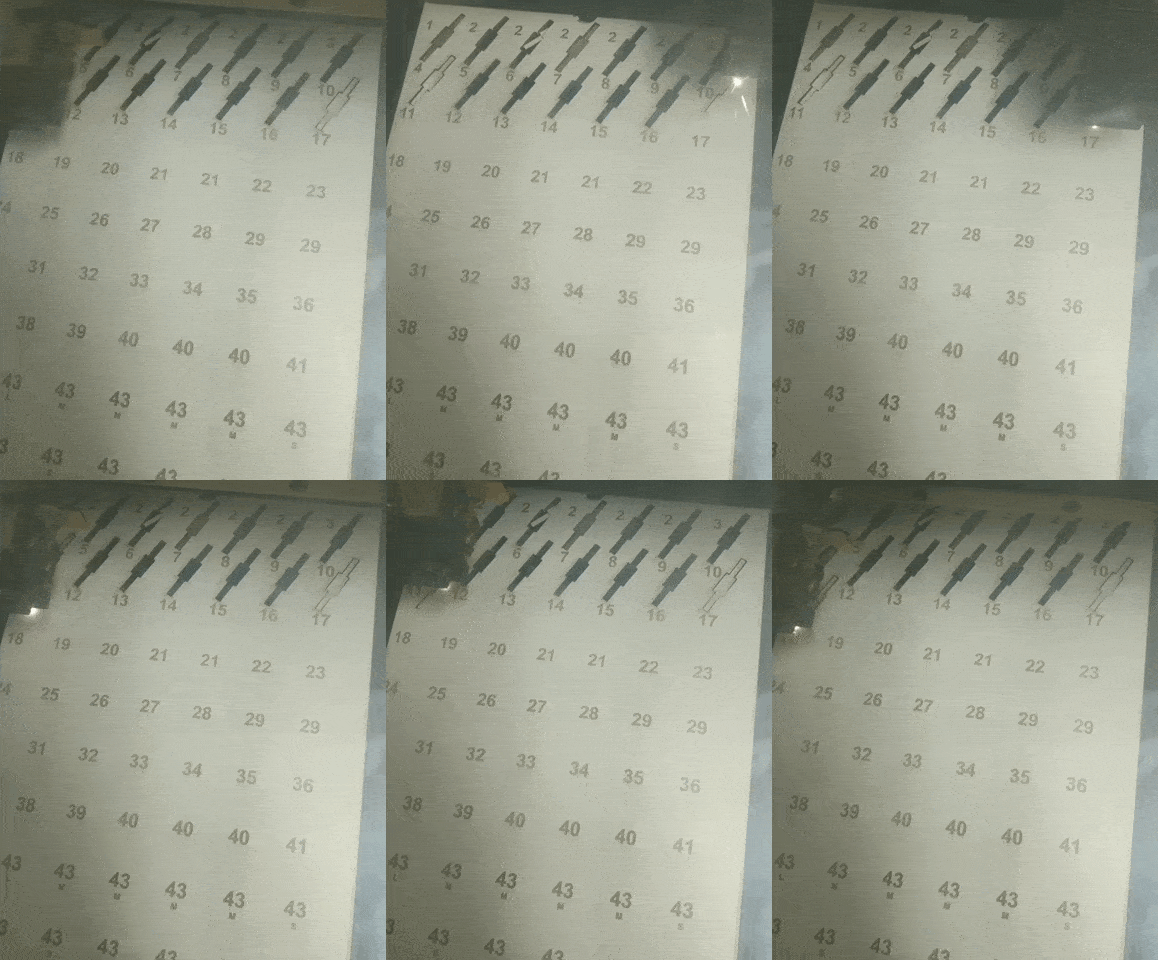
I made my special insert for the cardboard standees the same way as the box, but additionally engraved and cut it with the laser cutter. I’m afraid that part would be difficult to do without one. But not everyone needs such an insert. I didn’t pre‑print and cut it because I couldn’t align the print cleanly with the cutouts otherwise.
A word of caution: at least with my print, the surface is not very water‑resistant. A single drop is enough to make the colors run. I sprayed a thin layer of clear matte varnish over the box so that a splash of water wouldn’t immediately ruin the artwork.
There are certainly many different ways to build boxes like this, even if you use the same materials. I’m always open to tips and suggestions for improvement. Just leave me a comment.
25 - When You Want the Prototype to Look Pretty … (Part 2: Cards)
25 - When You Want the Prototype to Look Pretty … (Part 2: Cards)
Handmade playing cards can look surprisingly professional very quickly. There’s not much magic behind it. What you’ll notice most are poor print quality and paper that’s too thin — which is why I went to the copy shop.
For my cards, I only added bleed to the back side, since I cut the fronts by hand anyway. That way, the front stays nicely centered. If it’s important in your game that card backs are indistinguishable, I would definitely do it the other way around.
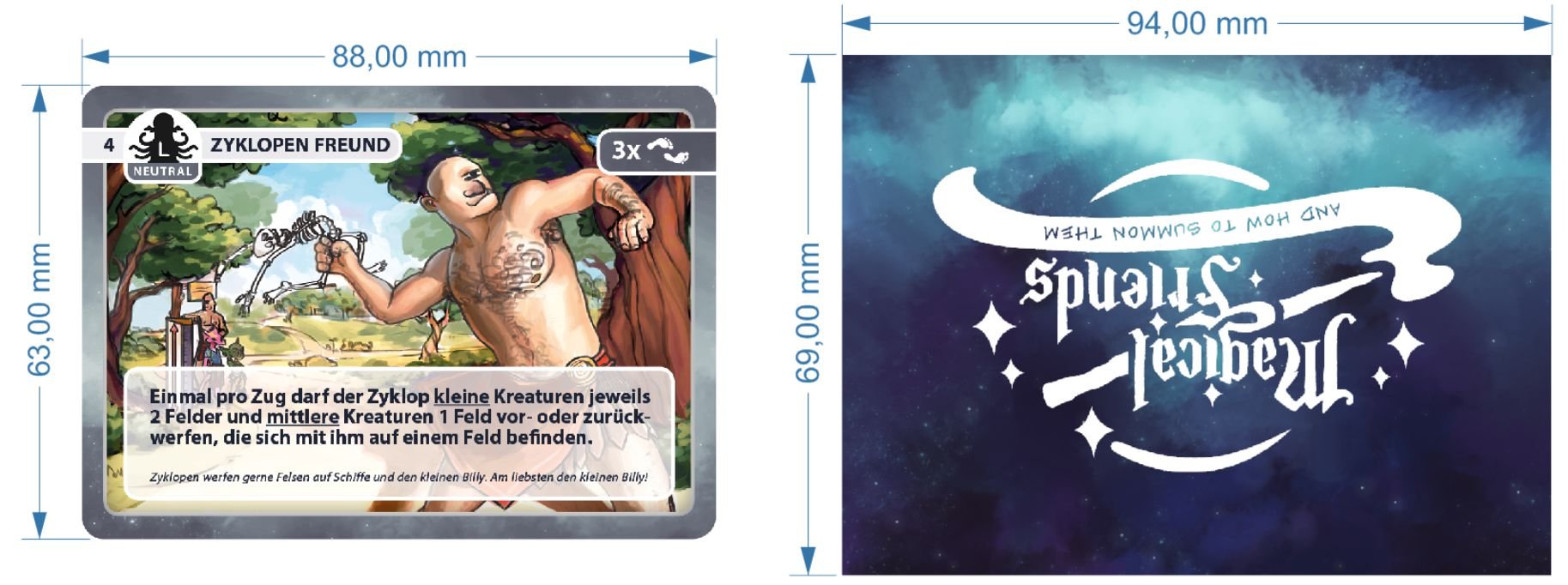
And don’t forget to rotate the card backs correctly!
As mentioned before, I cut the cards by hand. Whether you use scissors or a knife, it needs to be sharp. With my paper and print quality, the color can sometimes crack along the edges if the blade isn’t sharp enough, and that doesn’t look good.
For the corners, I used a corner rounder. It makes the rounded edges look much nicer. These tools aren’t expensive (though I wouldn’t buy the same model again).
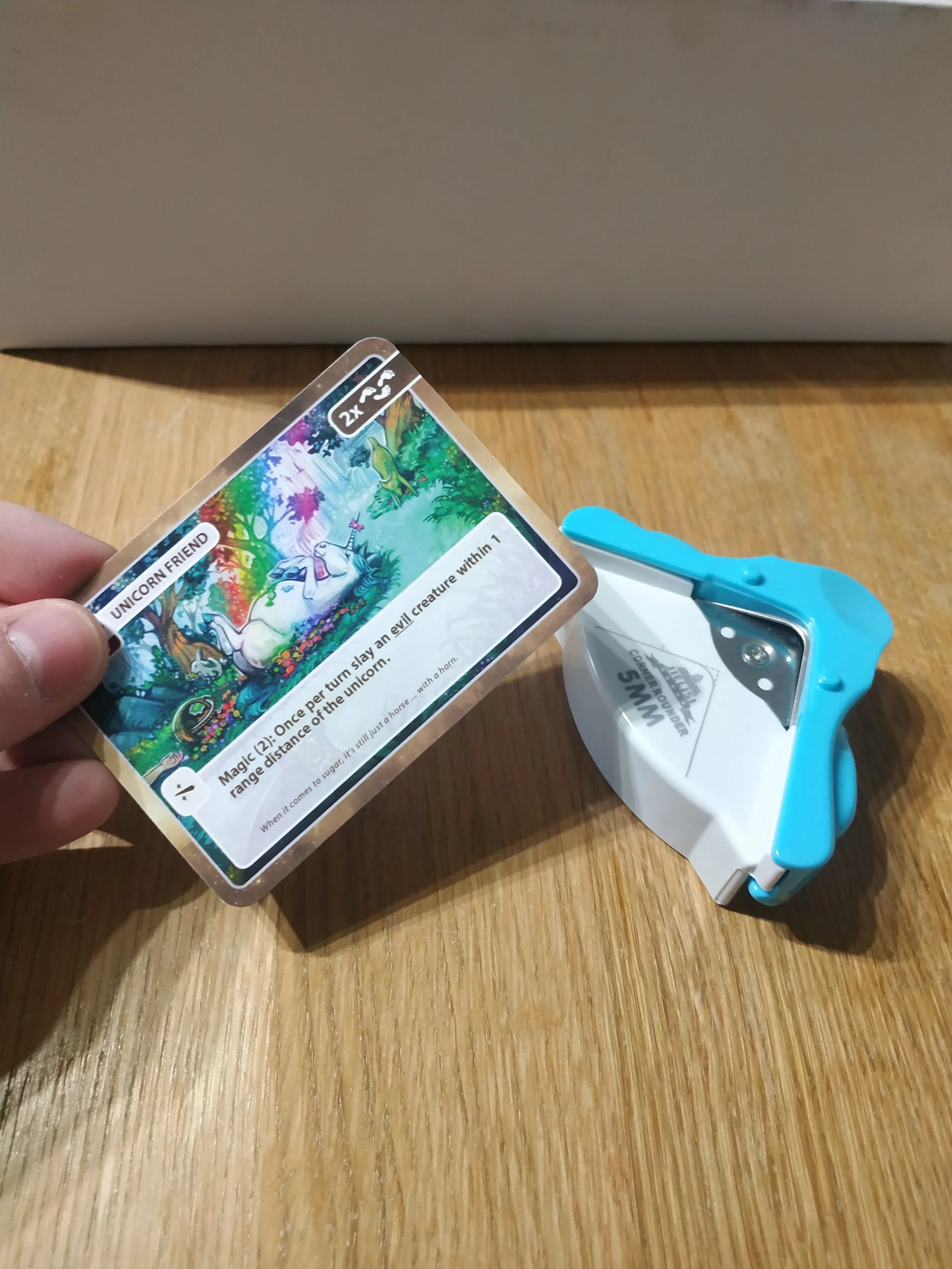
Normally, cards would also get a coating — a finish to fix the colors and sometimes add effects. Instead, I simply put my cards into sleeves. That way, the missing finish isn’t noticeable, and the prototype lasts longer.
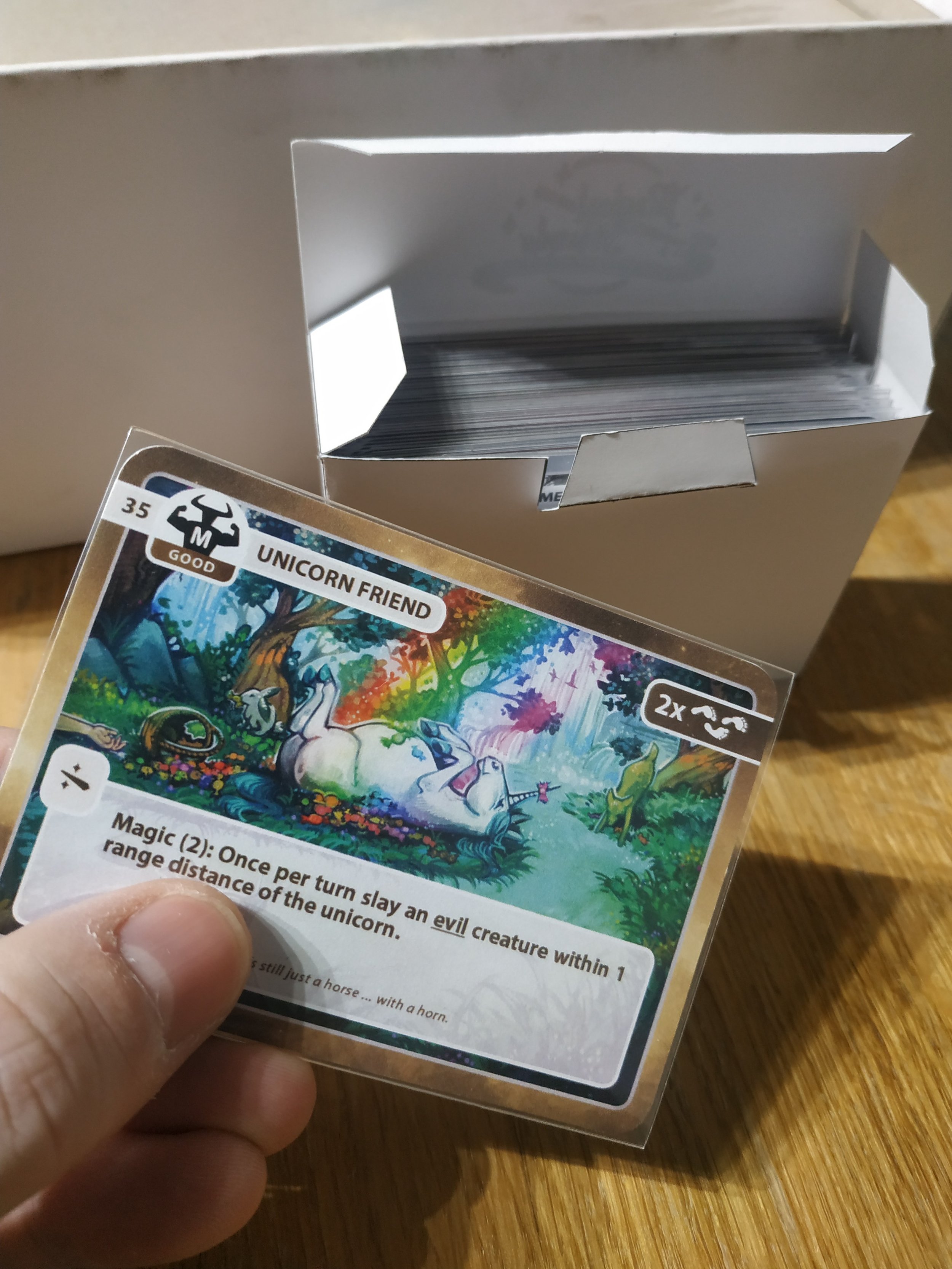
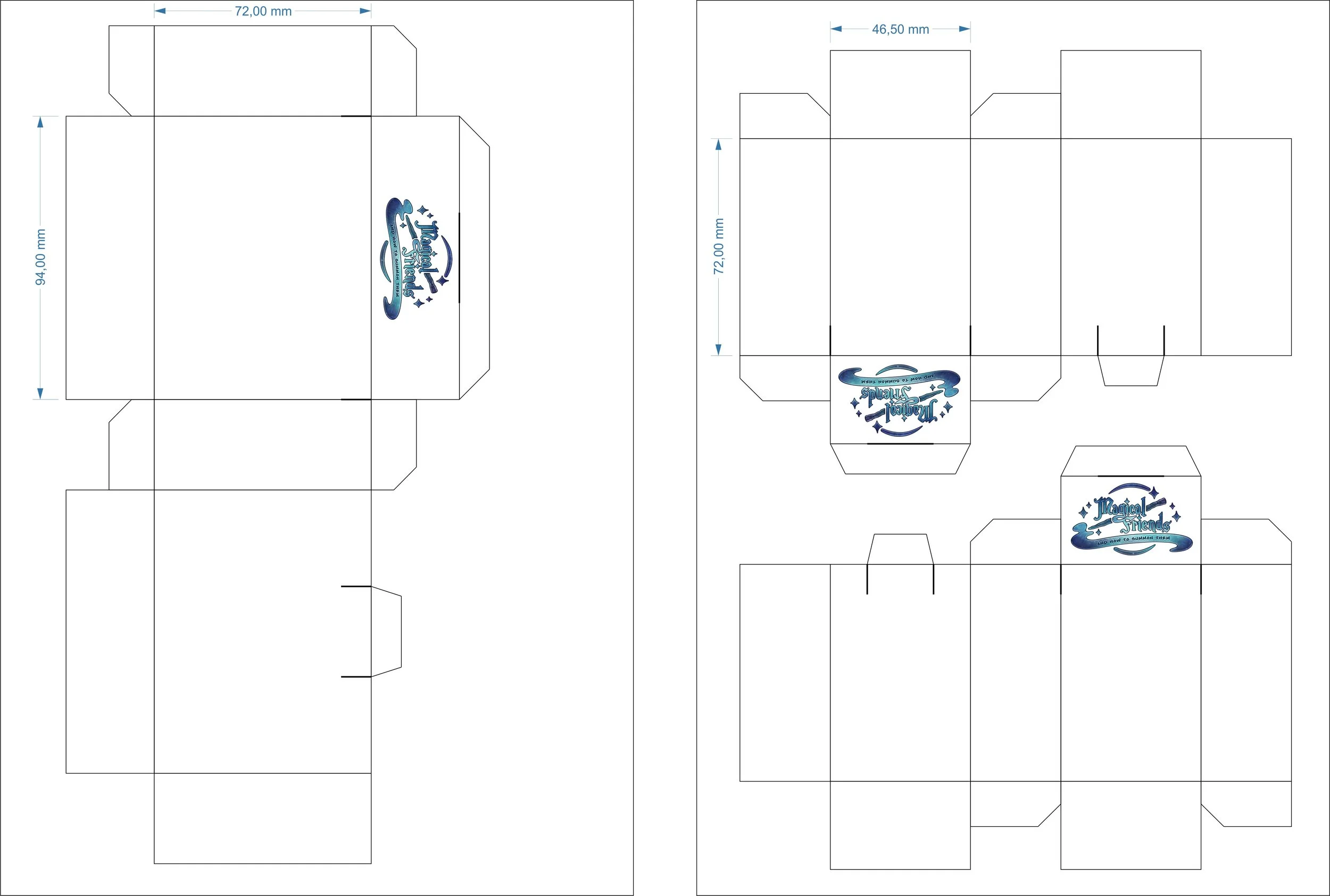
For storing the cards, I made simple boxes. A sheet of A4 paper (200 g) and a home printer for the template are enough. These boxes are very practical because they can hold both sleeved and unsleeved cards. This template worked very well for me.
Have you ever made playing cards yourself and have experiences you’d like to share? I’d love to hear your thoughts in the comments.
24 - When You Want the Prototype to Look Pretty … (Part 1: Copy Shop)
24 - When You Want the Prototype to Look Pretty … (Part 1: Copy Shop)
… the best option is usually to have someone else make it for you! However, that becomes difficult when your game has many special components. That’s why I ended up doing everything myself. The amount of work is enormous, and my approach is certainly not ideal. I’ll explain as clearly as I can how I build my review prototype by hand. There are definitely steps that could be done better. Since I still have several prototypes ahead of me, I’m very grateful for creative suggestions on how I could improve or simplify things without losing quality or adding significantly more effort.
The first step takes me to the copy shop.
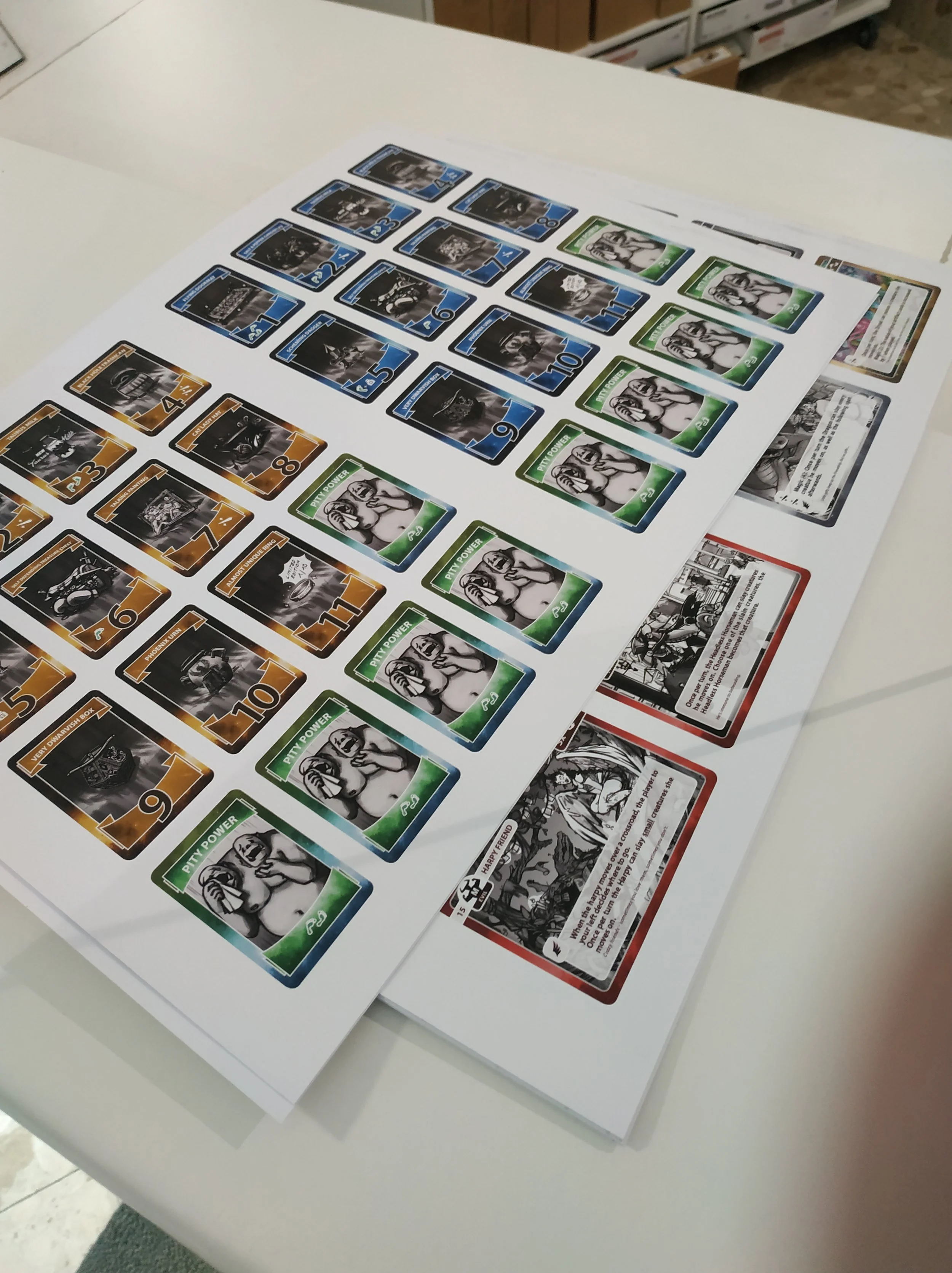
Game cards can still be printed reasonably well on a home printer. But since the color quality of my printer isn’t great, I had them printed at the copy shop. For cards, I recommend using 300 g or 350 g paper, as this roughly matches standard card stock. Thickness isn’t the only factor that matters for cards, but for a nice prototype it’s definitely sufficient.
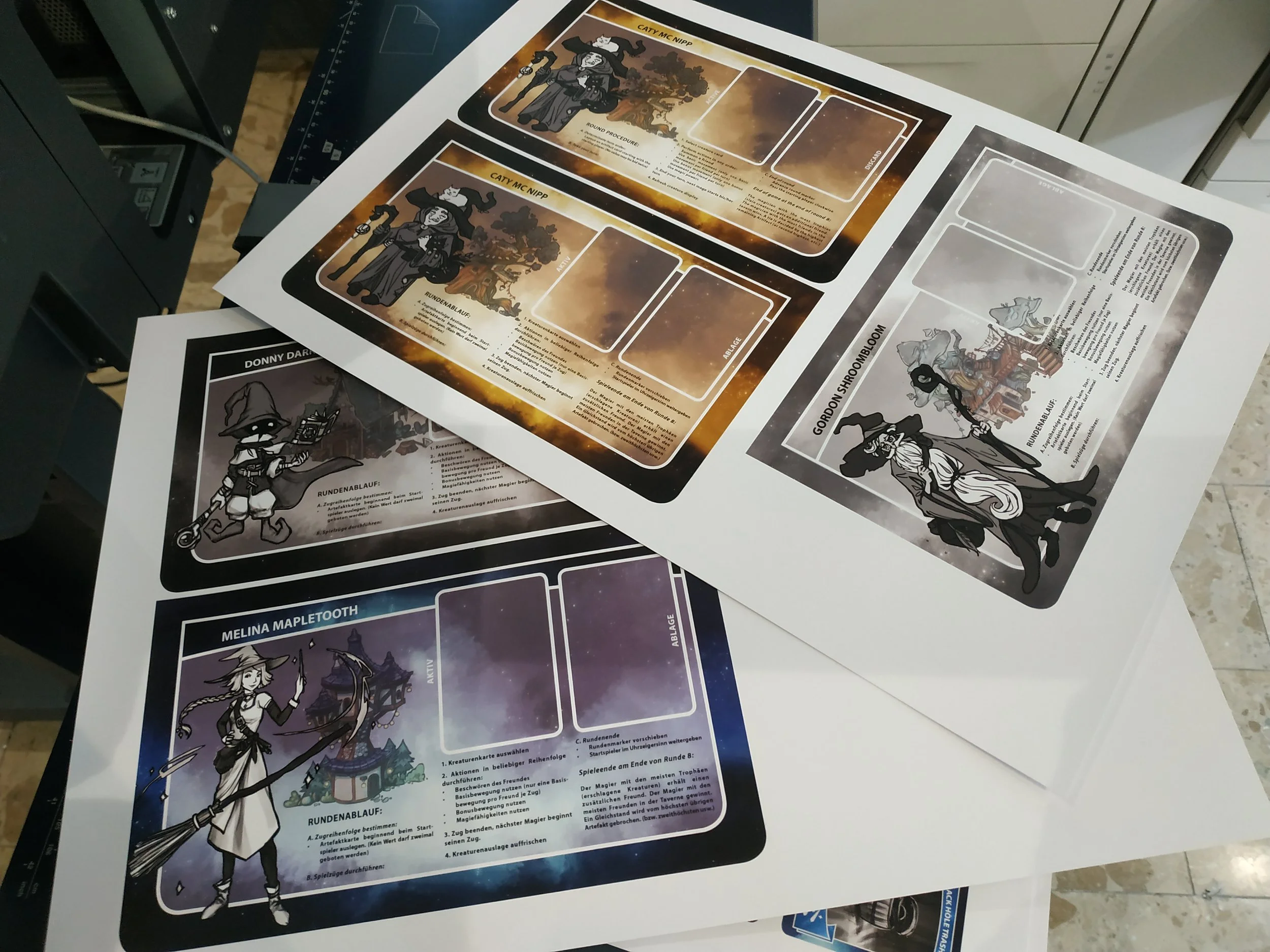
The player aids were also printed on 350 g paper. Even though they’re just information sheets, they simply feel better that way. For a final version, however, I would still choose a more durable material that doesn’t warp as easily.
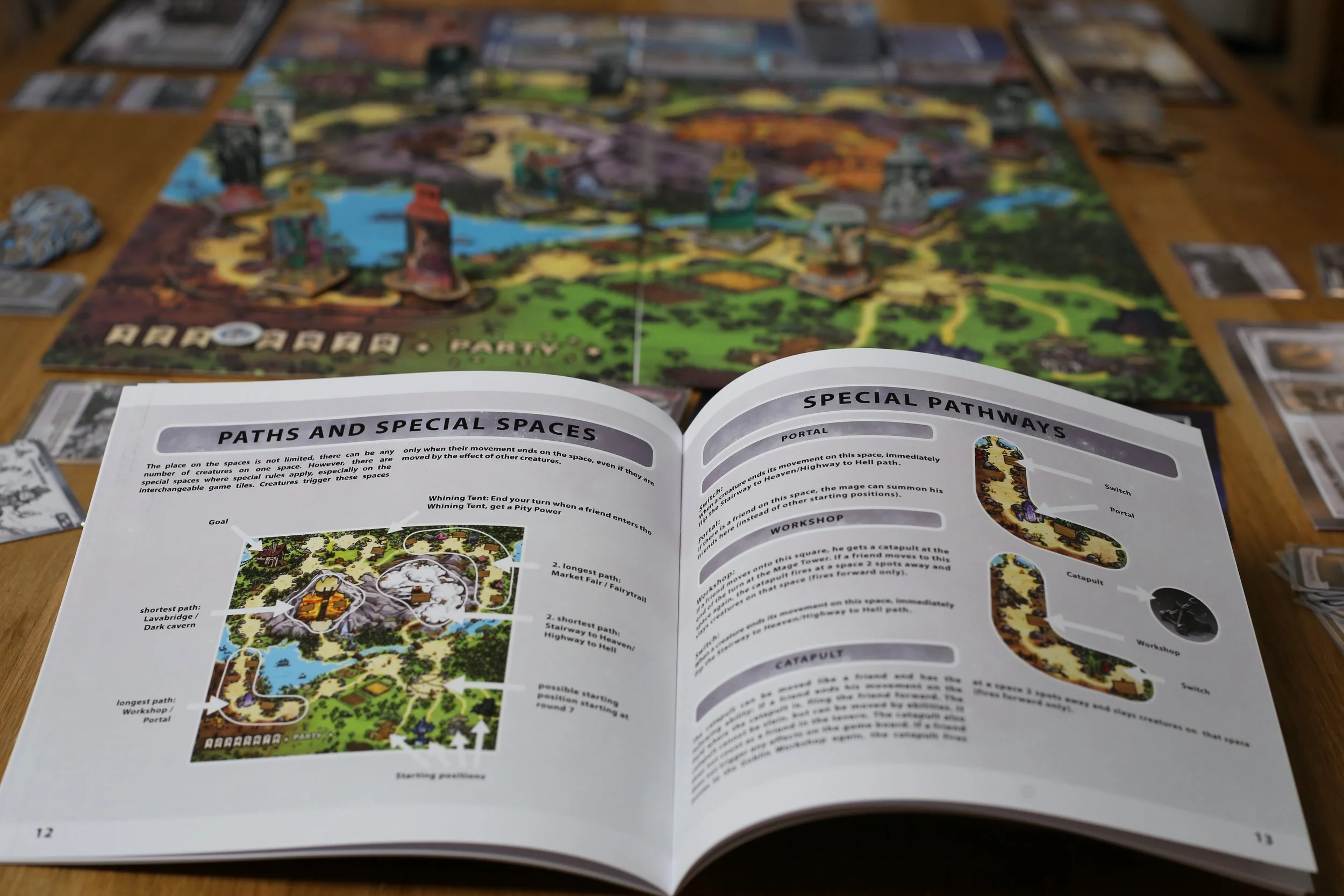
Printing the rulebook is much more complicated than you might think. Ideally, my rulebook would be almost as large as the game box itself. But that wasn’t possible at this copy shop. Rulebooks need to be printed double‑sided, and since each printed sheet equals two pages, you need a fairly large format. If I want the rules to be 280 mm × 280 mm, the printed sheet would need to be 280 mm × 560 mm — larger than A3. Having the rules bound as a booklet is very inexpensive at the copy shop, and it looks quite nice. For the rulebook, I used 140 g paper.
For all the larger prints I needed to glue onto cardboard, I used poster paper with a weight of 160 g. Depending on the size of your game, you might not need poster printing. But many of my graphics are larger than A3, so they had to be printed as posters. The box cover for a 300 mm × 300 mm × 100 mm box requires a print of roughly 550 mm × 550 mm. In a final production version, the box would also be wrapped in 160 g paper. It’s important that this paper isn’t too thin, because the corners of a box aren’t held together by the 2 mm cardboard — they’re held together only by the paper, and that paper shouldn’t tear easily.
Even though many illustrations and details aren’t finished yet, it’s a wonderful feeling to have high‑quality prints in front of you. At this stage, you get an excellent impression of the game and can imagine how the artwork will develop.
In the coming weeks, I’ll write more about what happens next with the prints. I’ll go into more detail about each component. If you have questions about printing, feel free to leave a comment. I’m also very happy about feedback and suggestions for improvement.
23 - Illustration and Production (Printing Plates)
23 - Illustration and Production (Printing Plates)
In the last post, I talked about bleed and margin. This time, it’s about printing plates and why they can be very important.
For larger productions, offset printing is the standard. In this process, printing plates are created for the colors cyan, magenta, yellow, and black (CMYK), which are then used for printing. For smaller print runs (500–1500), these plates also count as tooling costs.
Why am I mentioning this? Some companies offer special colors and use a fifth printing plate for them (something you should clarify when requesting quotes). This fifth plate can be used for special colors such as metallic inks. But it can also be an additional black plate. This has the following advantage:
If you want to produce a game in multiple languages, the text can be removed from the main black plate and placed on the fifth additional plate. This can potentially save tooling costs, because for an additional language you only need one extra plate instead of four.
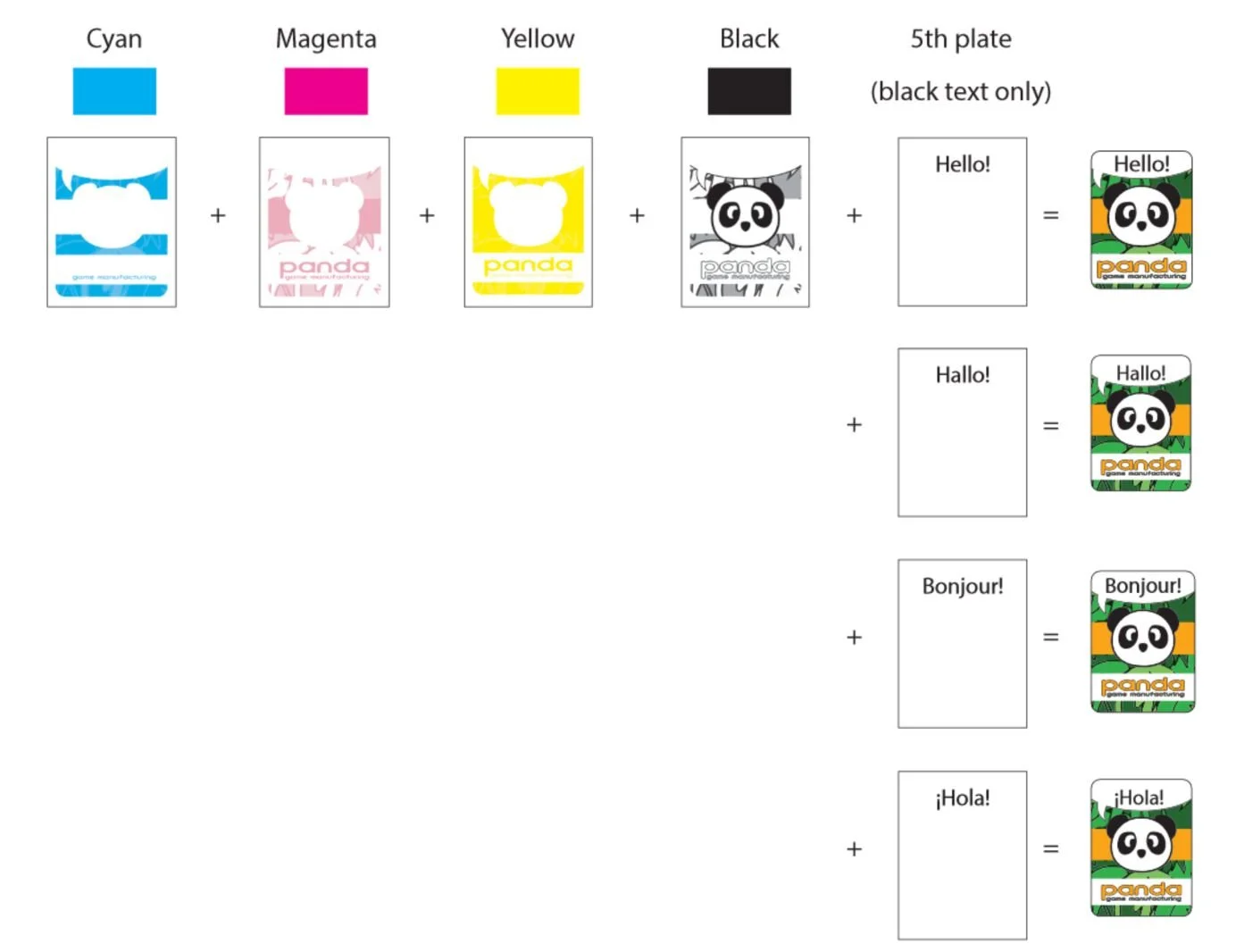
Source: Panda Game Manufacturing - Design Guidebook
This is why it’s important, when creating illustrations, to ensure that text can be edited separately from the artwork. In general, the design should be set up so that the text can use the same color everywhere. If, for example, you decide to use white text on dark backgrounds and black text on light backgrounds, you’ll run into problems.
Do you have more experience with printing and maybe something to add? There’s definitely still a lot to learn. Questions are helpful too. I’m looking forward to your comments.
22 - Illustrations and Production (Bleed and Margin)
22 - Illustrations and Production (Bleed and Margin)
When you start planning illustrations for your game, it’s a good idea to familiarize yourself with production standards. Doing so can save you a lot of work later on.
Panda Game Manufacturing even provides a Design Guide Book for this, which is incredibly helpful. In this post, I’ll talk about bleed and margin (trim area and safety area), and in the next one I’ll cover printing plates. However, design templates aren’t the same for every manufacturer.
You can assume that most manufacturers work with a bleed and margin of 3 mm. But what does that mean?
In this image of our card, I’ve drawn a red line. It represents the bleed. The purple line marks the margin. The black line shows the actual size of the card and the intended visible area.
The card is printed and then die‑cut. But the machine has a certain tolerance — small deviations that simply happen. The cut won’t always be exactly where the black line is; it might be slightly higher or lower, a bit to the left or right. Normally, these deviations don’t reach the full 3 mm. If they did, customers would probably complain.
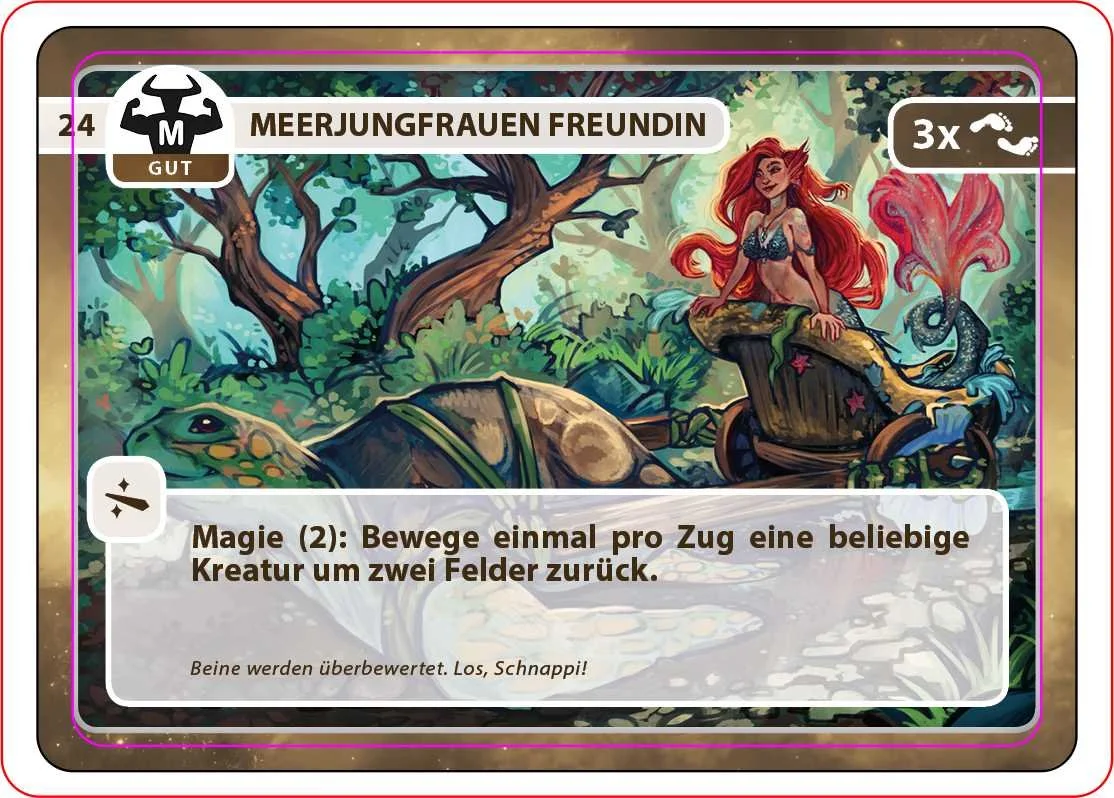
In this case, the colored border of the card needs to extend all the way to the red line (the bleed). Otherwise, if the cut shifts, you’d end up with a white edge on one or two sides. Even a tiny white edge would be noticeable and unpleasant. But if the cut shifts slightly to the left, that also means the right side will be cut deeper into the black area. That’s why you need to respect the margin (purple). The area between the black and purple lines shouldn’t contain any important information. In our example, the card number 24 would be cut off if the cut were actually 3 mm too far to the right.
Both bleed and margin are factors that must be considered for any printed and cut object. So especially with cards, you need to choose a design where bleed and margin won’t cause problems. The same applies to die‑cut cardboard components. With certain shapes, it’s not easy to maintain proper bleed and margin.
If I’ve forgotten something important in my explanation, please leave me a comment. And if you have any questions, feel free to ask — I’m sure you’re not the only one who would benefit from the answer.
21 - Can I Do All of This on My Own?
21 - Can I Do All of This on My Own?
By now, I’ve spent over 1,800 hours working on the game and the Kickstarter. For various reasons, I’m currently treating it as a full‑time job, and I don’t have a side job. Of course, that comes with some uncertainties, but I won’t go into those in this entry. In theory, you can do a lot of things on your own — but just because you can doesn’t mean it’s a good idea.
Designing a game together with someone else is certainly great and motivating. But it only works well if both people bring enough commitment and time. As people get older and start families, it often becomes harder to find someone for a project like this. Testing, on the other hand, is a bit easier — people often have time for that, and testing is incredibly important for the development process. That support is unbelievably valuable.
You can teach yourself many of the things you need. But some skills require so much practice that it really makes sense to get help. As I mentioned in an earlier post, illustration and graphic design are areas where I personally need support. Writing and crafting text also takes practice. If that’s not going so well yet, you need someone who can look over your work. A good working relationship with these collaborators is worth its weight in gold — especially when you’re working on the project alone, and even more so during the COVID lockdowns.

We work together regularly — at the moment, of course, digitally (during COVID). We use Discord for that. Even if we’re each working on our own tasks, seeing and hearing each other via webcam, exchanging thoughts now and then, and getting immediate feedback and opinions on certain things is fantastic. It’s incredibly motivating and inspiring.
If you manage to work on something alone for so long without occasionally falling into a motivation slump, running out of energy, or having your creativity refuse to cooperate — hats off to you. A great team helps immensely.
I hope you’re doing well during the lockdown and that you still have colleagues you can rely on. What helps you when things get particularly tough?
Update: This post was written during the COVID lockdown.
20 - The Prototype and the Rulebook
20 - The Prototype and the Rulebook
Even though the rulebook is usually ignored after the first few games, it is an extremely important part of any game.
Unfortunately, it’s also a part that requires a lot of work — especially if you don’t particularly enjoy writing … and if you plan to publish the game in two languages.
The earlier you write down a meaningful rulebook, the better. On the one hand, the game can then be tested without a personal explanation. On the other hand, it’s not only the game that needs testing, but also the rules themselves. If the rules are interpreted incorrectly, the game will be played incorrectly, and the playtest becomes only partially useful.
A written rulebook is often much longer than the usual verbal explanation of the rules. The quick clarifications you can answer with a simple “yes” or “no” during an explanation also need to be addressed in the written version.
There are several helpful tips online about how to write board game rulebooks, and it certainly doesn’t hurt to look through them.
It’s definitely useful to study rulebooks from games where you personally feel the rules are well explained. But going through the rules of very well‑known games isn’t a bad idea either. You’ll notice a common structure that board gamers are already familiar with.
It’s also helpful to think about the structure of your rulebook — in what order should the game be explained? Sometimes it’s beneficial to repeat certain rules. For example, it doesn’t hurt to mention the game’s objective early on, but it’s also useful to repeat it again during the final scoring section at the end of the rules.
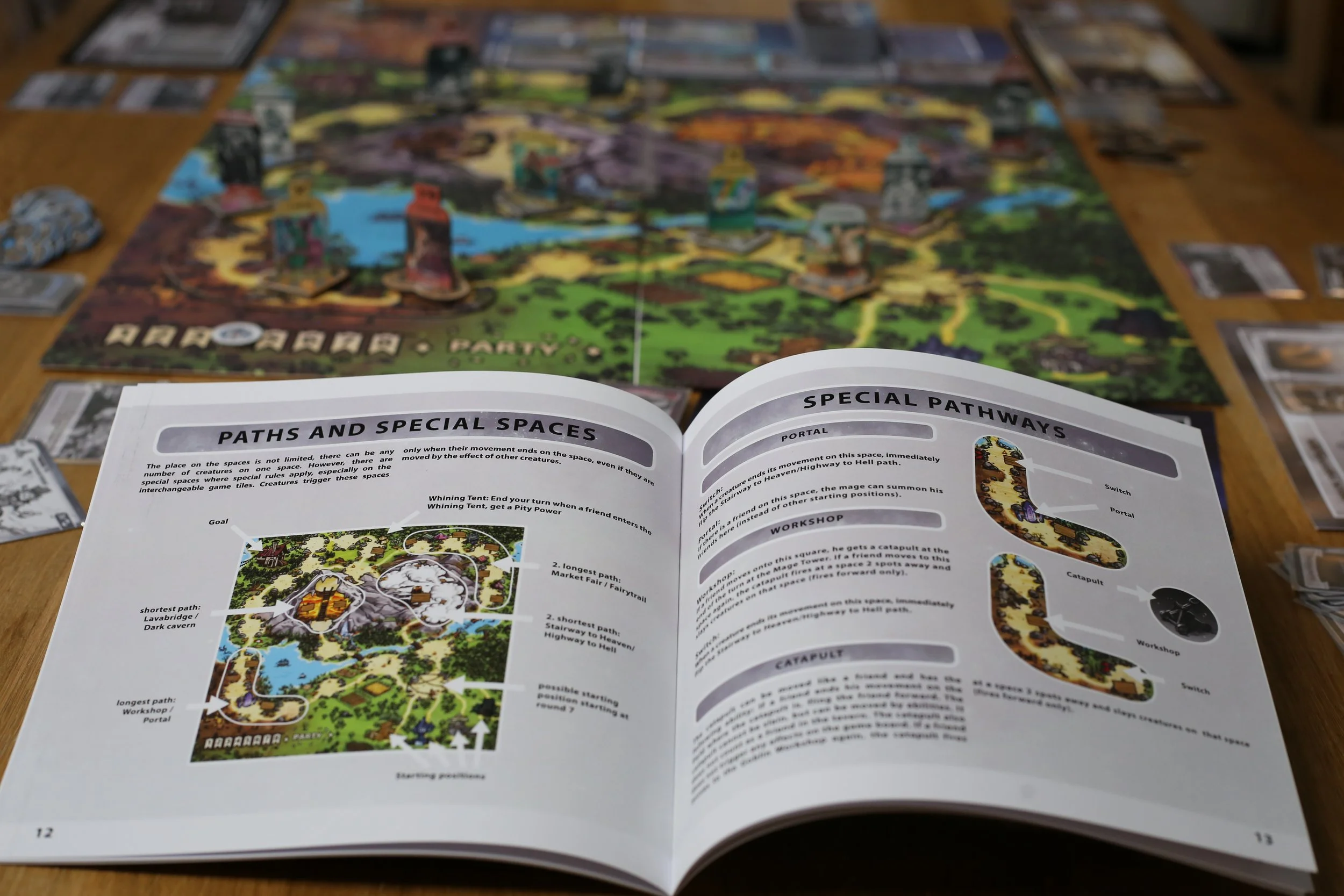
After the first few plays, the rulebook is mostly used for reference. Can players find information easily? Are all questions answered?
These are questions only testers can answer for me. Since all of this is not easy, it’s also difficult to reach a point where you can say: “Okay, this version of the rules is good/pretty enough to share.” Too many errors mean the rules aren’t very helpful and can frustrate testers. But without testers, you won’t discover many mistakes or opportunities for improvement. And when do you hand everything over to an editor? There will be many versions of the rulebook.
The rulebook for Magical Friends has already gone through many revisions, but now you can finally view it online. On the landing page, you can download the PDF if you like. I’m very happy about any feedback — but I’ll warn you in advance: there will probably be many more adjustments before it goes to an editor, and of course many images will still be replaced.
Are you also working on a rulebook? What problems have you encountered? If you take a look at the rules, your feedback will definitely help me improve them. Every tip is appreciated!
Update: Now that the game has been published, the rulebook is definitely the number one thing I want to improve for a second edition. ;-)
19 - Call to Action
19 - Call to Action
One of the most important parts of advertising is the “call to action” — the invitation to do something. At the same time, it’s also one of the most difficult parts for me personally. Ads that include a call to action are much more effective than those without. If you look up “call to action,” you’ll quickly find plenty of articles on the topic.
Such a call might be asking the reader or viewer to subscribe to a newsletter, like a post, follow a page, buy a product, or simply join a discussion. It’s an invitation to participate or a request for support. Someone who might not have thought about supporting a product or who doesn’t yet feel part of the community gets a little nudge and reminder. Above all, it clearly highlights the action you want them to take.
The calls to action I mentioned are very different from one another, and they trigger very different reactions in me. I want to create a great game. With advertising, I want to draw attention to it and build excitement. I want to spark interest, but I don’t want to tell anyone what to do. I’d like people to take action because they genuinely like my product. But it doesn’t feel good to ask a stranger for support.
It’s a good thing I’m already writing posts before the big advertising push, because calls to action are genuinely hard for me, and I need to learn how to do them. For example, I’ve gotten used to asking questions in my posts to invite people to participate. That actually feels completely fine and fitting, though it still takes some getting used to. It’s probably easier because I’m not really asking for support yet. It’s a request to do something, but it doesn’t require any real commitment — like signing up for a newsletter or spending money.
When I start asking for more support, everyone can still decide for themselves whether they want to give it or not. But I’m putting someone in a position where they might have to say no, and that can be uncomfortable for some people. That’s probably why it’s so hard for me. We’re used to saying no to ads by now, but you still don’t want to be perceived as “advertising.” You don’t want to come across like a big corporation trying to push products on people just to make money. But I do need support, and it is okay to ask for it. A project like this simply can’t be done alone in a meaningful way. And honestly, I’m not asking for anything huge — and thanks to anonymity, it shouldn’t be difficult for anyone to say no. I need to remind myself of that more often. Depending on your moral compass, advertising can be quite tricky.
18 - Paid Advertisment
18 - Paid Advertisment
Especially if you don’t want to sell only locally, you won’t be able to avoid paid advertising. Of course, organic advertising (spread through word of mouth and enthusiasm) is better in almost every way, but it will never reach the same audience. Why do I say “in almost every way”? Organic advertising takes an enormous amount of time. Paid advertising is also very inexpensive, especially when it points to a great product — that’s when it becomes truly efficient.
It’s also important to keep the right target group in mind. For example, you can place ads on BoardGameGeek, the largest platform for board games, or in other specialized forums. Or on various social media platforms.
For board games on Kickstarter, Facebook advertising actually seems to be the most efficient. At least, that’s what you read in board game design groups and blogs. The advantage here is mainly that you can define very precisely which target groups will see your ads. Apparently, you can also run very effective A/B tests. That means: I can show one version of the ad with slightly different wording to 100 people, and another version to a different group of 100 people. Based on their reactions, I can see which wording works better. This allows you to optimize your posts.
However, I’ve often read that ads on BoardGameGeek tend to work better for more complex games, and that otherwise the advertising there is relatively expensive.
You should be especially careful when it comes to pricing. It’s a tricky topic. Depending on the type of ad, you usually pay differently. Often it’s based on impressions — meaning how many people saw the ad. But just because an ad was shown 1,000 times doesn’t mean everyone is interested, or that they click for more information, or that everyone who clicks signs up for the newsletter, or that everyone who gets that far is actually willing to buy the game.
Photo by Andre Benz on Unsplash
So if I pay €1.70 per click on my ad, but only every tenth click leads to a purchase, that means I paid €17 in advertising for that customer. If my profit margin is €18, that customer is still a profit! Naturally, larger and more expensive games give you more room to work with. And more customers might allow me to produce a larger print run, which makes manufacturing cheaper.
There are also several positive effects of advertising that are difficult or even impossible to measure. Clicks that lead to your site bring you traffic, and you appear more often to other potential customers. People might share information about your game even if they don’t buy it themselves. And you can find fans who bring life to your pages or help you in other ways. It also generally helps when people have already seen or heard about a product before. Maybe I don’t click the first time I see an ad, but the next time I read something about the game, I might. Sure, there may be people who get annoyed by ads and therefore refuse to buy the product — but who knows whether they would have ever seen it, and then bought it, without the ad? So this point probably doesn’t weigh too heavily. As I said, these effects are very hard to measure, but they are mostly very positive side effects of advertising.
I haven’t run any paid ads for my game yet. I’ll report more once I have. These are primarily things I’ve found online or learned in marketing seminars and during my psychology studies. I’m sure some of you can add more precise insights. I — and certainly other readers — would really appreciate your comments!
Update 1: In the meantime, I have run ads, but I wasn’t able to track them properly. That makes it hard for me to judge how effective they were. There are trackers you need to install on the page your ad links to. Unfortunately, I didn’t have enough time to look into this properly.
Update 2: I unfortunately can’t say how effective Facebook advertising will still be in 2026. I know (though only from my personal circle) that hardly any of my friends use Facebook anymore since so many AI-generated posts started appearing there.
17 - Reviews and Previews
17 - Reviews und Previews
With the large number of new board games released every year, many board gamers look at reviews before making a purchase. This primarily includes reviews in magazines, board game blogs, podcasts, and above all video reviews on YouTube.
These are also excellent ways to reach players for Kickstarter campaigns. It is often recommended to start building relationships with reviewers as early as possible, since they frequently need some lead time to produce content—especially when it comes to YouTube videos. However, I have found that this approach is not always ideal when you are an unknown board game designer.
There are many board gamers who are working on a board game idea, but many of these ideas are never realized, or only after years. As someone who writes reviews myself, I can understand why you might not want to schedule time for someone from whom nothing may ever materialize. It therefore helps to already have something tangible to show, and depending on the scope of the game, it can take quite a while until you have something where the design and illustrations already look appealing. Initial contacts can also be made very effectively at conventions and, of course, when you are already part of the reviewer’s community.
Photo by Markus Winkler on Unsplash
In addition, it is important to research what kind of content is being produced. Does the channel focus on certain genres or mechanics that fit my game? Are previews shown from time to time—that is, games that are not yet available for purchase—or only games that are already on the market? Some creators also show games that are clearly not finished yet; others do previews as well, but only if the preview prototype already looks very polished.
It is also important to note that some reviewers or previewers charge money to produce their content. This is understandable, as there is often a great deal of work involved. However, there are also many who are happy to create content for free, as long as the game is interesting to them.
It is also worth considering providing reviews in different languages. On Kickstarter, you can usually assume that at least 60% of customers are English-speaking, so English-language reviews are definitely essential. Since I also plan to produce a German version, German should of course not be missing either. If additional languages can be included beyond that, it certainly won’t hurt—provided you can distribute the game well in those regions.
Do you also like to watch reviews? If so, which formats do you prefer, and which reviewers do you particularly enjoy? I’m curious to hear which ones you mention—there are so many, and you keep discovering new great channels all the time.